
Lieferung heute & morgen

Qualitätsgarantie

Willkommens-Angebote freischalten: KOSTENLOSE Lieferung | Bis zu 80 % RABATT | Kostenlose 30-Tage-JoyPlus-Testphase
App herunterladen
A shopping trolley can make it easier to transport groceries, crates of drinks or parcels in your day-to-day life. But not every model is suited to the same purpose. Older people often need a lightweight frame and a handle that’s easy to reach, while families tend to focus on capacity and load limits. For students and working professionals, a compact folded size and low weight are often more important.
That’s why it’s worth taking a closer look at the construction before you buy. Large capacity claims, supposedly extra-quiet wheels and high load limits are only useful if they suit the way you’ll actually use the trolley.
A shopping trolley with a 25 kg load capacity shouldn’t automatically be loaded with 25 kg of shopping. The key question is whether the figure applies to the bag, the frame or use as a hand trolley. A very large bag can also tempt you to place the load too high. Heavy bottles should go as low down and as close to the axle as possible.
Many shopping bags are made from coated Oxford fabric. This material is often water-repellent and, according to product details, protects against dust and light rain. That doesn’t mean the design will stay waterproof in heavy rain over a prolonged period. A protective cover, closable openings and a wipe-clean interior are practical features for everyday use.
A shopping trolley needs to work on more than smooth supermarket floors. Cobblestones, kerbs, gravel paths and stairs all put greater demands on the wheels. Two large EVA wheels often roll smoothly on level ground, while a stair-climbing shopping trolley with six wheels is designed for steps. That doesn’t automatically make it the ideal model for every route, though.
A load capacity of 20 to 25 kg is often enough for a typical weekly shop. If you want to transport crates of drinks, parcels or heavy supplies, look for an explicitly stated load capacity of 25 kg or more. With a 2-in-1 shopping trolley, check whether the maximum load applies equally to the bag and the detached hand trolley.
How you distribute the load also affects stability. A fully loaded shopping trolley should be pulled as straight as possible. Uneven surfaces, high kerbs and loads placed at an angle can increase the risk of tipping.
A powder-coated steel frame offers different load-bearing properties from a lightweight plastic frame. For frequent use, reinforced joints, a sturdy axle and secure folding mechanisms are important details to check. Aluminium can reduce the overall weight, while steel is often better suited to heavier loads when the dimensions are similar. The manufacturer’s specific figures are what matter most.
For the bag, 600D Oxford fabric, a protective cover and reinforced seams are useful features to look for. A rear zipped pocket can keep your keys, wallet or mobile phone separate from your shopping. The bag should also be removable for cleaning, or at least easy to wipe down with a damp cloth.
EVA or PU wheels can roll quietly over a range of surfaces. If you’re choosing a shopping trolley for an older person, look for a sturdy handle that’s high enough and has a good grip. This won’t automatically reduce every physical strain, but it can help you pull the trolley in a more upright position.
If you’re short on storage space, check the folded dimensions. A folding shopping trolley that fits behind a door, under a bed or in a car boot is more likely to be used regularly. A model that’s too large can be impractical, despite its high capacity.
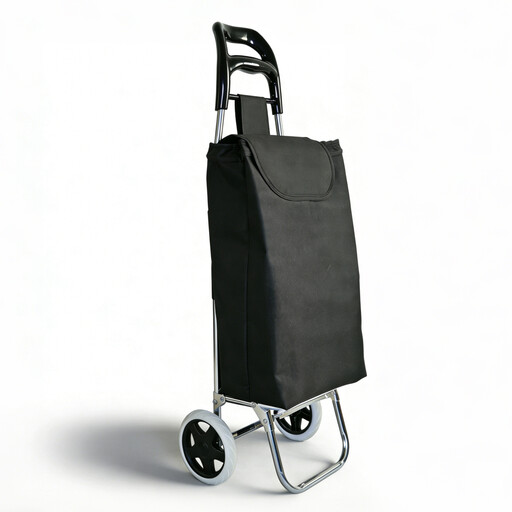
Why this product suits this type of user: At a stated weight of 1.15 kg, it’s easy to stow in the car and carry up a short flight of stairs. The bag holds 25 litres, and the detachable frame can be used as a hand trolley with a load of up to 20 kg.
The maximum load is clearly stated as 20 kg. The water-repellent 600D Oxford bag should still be considered suitable for light rain only, rather than fully waterproof.
1.15 kg weight, 25-litre bag, 20 kg hand trolley capacity and quiet EVA wheels.
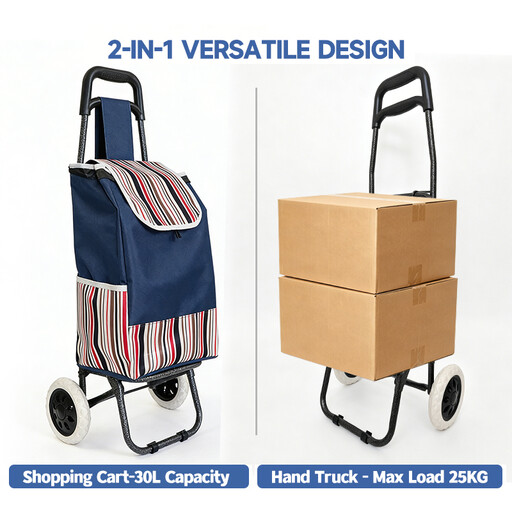
Why this product suits this type of user: The 16 mm steel frame, galvanised solid axle and stated load capacity of 25 kg are designed for regular shopping trips and transporting parcels or crates of drinks.
The bag is described as water-repellent and suitable for light rain. This makes it easier to judge the level of protection realistically than when a product is simply advertised as waterproof.
30-litre capacity, 25 kg hand trolley load capacity, 16 mm steel frame and folds flat.

Why this product suits this type of user: The tri-wheel system, with three wheels on each side, is designed for stairs, kerbs and uneven paths. The 25-litre bag is detachable, and the frame can then be used as a hand trolley with a load of up to 25 kg.
The six wheels are specifically designed for steps and edges, rather than being promoted with a vague claim of all-terrain suitability. You should still guide the load carefully on stairs.
Six PU wheels, 25 kg hand trolley load capacity, water-repellent 600D bag and compact storage.
We’ve put together a complete, regularly updated list of products that meet these strict selection criteria and fully comply with the safety regulations in force in the EU.
Its lifespan depends on the frame material, wheel design, load and surface. Regularly overloading it, using unsuitable wheels on stairs and storing it in damp conditions can all speed up wear and tear. Models with a sturdy axle and joints that are easy to inspect are simpler to maintain in everyday use.
For individual steps or several flights of stairs, a stair-climbing shopping trolley with six wheels is a better choice than a model with two standard wheels. Even so, keep the load moderate and guide it slowly over the steps. If you often transport heavy crates, the stated load capacity is particularly important.
In normal use, the main potential costs are replacement wheels, bags or fixings. Cleaning it with a damp cloth and occasionally checking the axles takes little effort. Before you buy, check whether spare parts and manufacturer contact details are listed.