
Lieferung heute & morgen

Qualitätsgarantie

Willkommens-Angebote freischalten: KOSTENLOSE Lieferung | Bis zu 80 % RABATT | Kostenlose 30-Tage-JoyPlus-Testphase
App herunterladen
A shopping trolley can make transporting groceries, drinks and household goods much more convenient. However, not every model offers a practical solution in everyday use. Narrow pavements, high kerbs, stairs, full shopping bags and limited storage space all create different demands.
That is why it is worth taking a close look at the design, load capacity and folded dimensions before buying. The following criteria will help you distinguish marketing promises from product features that genuinely matter.
Terms such as “heavy-duty” or “large shopping trolley” do not always refer to the same measurement. Some manufacturers state the frame’s maximum load, while others specify the bag’s capacity. What matters is whether the frame, base, wheels and fixings are all designed to handle the stated load together.
A trolley with a large capacity is not automatically suitable for crates of drinks or heavy gardening equipment. The load should be distributed evenly. Heavy items should be placed as low down as possible to keep the centre of gravity low.
A foldable shopping trolley saves space, but complicated joints or a lock that is difficult to reach can make it impractical. Before buying, consider the following points:
With a folding transport trolley, you should also check that the wheels do not turn unintentionally when it is being stored.
A shopping trolley with wheels may roll easily across a smooth supermarket floor, but reach its limits on cobblestones or kerbs. More important than the number of wheels alone are their diameter, width, material and ability to swivel.
Two larger wheels are often suitable for pulling the trolley along even paths. Four swivelling wheels can offer advantages when pushing and manoeuvring. Stairs require specially designed wheel constructions. Even a stair-climbing shopping trolley should not be loaded beyond its maximum capacity and must be guided carefully on every step.
The load capacity in kilograms and the volume in litres describe two different properties. A medium-sized bag is often sufficient for a weekly supermarket shop. Families, gardeners and campers, on the other hand, often need a high-capacity shopping trolley or a separate transport trolley.
Look for clear manufacturer specifications and distinguish between:
A high capacity is only useful if the trolley can still be moved safely when fully loaded.
Steel frames are often sturdy, but they can be heavier. Aluminium frames reduce the trolley’s own weight. Outdoor models often feature 600D Oxford fabric, steel tubes and plastic or rubber wheels. The fabric should be easy to clean with a damp cloth and must be completely dry before folding.
With a foldable utility wagon or foldable camping wagon, the joints, locks and wheel fixings are also important. Check them regularly for loose connections. A trolley should never be used as a seat, ladder or step unless the manufacturer expressly permits this.
An adjustable or ergonomically shaped handle can be useful for people of different heights. For a shopping trolley for seniors, a clear folding mechanism, easily accessible brakes and controlled handling are also important. However, the term “senior-friendly” is no substitute for specific information about handle height, weight or wheel size.
A lightweight model may be sufficient for short journeys around town. For gardening, camping or transporting larger loads, wide wheels, a sturdy frame and greater ground clearance are more relevant.
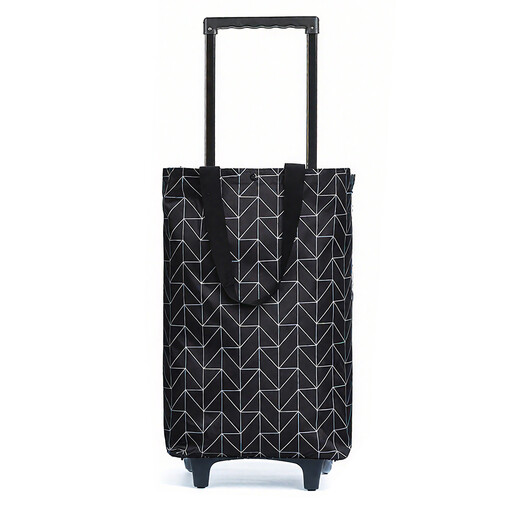
Why this product suits the profile: This foldable pull-along model is suitable for everyday errands and for users who prefer a compact trolley with a low net weight.
The folding function and pull-rod design are clearly intended for space-saving storage and easy journeys. Nevertheless, check the stated load capacity before buying.
Foldable design and a simple black finish for everyday mobility.
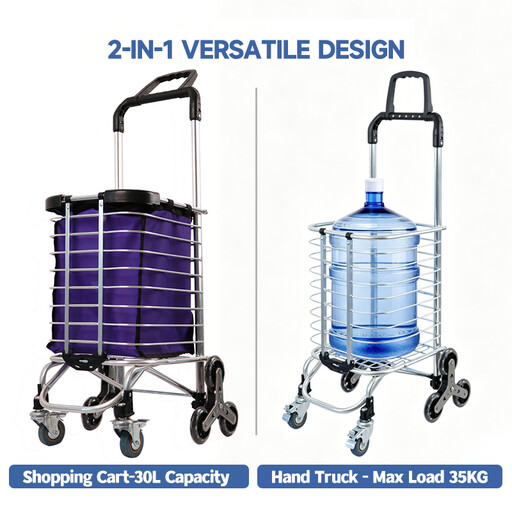
Why this product suits the profile: The aluminium frame, adjustable handle and foldable construction appeal to users who pay attention to material specifications and flexible handling.
The specification of an aluminium frame is more concrete than a general description such as “robust”. Check the load limits and folded dimensions in the product details as well.
Aluminium frame and adjustable handle; designed for household tasks and supermarket shopping.
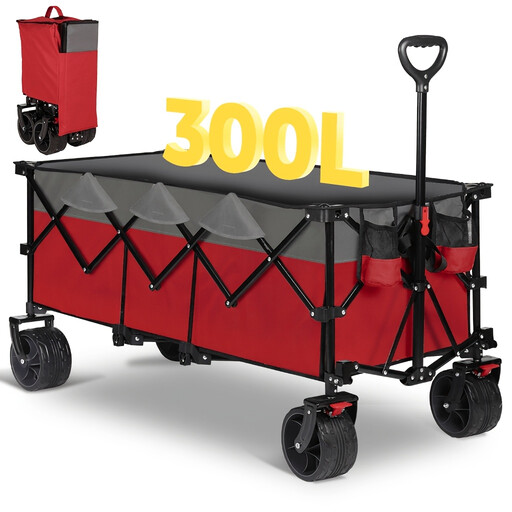
Why this product suits the profile: With 300 litres of storage space and a stated load capacity of 200 kg, this foldable transport trolley is designed for camping equipment, gardening tools and larger loads.
The specifications of 300 litres and 200 kg make the volume and load capacity easy to assess separately. The trolley must be fully locked and used on ground that is as stable as possible.
300-litre storage space, stated 200-kg load capacity and wide 7-inch tyres with brakes for parking.
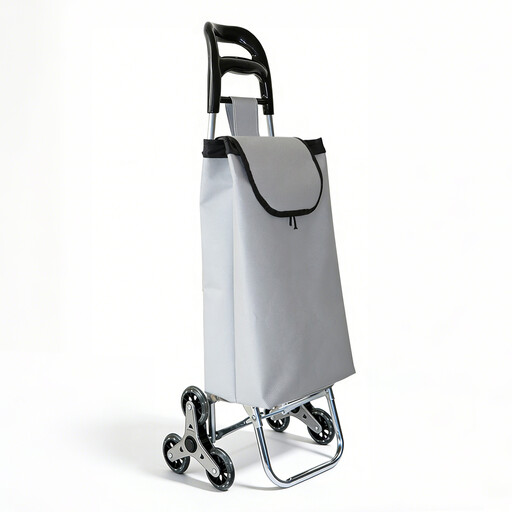
Why this product suits the profile: This model is marketed as a stair-climbing shopping trolley with an ergonomic handle and plenty of storage space. It is aimed at users who regularly do larger shops.
The product name explicitly mentions the handle design, folding function and stair-climbing wheels. On steps, the load must still be distributed evenly, and the permitted capacity must not be exceeded.
Large foldable design and an ergonomically described handle for household tasks and shopping.
We have put together a complete, regularly updated list of products that fully meet these strict selection criteria and the safety regulations applicable in the EU.
Before using the trolley for the first time, unfold it fully and check the locking mechanism. Distribute the weight evenly and secure loose items. On a trolley with a brake, this is generally intended for parking, not for slowing down while moving.
For a longer service life:
On uneven paths, at high kerbs and on slopes, pull or push the trolley slowly and in a controlled manner.
A compact bag may be sufficient for individual or smaller shops. Families and people who shop only once or twice a week are more likely to benefit from a large shopping trolley. For camping and gardening, models with several hundred litres of capacity are more suitable, provided that the paths, storage space and load capacity are appropriate.
Its service life depends on the load, the ground it is used on, care, and the quality of the wheels and joints. Evenly distributed loads, dry storage and regular checks of the fixings help reduce wear. Without specific conditions of use, giving a general number of years would not be reliable.
A shopping trolley does not require fuel and normally does not need electricity. Ongoing costs may arise from replacement wheels, new fixings or a damaged bag. Before buying, check whether replacement parts are available and what warranty or service information is provided for the product in question.