
Lieferung heute & morgen

Qualitätsgarantie

Willkommens-Angebote freischalten: KOSTENLOSE Lieferung | Bis zu 80 % RABATT | Kostenlose 30-Tage-JoyPlus-Testphase
App herunterladen
A shopping trolley can make transporting groceries and household goods much easier. However, not every model is suitable for every shopping trip. Product pages often use terms such as “Heavy-Duty”, “Stair Climber” or “Large Capacity”, without making the crucial details immediately clear.
Three common purchasing misconceptions particularly often lead to the wrong choice:
A shopping trolley with a seat is not automatically suitable for every situation either. If a model is not expressly approved for use as a seat, it must not be used for sitting. The same applies to products intended exclusively for transporting goods.
For regular shopping trips, three specifications should be considered separately:
A shopping trolley with a large capacity is practical for bigger shops. However, a model with a volume of 60 litres should not automatically be equated with a load capacity of 60 kilograms. For example, the JORDAN&JUDY trolley is listed as offering approximately 60 litres of volume and a maximum load of 35 kilograms. Before buying, you should compare figures like these with your own shopping habits.
Steel, stainless steel and aluminium are common frame materials. Steel can provide a sturdy construction, but is often heavier. Aluminium is usually lighter, while stainless steel indicates a different choice of material and resistance to surface wear. The material specification alone does not replace an inspection of the joints, wheels and attachment points.
For flat pavements, a shopping bag on wheels with two wheels is sufficient for many households. This type of system is often compact and straightforward, but can reach its limits when dealing with high kerbs or uneven paving.
A 6-wheel shopping trolley distributes the wheel mounts across both sides. The JJA model is specified as having a triple-wheel system on each side, a steel frame, a removable polyester bag and a capacity of 40 litres. According to the product description, the total weight is 2.5 kilograms. The load should be distributed evenly to prevent the trolley from tipping over.
A shopping trolley with a stair-climbing function is particularly interesting for routes with individual steps. This feature does not necessarily make every staircase easier to tackle. Careful handling is still required in narrow stairwells, on high steps or when the trolley is heavily loaded. The goods trolleys mentioned here are not designed to carry people, children or pets.
A foldable shopping trolley should fold down without requiring much force and, when folded, fit inside the intended cupboard, boot or hallway. Check the following:
A shopping trolley with an insulated bag is suitable for chilled goods on short journeys. Insulation does not keep the temperature constant indefinitely. For perishable food, the information on the packaging and the usual cold-chain requirements remain important.
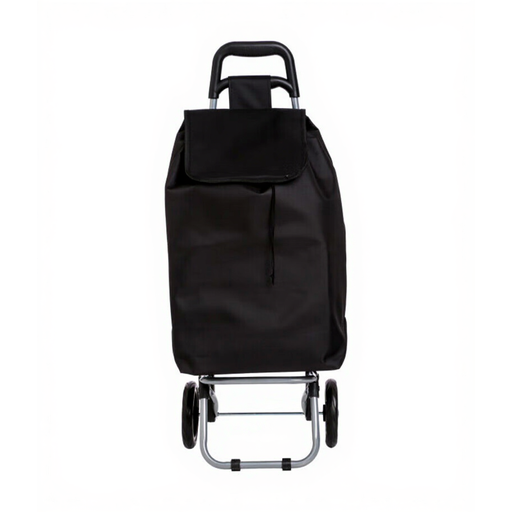
Why this product suits this profile: This two-wheeled trolley is designed for regular shopping trips on flat routes and has a removable bag.
The product description specifies use on standard surfaces and warns against very uneven terrain and high kerbs.
Removable satin bag, steel frame and compact dimensions of 35 × 27.5 × 91 cm.
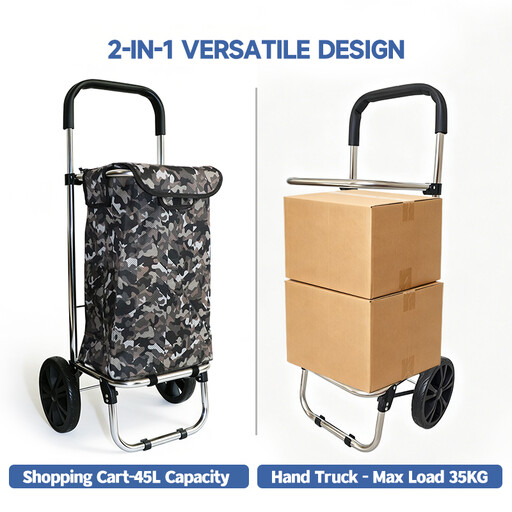
Why this product suits this profile: The stainless steel frame, ergonomic handle and foldable design appeal to shoppers who value both material quality and convenient storage.
The material specification makes the frame clear; nevertheless, you should check the folded dimensions and permitted load before buying.
Foldable stainless steel frame, large storage capacity and ergonomic handle according to the product name.
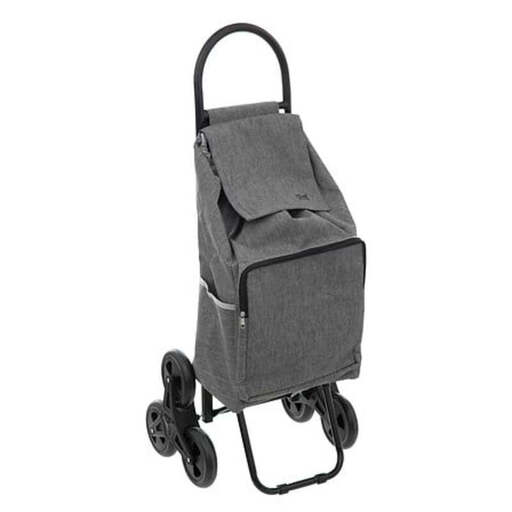
Why this product suits this profile: For market trips and urban routes with kerbs or individual steps, this model combines six wheels with a removable bag.
The product data explicitly states the wheel configuration, capacity, own weight and intended use for transporting goods.
40-litre capacity, 2.5-kilogram own weight, steel frame and removable insulated polyester bag.
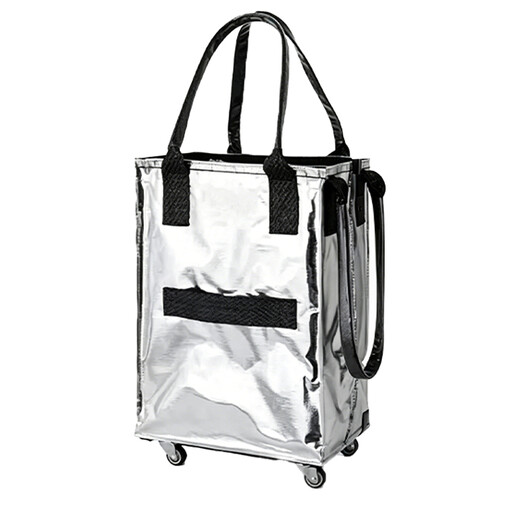
Why this product suits this profile: The larger capacity is suitable for households that want to transport several categories of goods in a single shop.
Capacity and maximum load are specified separately: approximately 60 litres and up to 35 kilograms according to the product description.
Woven bag, silver finish and stated load capacity of 35 kilograms.
We have put together a complete, regularly updated list of products that fully meet these strict selection criteria and the safety regulations applicable in the EU.
Heavy products such as tins or bottles of drinks should be placed at the bottom, as close to the wheel side as possible. Lighter goods should go on top. This keeps the centre of gravity low. With a stair-climbing model, the trolley should not be pulled abruptly. You should also regularly check the wheel axles, fastenings and handle.
A removable bag makes cleaning easier. After wiping it down, the fabric should be allowed to dry completely before the trolley is folded. This helps reduce moisture in the storage area. If space is limited, you should also compare the folded dimensions with the available cupboard or boot space.
Its lifespan depends on the load, surface, care and folding mechanism. High kerbs, uneven loads and exceeding the stated load capacity can put greater strain on the wheels and frame. It is therefore not possible to give a reliable general service life.
This may depend on the individual’s strength, the height of the steps and the weight of the shopping. A 6-wheel system can help with negotiating individual steps, but it does not replace safe handling. The trolley is designed as a transport aid for goods, not as a walking aid or seat.
There are generally no regular running costs. Potential follow-up costs may arise from replacement wheels, damaged bags or wear parts, if these are available. Before buying, it is therefore worth checking the contents, care instructions and availability of suitable spare parts.