
Lieferung heute & morgen

Qualitätsgarantie

Willkommens-Angebote freischalten: KOSTENLOSE Lieferung | Bis zu 80 % RABATT | Kostenlose 30-Tage-JoyPlus-Testphase
App herunterladen
A shopping trolley can make it easier to transport groceries, drinks and household essentials. However, not every model is suited to every shopping route. Focusing solely on large capacity or eye-catching marketing claims can mean overlooking important details such as load capacity, wheel spacing, folded dimensions and handle height.
This guide from the Joybuy Product Recommendation Officer explains what to look for when buying a shopping trolley and which models are suited to different everyday situations.
A large shopping trolley offers plenty of space, but it cannot be loaded without limits. A spacious bag may encourage you to fill it completely with heavy bottles or tins. That is why the explicitly stated maximum load capacity is the key specification.
Also pay attention to balanced weight distribution. Heavy items should ideally be placed low down and close to the wheel axle. This can help reduce the risk of tipping on level surfaces. Terms such as “heavy-duty” or “large capacity” are no substitute for a specific weight rating in kilograms.
“Foldable” initially describes only the function. For storage in a hallway, basement or car boot, the actual folded dimensions are what matter. Even a model with a folding mechanism may take up a considerable amount of space if it has a large frame.
Check the following before buying:
A lightweight shopping trolley is particularly practical if it needs to be carried up stairs regularly or stored on public transport.
A six-wheel stair-climbing shopping trolley may be designed for steps, kerbs or uneven surfaces. However, this does not mean that every staircase can be managed effortlessly or without physical exertion. Even when using a pull-along shopping trolley, the load and centre of gravity must remain under control.
Balanced loading, a secure grip and an appropriate pace are essential. Do not use a shopping trolley as a seat, walking aid or means of transporting children or pets unless the manufacturer explicitly permits this.
For a regular supermarket trip, smaller models with a limited load capacity may be sufficient. Anyone who regularly transports drinks, detergent or larger household items should instead look for a clearly stated load capacity of 25 kg, 35 kg or more, for example.
Capacity is often specified in litres. A large-capacity shopping trolley holding 40 to 60 litres provides more storage space, but it can also become significantly heavier when fully loaded. For older people or anyone with limited strength, the trolley’s own weight is therefore just as relevant as its maximum load capacity.
Two large wheels are generally sufficient on smooth pavements and in supermarkets. Four wheels can provide greater stability when pushing, while a six-wheel system may help certain models negotiate steps.
Pay attention to:
A wheeled shopping bag designed for short trips has different requirements from a transport trolley used daily for market visits.
An ergonomic handle should be comfortable to grip securely and suit the user’s height. Some transport trolleys feature telescopically adjustable handles. This can be convenient for people of different heights and allows for more space-efficient storage.
Frames may be made from steel, aluminium or combinations of plastic and metal. Steel can offer greater structural stability, while aluminium generally enables a lower overall weight. The decisive factor is the combination of material, frame geometry, wheels and permitted load.
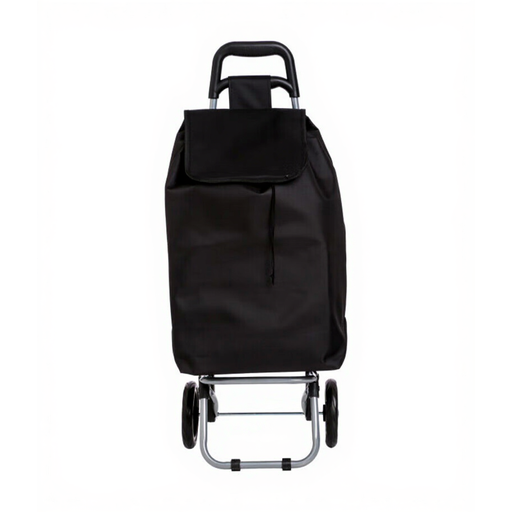
Why this model is a good fit: This two-wheel shopping trolley with a removable satin bag is well suited to regular shopping trips on level ground and supermarket floors.
The product description specifies dimensions of 35 × 27.5 × 91 cm and highlights balanced weight distribution.
Removable bag; steel frame; designed for goods and not as a seat or mobility aid.
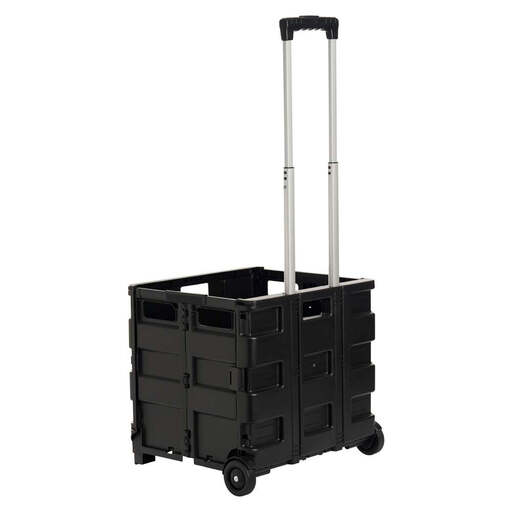
Why this model is a good fit: For commuters, city residents and households with limited storage space, this folding shopping trolley offers stated folded dimensions of 45.5 × 45.5 × 8 cm.
The folded dimensions and maximum load capacity of 25 kg are clearly specified. The manufacturer also indicates that it is intended for use on level surfaces.
42.5-litre capacity; 2.65 kg net weight; extendable handle with a height of 97.5 cm.
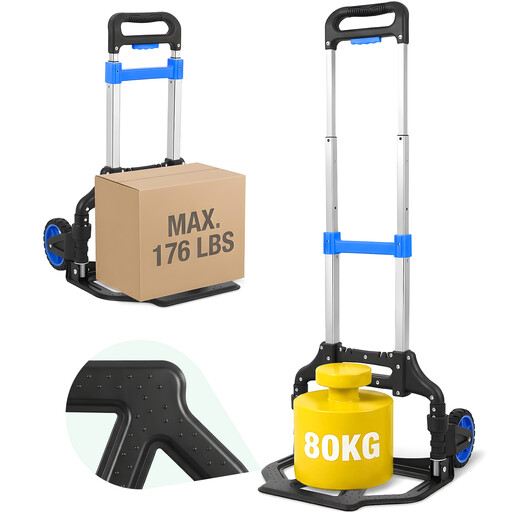
Why this model is a good fit: As an alternative to a classic shopping trolley, this hand truck is suitable for beverage crates, parcels and other heavy items.
The 80 kg load capacity, 3.5 kg net weight and handle heights of 63, 90 and 100 cm are clearly specified.
Aluminium frame; just 5.7 cm wide when folded; TPR wheels with ball bearings and automatic wheel folding.
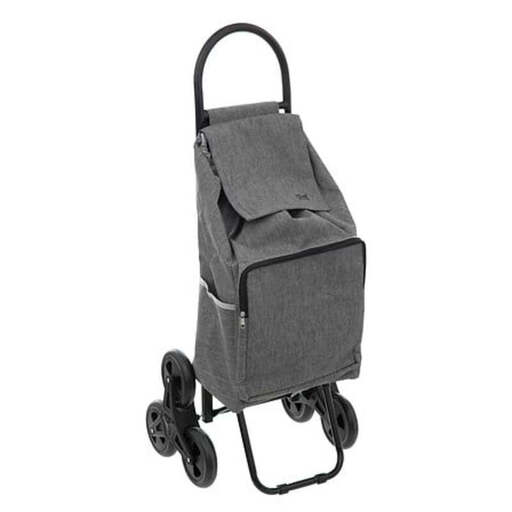
Why this model is a good fit: The six-wheel system is particularly interesting for anyone whose shopping route includes kerbs or stairs.
The description specifies a 40-litre capacity and 2.5 kg weight, and states that the trolley must not be used as a mobility aid.
Steel frame; removable polyester bag; six wheels with a triple-wheel configuration on each side.
Our continuously updated category features shopping trolleys, wheeled shopping bags and foldable transport models for a wide range of requirements.
Remove dirt from the wheels and axles regularly. For many frames, a damp cloth is sufficient; textile bags should be cleaned according to the manufacturer’s instructions. Store the shopping trolley in a dry place and avoid overloading it for extended periods. On folding models, keep the mechanism free from sand and small foreign objects.
Before each use, it is worth briefly checking the wheel mounts, handle and base plate. Squeaking wheels, loose screws or tears in the bag are warning signs that should be inspected before the next heavy shopping trip.
A manageable net weight, an easy-to-grip or height-adjustable handle and smooth-running wheels are key. Six wheels may be a suitable option for negotiating stairs. However, the shopping trolley should not be used as a walking aid or for support.
For smaller grocery trips, 6 to 15 kg may be sufficient. For beverage crates or larger household purchases, models rated for 25 kg or more are a sensible choice, provided the surface and the user’s handling ability are suitable. The manufacturer’s maximum load specification must not be exceeded.
Service life depends on the load, surface, storage conditions and maintenance. Frequent travel over high kerbs or prolonged overloading place greater strain on the wheels and frame. Choosing a suitable model, distributing the load evenly and carrying out regular checks can help maintain reliable everyday performance.