Families with predictable biscuit habits
If you’re buying for several coffee breaks or visits, match the total quantity and number of individual packs to how much you expect to eat.


When stocking up on shortbread, it’s not just the total quantity that matters. Choose a pack format to suit how much you expect to eat, and check the storage instructions and ingredients for each variety. Multipacks work well if you eat shortbread regularly, while smaller packs can help you avoid opening a large quantity all at once if you only enjoy it occasionally.
If you’re buying for several coffee breaks or visits, match the total quantity and number of individual packs to how much you expect to eat.
If shortbread is an occasional treat, consider how much you’ll need to open at once and how you’ll store the remaining packs.
For these households, the labelling on each specific variety matters. A gluten-free butter biscuit isn’t automatically shortbread or free from other allergenic ingredients.
First, work out how much shortbread your household is likely to eat and how many packs you’d need to open. Then you can decide whether one larger quantity or several smaller packs would be more practical.
| Factor | What to check before buying | Who it matters most to |
|---|---|---|
| Quantity | Compare the total weight and number of individual packs with the occasions you’re planning for. | If several people eat shortbread regularly, make sure there’s enough for the occasions you have in mind. That’s why around 40 % of consumers might prioritise getting the quantity right. |
| Freshness and portioning | Check how the product is divided between packs, the storage instructions and the best-before date. | If you only eat shortbread occasionally, you may not want to open the whole supply at once. Around 30 % of consumers might see portioning as their main consideration. |
| Ingredients and allergens | Read the ingredients list, check which allergens are highlighted and look for any may-contain warnings on the specific variety. | If you have dietary or allergen requirements, every pack you plan to buy must be suitable. For around 20 % of consumers, these checks might be the first thing that determines their choice. |
| Type and variety of biscuit | Check the product name and flavour: shortbread, chocolate shortbread and gluten-free butter biscuits aren’t the same thing. | If you want different varieties for different occasions, the type of biscuit comes first. For around 10 % of consumers, it might be the most important factor in their choice. |
A large quantity is only right if it suits your household’s consumption and storage space. According to the German Food Federation, the best-before date applies to unopened products stored appropriately.
Before buying, think about how many packs you’d open one after another. If you eat shortbread irregularly, smaller packs may be more practical.
A gluten-free label doesn’t tell you whether a biscuit is shortbread or contains other allergenic ingredients. Recipes can also vary between products from the same brand.
Check the product name, ingredients list, highlighted allergens and any may-contain warnings on every pack.
The best-before date isn’t an automatic ‘throw away’ date. However, it doesn’t tell you how long an opened pack will keep. Visible changes or mould are warning signs.
Follow the storage instructions and use older packs first, as recommended by the Federal Centre for Nutrition for food kept in stock.
REWE lists Walkers shortbread in different shapes and pack sizes, including a 250-g pack and a 140-g variety labelled gluten-free.
REWE describes its Shortbread Fingers as a 150-g pack made with 32 % salted butter.
Tims Feines Shortbread Schoko is available on Amazon.de as a multipack of 7 × 165 g.
This butter biscuit could be a good choice for a modest biscuit supply if it doesn’t have to be classic shortbread. The key thing is whether the 200-g pack suits how much you’ll eat.
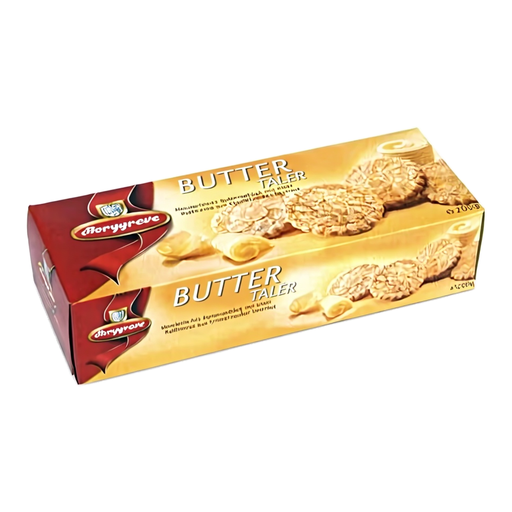 No image available
A handy choice for a modest biscuit supply if you’re happy with butter biscuits rather than classic shortbread. The pack contains 200 g.
If you’d prefer to open the biscuits in portions, check how the pack is divided. If you have dietary or allergen requirements, always refer to the label on the specific pack.
No. According to the German Food Federation, it indicates how long an unopened food product will retain its specific qualities when stored appropriately. Once the date has passed, check its condition, smell and texture. Don’t eat biscuits with mould.
Follow the instructions on the pack. REWE recommends storing its Feine Welt Shortbread Fingers in a dry place, away from heat. The Federal Centre for Nutrition also recommends checking the best-before dates on your supplies regularly and using older packs first.
Check the ingredients list and any may-contain warnings for every specific variety. The German Food Federation explains that allergens which must be declared are highlighted in the ingredients list. A gluten-free label doesn’t mean a biscuit is free from milk, eggs or other allergens.
Not necessarily. A single 250-g pack is a good fit if your household will finish it soon after opening. If you eat shortbread less often, opening smaller packs one at a time may work better for your stocking-up plans.