
Lieferung heute & morgen

Qualitätsgarantie

Willkommens-Angebote freischalten: KOSTENLOSE Lieferung | Bis zu 80 % RABATT | Kostenlose 30-Tage-JoyPlus-Testphase
App herunterladen
Hard or limescale-rich tap water can leave deposits on bathroom taps, shower screens and nozzles. That’s why many households look for a shower head with a filter to reduce chlorine, sediment or certain metal residues while still providing a pleasant spray.
However, product claims on the market aren’t always easy to compare. A high number of filter stages alone says little about actual filtration performance. The key factors are the filter media, connection, replacement intervals and suitability for your water pressure.
Labels such as ‘20-stage filter’ or ‘34-stage filtration’ may sound impressive. However, they usually describe a combination of different materials and processing steps. Depending on the design, a shower filter containing KDF-55, calcium sulphite or mineral beads may reduce certain substances. This does not automatically remove dissolved minerals that cause water hardness, such as calcium and magnesium.
So, if you’re looking for a shower head to tackle chlorine and limescale, it’s important to distinguish between reducing chlorine or particles and genuinely softening the water. Very hard water may require a separate water-softening system.
A high-pressure shower head doesn’t create additional pressure in your home’s pipes. Some models concentrate the water flow through smaller nozzles or an internal design. This can make the spray feel more powerful, but it doesn’t change the performance of your plumbing.
Water pressure may still be limited in older buildings or when several taps are running at the same time. An integrated flow restrictor can also reduce water consumption, but it may lower the flow rate.
A filter cartridge is a consumable part. Depending on water quality, frequency of use and filter type, it may need replacing after a few weeks or months. Reduced water pressure, visible deposits or changes in odour can indicate that maintenance is needed.
Before buying, check whether replacement cartridges are available and how often the manufacturer recommends changing them. For the Cobbe shower heads featured here, for example, the recommended replacement interval is around three to four months. This is the manufacturer’s guidance and may vary from household to household.
Check which materials are specifically listed. Common options include:
Performance depends on contact time, flow rate, incoming water quality and the condition of the cartridge. Claims such as ‘up to 99 per cent’ should be treated as manufacturer claims unless independent evidence is available for that exact model. They do not demonstrate any medical or therapeutic benefit.
A common connection in Germany is G1/2 or 1/2 inch. Even so, check whether your existing shower hose uses this thread. Models with a compatible standard connection can usually be installed without a professional.
Before installation:
A water-saving shower head shouldn’t just promise reduced water consumption; it should also provide a flow rate that suits your household. Several spray settings can be useful, such as rain, massage, mist, Eco or Turbo modes. Families may also benefit from a longer hose when showering children or pets, or when reaching awkward areas.
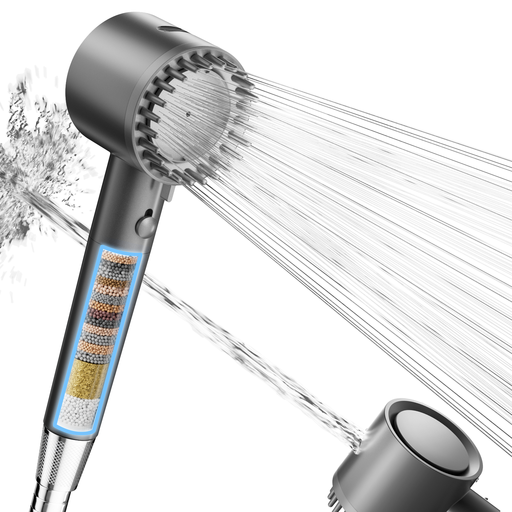
Why this product suits this profile: This handheld shower head has a standard connection, a 1.5-m hose and a pre-installed cartridge. It’s a good choice for households looking to switch to a filtered shower head without needing any tools.
The filter media, KDF-55, calcium sulphite and mineral beads, are clearly listed. The stated cartridge replacement interval of three to four months also makes ongoing costs easier to plan for.
20 filter stages, five spray settings, a 1.5-m hose and a G1/2 connection, according to the product description.
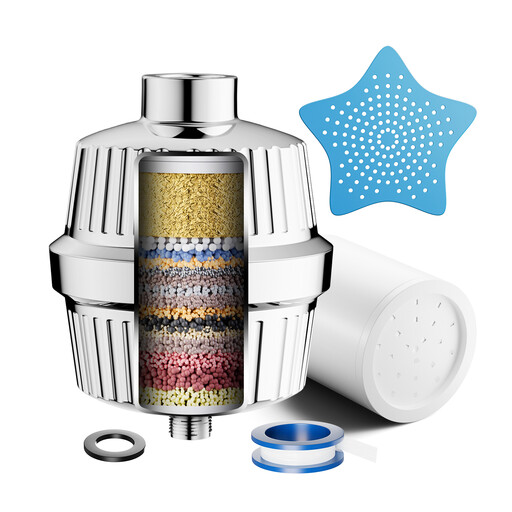
Why this product suits this profile: This separate shower filter fits between the shower hose and shower head. It’s a good option if you’d like to keep using your existing handheld or fixed shower head.
The set includes a replacement cartridge, a seal and sealing tape. This means the next filter change is already catered for when you buy it.
34 stated filter stages, a G1/2 thread, ABS and stainless steel components, plus two cartridges included.
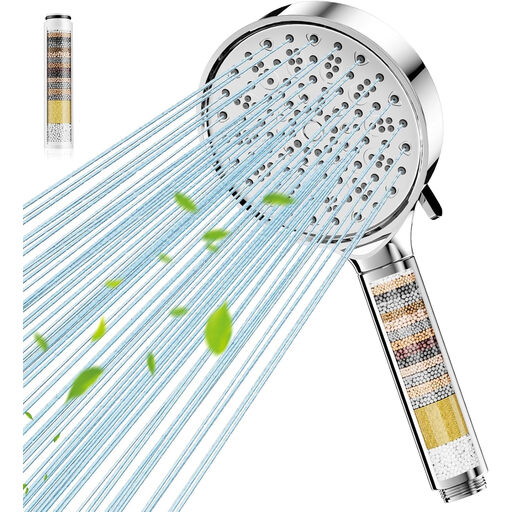
Why this product suits this profile: With six selectable spray settings and a large 124 × 124 mm shower face, this model is designed for families, frequent hair washing, and showering children or pets.
The description recommends changing the filter every three to four months, or when water pressure drops. The included flow restrictor can also affect the water flow.
20-stage filtration, six spray functions, a 124-mm shower face and a universal G1/2 thread, according to the product details.
We’ve put together a complete, regularly updated list of products that meet these strict selection criteria and fully comply with the safety regulations in force in the EU.
A shower head with a filter needs regular care. Silicone nozzles can be cleaned with a soft cloth. Only use harsh limescale removers if the manufacturer specifically approves them. For cartridges containing active materials or mineral fillings, follow the relevant instructions for initial flushing and storage.
When working out the total cost, consider:
Generally, no. Many filters reduce chlorine, sediment and certain metal residues, but they don’t necessarily make a significant difference to the water’s hardness. If you want to reduce limescale deposits more comprehensively, check the filter media and specific performance claims for the model you’re considering.
It depends on water quality and how often you use it. For the Cobbe models mentioned above, the recommended replacement interval is around three to four months. A drop in water pressure may also indicate that the filter is clogged. Always follow the instructions for your specific product.
Many models use a G1/2 thread, which is common on many shower hoses. However, compatibility can’t be guaranteed in every case. Before buying, check the thread, hose connection, seal and available installation clearance.