
Lieferung heute & morgen

Qualitätsgarantie

Willkommens-Angebote freischalten: KOSTENLOSE Lieferung | Bis zu 80 % RABATT | Kostenlose 30-Tage-JoyPlus-Testphase
App herunterladen
A shower head with hose can easily upgrade your shower without the need to alter any fittings or tiles. However, the sets differ significantly in hose length, connection type, spray patterns, cleaning requirements and filter technology. Marketing terms like “high pressure”, “water saving” or “20-layer filter” are only meaningful when the technical specifications actually match your own bathroom.
A high-pressure shower head can produce a concentrated water jet through smaller nozzles or a modified water pathway. The actual result, however, also depends on your household water pressure, the tap fitting and any flow restrictor. If your mains pressure is low, not every shower head can compensate for a weak supply.
Also check whether a flow restrictor is fitted. This can reduce water consumption, but it may alter the perceived spray strength.
Depending on the model, a shower head with a filter may contain filter media such as activated carbon, calcium sulphite, KDF or mineral granules. The effectiveness and lifespan depend on water quality, usage and the filter construction. Claims about reducing chlorine or certain substances should be treated as manufacturer’s claims and are not equivalent to medical or hygienic treatment of tap water.
With hard water, external cleaning remains important. Limescale can clog nozzles and alter the water spray, even if a filter is fitted inside.
Many sets use a G1/2 thread, which is common on standard shower connections. Nevertheless, you should check before buying whether your existing tap fitting, wall connection and the supplied hose are compatible. A matching connection not only prevents leaks but also makes tool-free installation easier.
A 1.5 m shower hose is suitable for many standard showers and allows you to detach the hand shower for targeted rinsing. For a bathtub, a low-mounted tap fitting or cleaning the shower enclosure, greater freedom of movement can be useful. Flexible connections and seals that don’t jam when screwing in are important.
Stainless steel hoses are often combined with PVC or plastic components. Stainless steel can form a durable outer casing, while PVC provides flexibility. The quality of the connection fittings remains the deciding factor.
ABS plastic is common for hand showers because it is lightweight and easy to clean. Stainless steel is frequently used for the hose. A chrome finish looks neutral and suits many tap fittings; a black shower head can be a stylish choice for modern bathrooms. With either option, avoid using harsh abrasive cleaners.
Soft silicone nozzles or anti-limescale nozzles are practical, as they can be cleaned of surface deposits with a cloth or by gentle rubbing. This isn’t permanent limescale prevention, but it does reduce maintenance effort.
A shower head with multiple spray patterns lets you choose between, for example, Rain, Massage, Jet, Mist or a combination function. More choice is only useful, however, if the selector switch is easy to reach and the chosen setting stays stable.
With a water-saving shower head, look for a specific figure for the flow restrictor or the potential reduction in consumption. The Cobbe model with three spray patterns, for example, claims a possible water saving of up to 30 per cent according to the product description. The 5Five set states a reduction of up to 40 per cent thanks to a water-saving disc. These values depend on pressure, tap fitting and usage habits.
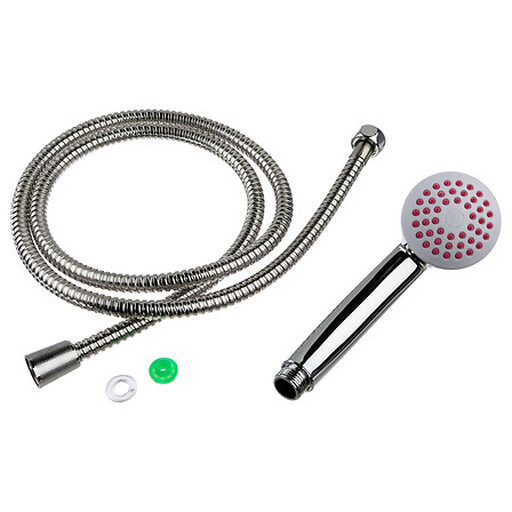
Why this product fits the profile: The set combines a hand shower with a 150 cm hose and is aimed at households looking for a simple solution without extra features.
The specifications state a specific hose length, anti-limescale nozzles and a water-saving disc rather than relying solely on general marketing claims.
150 cm flexible hose, stainless steel, ABS and PVC components, plus a single Rain spray function.
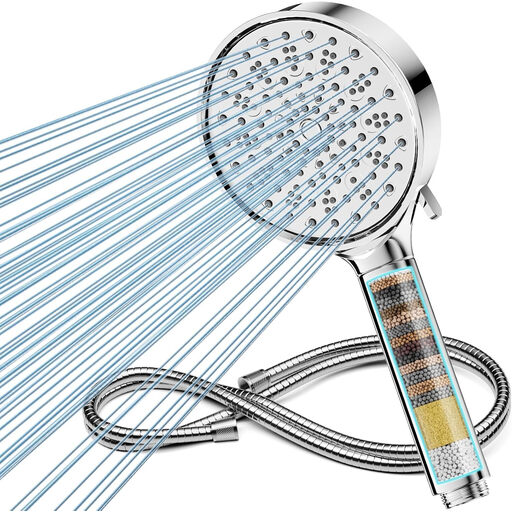
Why this product fits the profile: For households with hard water, the filter construction, six spray patterns and a standard G1/2 connection are the key features.
The filter element is pre-installed; at the same time, it mentions an optional flow restrictor and notes its suitability limits for electric showers.
20-layer filter according to the product description, six switchable spray patterns and a 124 × 124 mm spray plate.
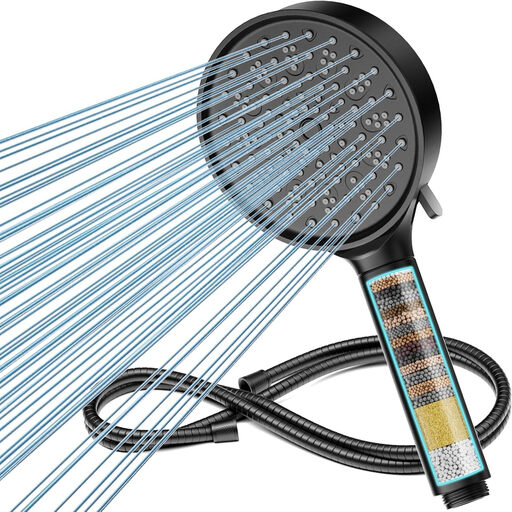
Why this product fits the profile: The black finish suits modern bathrooms; six spray patterns and a 150 cm hose support various everyday situations.
The product data mentions filter replacement depending on water quality and usage, as well as cleaning the silicone nozzles.
20-layer filter system according to the supplier, six modes, 150 cm hose and black ABS finish.
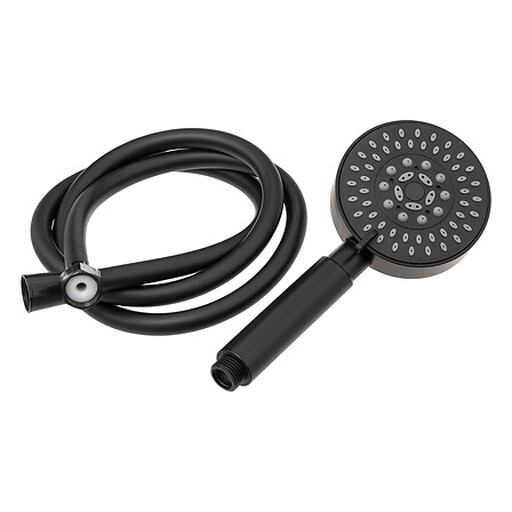
Why this product fits the profile: Five modes and the flexible hose make targeted rinsing, use by multiple people and cleaning the shower area much easier.
The spray pattern is selected directly on the hand shower; rubber seals are said to support a leak-proof connection.
Five spray patterns, including Massage, Rain, Mist and Jet, plus a flexible stainless steel hose.
We have put together a complete, regularly updated list of products that fully meet these strict selection criteria and the safety regulations in force in the EU.
Installing a set with a standard connection is usually done in just a few steps:
For maintenance, a soft cloth with a mild cleaning agent is sufficient for many models. Limescale on the nozzles should be removed regularly. Filter cartridges or filter granules must be checked and replaced according to the product instructions. With electric showers, the respective manufacturer’s approval is particularly important.
Many models use a G1/2 connection and therefore fit numerous standard tap fittings. However, a blanket guarantee for every shower is not possible. Check the thread, seal and suitability for instantaneous water heaters or electric showers based on the product specifications.
This depends on the filter type, water hardness and frequency of use. Specific intervals may be stated for the respective product; with one of the Cobbe models, replacing the filter cartridge after around three to four months is recommended for optimal performance. Reduced flow or visible deposits are additional signs that it’s time to check.
A flow restrictor or a special nozzle structure can reduce water consumption. The actual saving depends on water pressure, the tap fitting, shower duration and household habits. Figures such as “up to 30 or 40 per cent” should therefore be understood as model-specific manufacturer claims rather than a fixed general value.