
Lieferung heute & morgen

Qualitätsgarantie

Willkommens-Angebote freischalten: KOSTENLOSE Lieferung | Bis zu 80 % RABATT | Kostenlose 30-Tage-JoyPlus-Testphase
App herunterladen
A new shower system can transform your daily shower from a mere necessity into a mini spa-like experience. However, the market is vast, and the technical details are often unclear. Many buyers invest in models that don't fit their connections, suffer from low water pressure, or quickly become unsightly and lose functionality due to hard water. This guide will help you understand the crucial features and make an informed decision.
Before you choose a model, you should be aware of the three most common problems that can lead to frustration and unnecessary costs.
To avoid the problems mentioned above, focus on three technical aspects. These are the primary determinants of your new shower system's longevity, functionality, and compatibility.
Compatibility starts with the connections. The European standard for shower hoses and wall connections is the G1/2-inch thread. Check whether your chosen complete shower set or individual shower head with hose conforms to this standard to ensure a hassle-free installation.
For renovators, a shower column without fittings is often a practical solution. Look for models with adjustable wall brackets. These allow you to use the existing drill holes in the wall, ensuring a clean and simple installation without drilling new tiles.
The choice of material affects both the look and the maintenance effort.
Not every shower system is suitable for every water quality or pressure level.
Here are some product recommendations tailored to specific user profiles and their requirements.
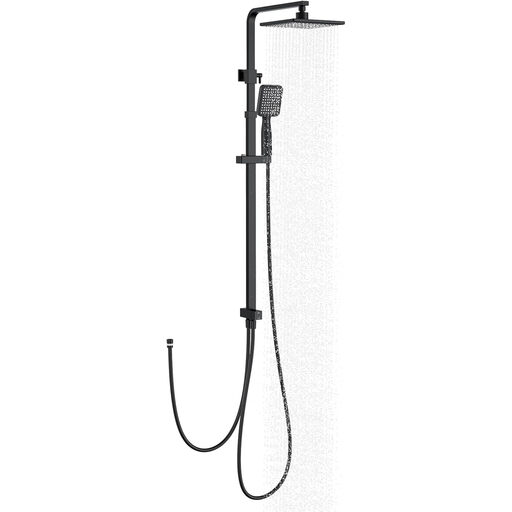
Why This Fits Their Persona: Ideal for renters or homeowners who want to modernise their bathroom without major effort. This set comes without fittings and can be connected directly to an existing thermostatic or mixer tap, allowing for a quick and cost-effective upgrade.
It solves the compatibility problem by being designed for retrofitting. The height-adjustable shower rail (730-1153 mm) and standard G1/2-inch connections provide flexibility during installation.
Combines a large, square rain shower head (20x20 cm) with a hand shower. The black, brushed finish gives the bathroom a modern aesthetic.
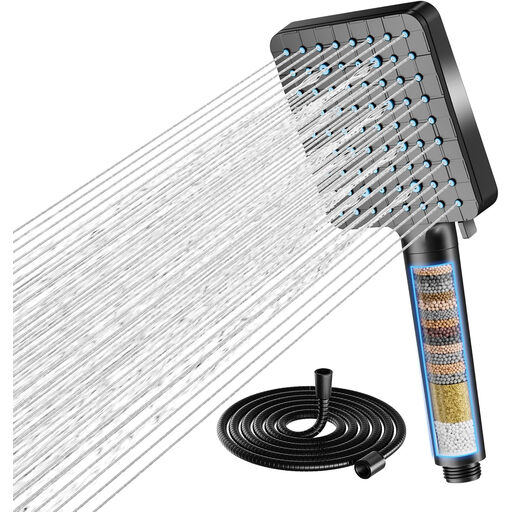
Why This Fits Their Persona: A targeted solution for anyone struggling with the effects of hard, limescale-heavy water on their skin, hair, and bathroom fittings. This shower head can be easily installed on any existing hose.
Directly addresses the problem of rapid wear from limescale. According to the manufacturer, the integrated 20-stage filter system reduces impurities and protects the nozzles from the inside.
Features a shower head with a limescale filter and internal pressure-boosting technology that ensures a powerful stream even with low mains pressure. Six different spray modes offer additional comfort.
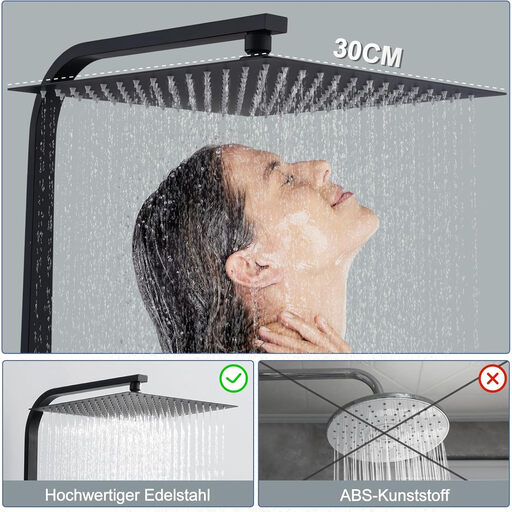
Why This Fits Their Persona: For families and anyone who values safety, comfort, and a cohesive overall look. This complete system offers precise temperature control and a luxurious shower experience thanks to its large overhead shower.
The integrated thermostat with a 38°C safety lock reliably prevents scalding from sudden temperature fluctuations—a common shortcoming of basic mixer taps.
Offers a complete shower set made of stainless steel with a very large square rain shower head (30x30 cm). The shower rail is height-adjustable and the wall bracket is flexible, which simplifies renovation.
We have compiled a complete, up-to-date list of products that fully meet these strict selection criteria and German safety regulations.
1. What does "shower column without fittings" mean, and who is it for? A shower column without fittings is a set that includes a shower rail, an overhead and/or hand shower, and the connecting hoses, but does not contain its own mixer tap (fittings). It is ideal for people who want to keep their existing, functional tap and simply modernise the shower heads and rail. This is a cost-effective way to upgrade your bathroom.
2. How often should a filter in a filtered shower head be replaced? Most manufacturers recommend replacing the filter cartridge every 3 to 6 months. The exact lifespan depends on the water hardness in your area and the frequency of use. A noticeable decrease in water pressure is often a clear sign that the cartridge is saturated and needs to be replaced.
3. Can a water-saving shower head still produce a strong water stream? Yes, that's possible. Modern water-saving shower heads use technologies to increase the perceived water pressure. By narrowing the nozzles or injecting air, the water is accelerated, and the stream feels more powerful, even though the actual water consumption is reduced. This not only protects the environment but also your wallet.