
Lieferung heute & morgen

Qualitätsgarantie

Willkommens-Angebote freischalten: KOSTENLOSE Lieferung | Bis zu 80 % RABATT | Kostenlose 30-Tage-JoyPlus-Testphase
App herunterladen
A silicone baking mould can make baking easier, save space and cut down on washing up. However, moulds vary considerably in stability, dimensions and intended use. If you focus only on terms such as ‘non-stick’ or ‘flexible’, you could overlook important details.
A very flexible silicone baking mould is easy to store, but it can become unstable when you carry it to the oven. There is a particular risk of it tipping when filled with runny cake batter, quiche filling or bread mix.
Models with an integrated steel frame or reinforced construction are therefore a practical choice. Alternatively, always place a silicone mould on a sturdy baking tray before filling it.
Not every silicone mould is suitable for every heat source. Before buying, check whether it can be used in the oven, microwave, freezer and dishwasher. The maximum temperature can also vary from one product to another.
The 5five silicone loaf tin is one example: according to its product description, it is suitable for oven use up to 220 °C and freezer use down to −20 °C. These details apply to that particular model and should not be assumed to apply to other moulds.
A shallow silicone tart tin is not necessarily suitable for a deep cake. Similarly, a muffin tin will give you different results from a loaf tin. The key factors are depth, number of cavities, diameter and capacity.
Before buying, consider what you’ll mainly use the mould for: cakes, muffins, bread, tarts or French patisserie.
Check the specific material details, such as whether the mould is made from food-grade silicone. For moulds you use often, smooth surfaces with few pores are practical, as they’re easier to clean and may retain fewer residues. Material composition details come from the relevant product descriptions.
A sturdy rim is particularly useful for large or deep moulds. For example, a silicone muffin tin with a steel structure is easier to fill and carry securely than a completely soft model.
The external dimensions need to fit your baking tray and available storage space. For a round silicone cake mould, the diameter and height also matter. A deep mould is suitable for taller cakes, while shallow models are designed for tarts, quiches or flans.
The 5FIVE silicone tart tin is listed as measuring 31 × 31 × 4 cm. According to its product description, the oblong tart tin measures 37 × 22 × 3 cm. The 5five Silitop Silicone Loaf Tin is designed for bread and loaf cakes, with a stated capacity of 1,59 litres.
A flexible mould can make it easier to release your bake, but it doesn’t replace proper preparation. Lightly greasing the mould may be useful for delicate batters, particularly if the recipe recommends it. Also check whether the product is specifically described as a dishwasher-safe baking mould.
The product descriptions for the 5FIVE and 5five models featured here say they can be cleaned in the dishwasher. Even so, follow the care instructions, temperature limits and the manufacturer’s guidance.
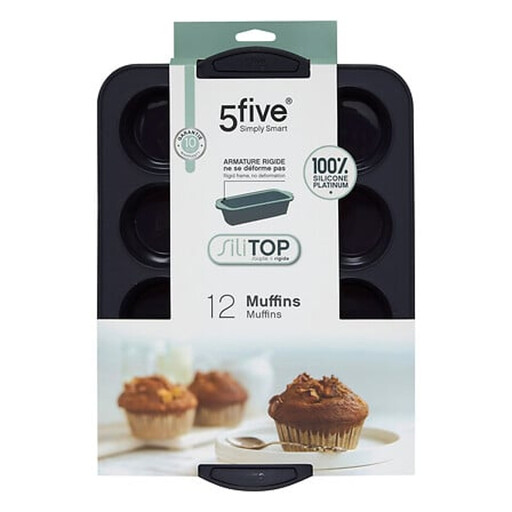
Why this product suits this profile: This 12-cavity tin is designed for regular muffin and cupcake baking, with a clear size specification of 6,5 cm diameter per cavity.
The integrated steel structure helps prevent the tin from bending out of shape when filled or carried to the oven.
12 cavities, a total volume of 0,85 litres and, according to the product description, dishwasher-safe.
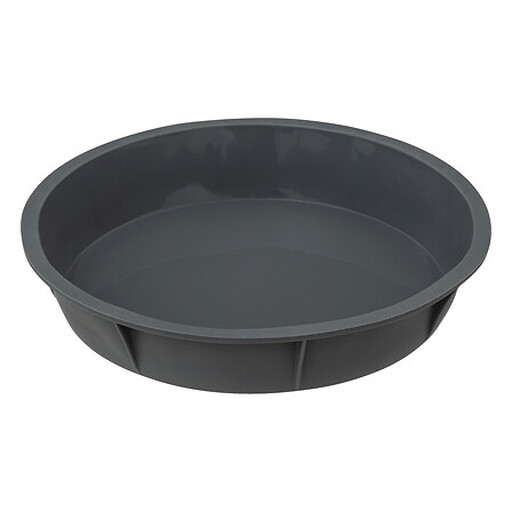
Why this product suits this profile: This deep, round mould, measuring 30 × 30 × 6 cm, is suitable for taller cakes, gâteau manqué, fruit cakes and quiches.
Its stated depth is suited to taller bakes, helping you avoid choosing a shallow tin for recipes that need a deeper mould.
100% food-grade silicone according to the product description, a flexible design and dishwasher-safe cleaning.
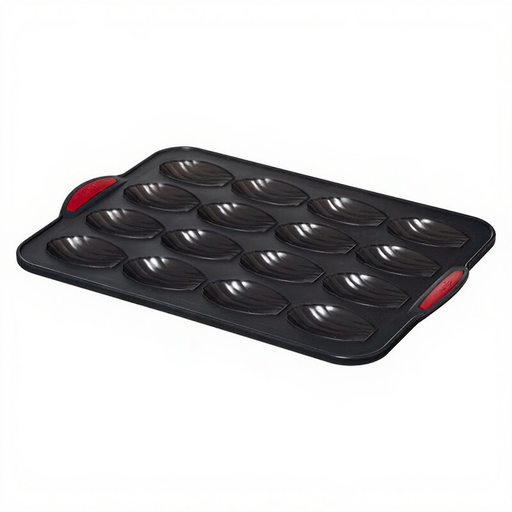
Why this product suits this profile: This madeleine tin has 16 cavities, so you can bake several at once. It’s ideal for French patisserie and small cakes.
The rigid frame helps address the common stability issue with large, flexible silicone moulds.
16 cavities, a weight of 0,31 kg and, according to the product description, dishwasher-safe.
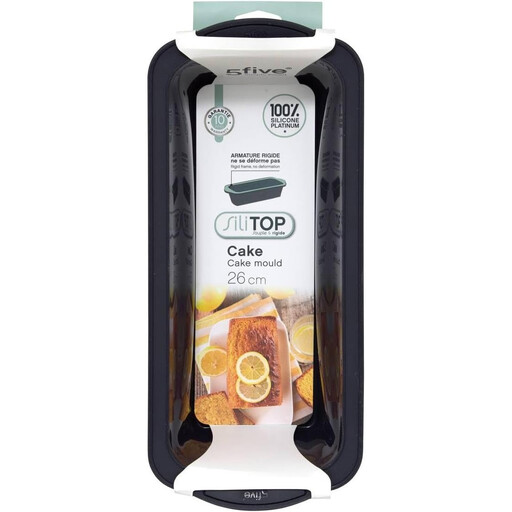
Why this product suits this profile: The combination of steel and silicone is designed for bread, loaf cakes and other oblong bakes.
The integrated rigid frame helps prevent the tin from bending under the weight of heavy dough, while its capacity makes recipe planning easier.
A capacity of 1,59 litres, suitable for use in the oven or microwave and, according to the product description, dishwasher-safe.
Before using your mould for the first time, check the care and temperature guidance from the manufacturer. These steps can help you get an even result:
A cannelé tin has deep, ridged cavities designed specifically for cannelés. If you make this French speciality regularly, choose a suitable mould such as the 5FIVE Silicone Mold for Cannels rather than a general cake tin. For tarts, quiches and shallow fruit cakes, a low-sided tart tin is a more practical choice.
We’ve put together a complete, regularly updated list of products that meet these strict selection criteria and fully comply with the safety regulations in force in the EU.
It depends on the recipe, the batter and the surface of the mould. Even if a product is described as non-stick, a thin layer of grease can be useful for delicate or high-sugar batters. Follow the manufacturer’s guidance and the recipe.
There’s no reliable one-size-fits-all answer. It depends on how often you use it, the temperature, cleaning and storage. Visible cracks, sticky patches, significant warping or lingering odours are signs that you should stop using the mould.
Many models are described as dishwasher-safe, including several of the products mentioned here. However, always check the specific product description. For very large moulds, hand-washing may also be gentler on the frame and material joins.