
Lieferung heute & morgen

Qualitätsgarantie

Willkommens-Angebote freischalten: KOSTENLOSE Lieferung | Bis zu 80 % RABATT | Kostenlose 30-Tage-JoyPlus-Testphase
App herunterladen
Silicone baking moulds are flexible, space-saving and suitable for all kinds of sweet and savoury recipes. However, not every silicone baking mould is right for every household. A soft mould can become unstable when carried to the oven, a shallow tart tin is unsuitable for tall sponge cakes, and a coated metal tin often needs more care than expected.
It is therefore worth looking at the actual product specifications before buying rather than relying on general marketing claims. The key factors are material, temperature range, shape stability, dimensions and cleaning instructions.
Silicone is easy to bend and can be stored in a space-saving way. This very feature can become a disadvantage when filling the mould: a large, soft mould may warp if it is carried to the oven with liquid batter without a supporting tray.
For round cake tins, tarts and heavy batters, a baking tray or sturdy oven rack as a support is advisable. Alternatively, consider silicone moulds with an integrated steel frame. Individual muffin cases can also be placed in a rigid muffin tin for extra support.
Many silicone baking moulds have a smooth surface that often allows cakes, muffins and desserts to be removed easily. However, the result also depends on the recipe, the consistency of the batter and the cooling time. For delicate batters, applying a thin film of butter or neutral oil may still be useful.
A carbon-steel non-stick baking tin is not automatically dishwasher-safe either. For example, according to the product details, the Le Creuset muffin pan in this guide is intended for hand washing only.
The external dimensions do not always indicate how much batter the mould can actually hold. The internal dimensions, number of cavities and depth are therefore important when making your choice. A shallow tart tin is suitable for tarts, quiches and flans, while a deep silicone cake mould offers more capacity for sponge or whisked cake batter.
For muffins and cupcakes, you should also check whether the cavities match your desired portion size. Small moulds are suitable for mini desserts, while standard cavities are generally designed for classic muffin recipes.
Pay attention to the specific material details. According to the product description, the 5FIVE moulds mentioned are made from 100% food-grade silicone. This describes the material, but does not replace checking the instructions for use or the stated temperature range.
Temperature limits vary by model. According to the product details, the six-piece heart-shaped mould set has a range of -40 °C to 230 °C. This makes it suitable for use in the freezer and oven. According to the product details, the Le Creuset carbon-steel muffin pan is oven-safe up to 240 °C. It is not intended for use on a hob or over direct heat.
A dishwasher-safe baking mould saves time, but this is not standard for every material. According to the product details, the silicone moulds in this selection are dishwasher-safe. For coated carbon steel, however, hand washing is often recommended, as harsh detergents, high temperatures and abrasive sponges can damage the coating.
Every mould should be cleaned before first use. Do not use sharp knives or metal utensils directly on the surface of coated moulds. Silicone can develop odours and discolouration depending on the recipe; a smooth, non-porous surface is generally easier to clean than highly textured materials.

Why this product suits this profile: Six small moulds measuring 8 × 7,5 × 3,1 cm offer an accessible introduction to making individual cakes, cupcakes, jellies and frozen desserts.
The individual cavities are easier to handle than one large, soft mould. The stated temperature range of -40 °C to 230 °C covers both oven and freezer use.
Six-piece set, stackable, each mould weighs just 15 g and is dishwasher-safe according to the product details.
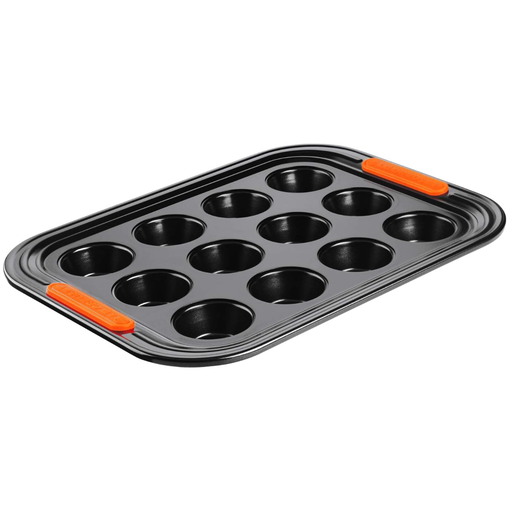
Why this product suits this profile: The 12-cavity carbon-steel pan is designed for regular batch baking and for users who prefer a sturdy construction.
The sturdy construction reduces the risk of a filled pan warping during transport. The hand-washing requirement makes the care instructions clear.
12 deep cavities, oven-safe up to 240 °C according to the product details, with a smooth non-stick coating on the inside and outside.
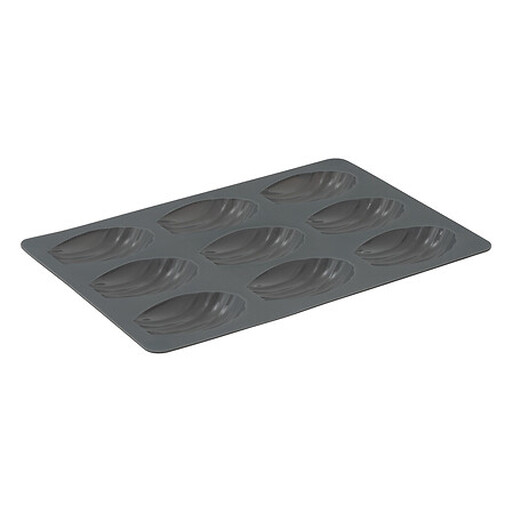
Why this product suits this profile: The shell-shaped cavities are designed for Madeleines, making this mould ideal for bakers who want to create French patisserie at home.
The mould is clearly specified as measuring 36 × 21,5 × 2 cm. This allows you to check before buying whether it will fit your existing baking tray or oven rack.
100% food-grade silicone according to the product description, a low weight of 50 g, and suitable for use in the oven, freezer and dishwasher according to the product details.
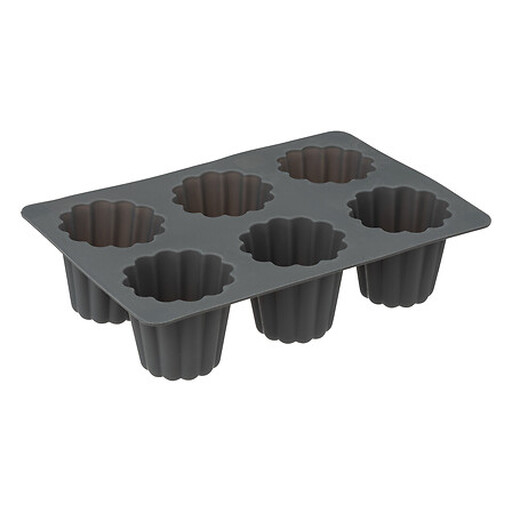
Why this product suits this profile: The deep, ridged cavities are designed for Cannelés and also offer additional uses for chilled desserts or speciality ice moulds.
Measuring 31 × 17 × 6 cm, this is a comparatively deep mould. This makes it easier to assess in advance whether the recipe quantity and desired portion size are a good match.
100% food-grade silicone according to the product description, and suitable for use in the oven, microwave, freezer and dishwasher according to the product details.
We have put together a complete, regularly updated list of products that fully meet these strict selection criteria and the safety regulations applicable in the EU.
Silicone is lightweight, flexible and generally easy to store. It is particularly suitable for households with limited storage space and for desserts that are removed from the mould after chilling. A sturdy support is recommended for tall cakes or liquid batters.
Coated carbon steel is shape-stable and provides a firm base when filling. However, scratches, direct heat and harsh cleaning products should be avoided. Before buying, check whether the mould is dishwasher-safe or must be cleaned by hand only.
Not always. With many smooth silicone moulds, the batter can be removed without heavy greasing. However, lightly greasing the mould can make it easier to remove delicate, sugar-rich or particularly sticky recipes. You should also follow the manufacturer’s care instructions.
There is no standard service life that applies to every mould. It depends on temperature, cleaning, storage and contact with sharp objects. Check the mould regularly for cracks, sticky areas, deformation or material coming away from the surface. Damaged moulds should no longer be used.
This depends on the model. According to the product details, several of the 5FIVE silicone moulds mentioned are dishwasher-safe. Coated metal moulds, on the other hand, may require hand washing. The instructions on the relevant product page and packaging should always be treated as authoritative.