
Lieferung heute & morgen

Qualitätsgarantie

Willkommens-Angebote freischalten: KOSTENLOSE Lieferung | Bis zu 80 % RABATT | Kostenlose 30-Tage-JoyPlus-Testphase
App herunterladen
Silicone baking moulds are flexible, space-saving and suitable for many sweet and savoury recipes. However, not every budget-friendly silicone baking mould automatically delivers even results. Material specifications, dimensions, stability and the intended temperature range are all important.
Anyone who focuses only on terms such as “non-stick” or “suitable for all purposes” often overlooks important details. The following advice will help home bakers, families and beginners choose the right silicone baking mould.
Silicone moulds are easy to remove from baked goods and can be stored compactly. However, a very soft mould may slip when being carried to the oven or distort under heavy batter. A stable rim or reinforced frame is particularly useful for a large silicone cake mould or a deep mould.
For delicate mixtures, it is best to place the flexible baking mould on a baking tray before filling it. This makes it easier to slide safely into and remove from the oven.
Not every silicone baking mould is automatically suitable for all appliances. Before buying, it should be clearly stated whether the mould is intended for the oven, microwave and freezer, and which temperature range applies. According to the product information, the six heart-shaped moulds in the range are designed for -40 °C to 230 °C.
Cleaning is also worth considering: a dishwasher-safe baking mould can save time in everyday use. This is not necessarily the case with coated steel moulds. According to the product description, for example, the Le Creuset muffin moulds are intended for hand washing only.
A tart mould is not suitable for every type of cake. Shallow moulds are ideal for tart bases, quiches and flans, while deep moulds provide more volume for sponge or cake batter. A Madeleine mould or Cannelé mould, on the other hand, is designed for a specific pastry speciality with a distinctive shape.
It is therefore worth checking the dimensions, depth, number of cavities and typical intended use before buying.
Look for a specific material description such as food-grade silicone. According to the product descriptions, several 5FIVE products are made from 100% food-grade silicone. The surface is described as non-porous and flexible. This can make cleaning easier and help you remove delicate baked goods from the mould.
Silicone moulds should be cleaned according to the manufacturer’s instructions before first use. With mixtures that are particularly prone to sticking, applying a thin layer of grease may be helpful, even when the material is described as easy-release.
The external dimensions determine whether the mould will fit on your baking tray and in your home oven. Examples from the selection include:
For muffins and cupcakes, the diameter of each cavity is also important. According to the product information, the Silitop mould has twelve cavities, each measuring 6.5 cm in diameter.
A flexible baking mould can be rolled or folded, making it suitable for small kitchen cupboards. At the same time, it needs a firm base when being filled. Also check whether the manufacturer states that the mould is dishwasher-safe and whether it has a steel frame.

Why this product suits this profile: Six individual moulds measuring 8 × 7.5 × 3.1 cm are suitable for individual cakes, cupcakes, jellies and frozen desserts.
The stated temperature range of -40 °C to 230 °C clearly indicates that the mould is intended for use in the oven, microwave and freezer.
Flexible, food-grade silicone; stackable and, according to the product information, dishwasher-safe.
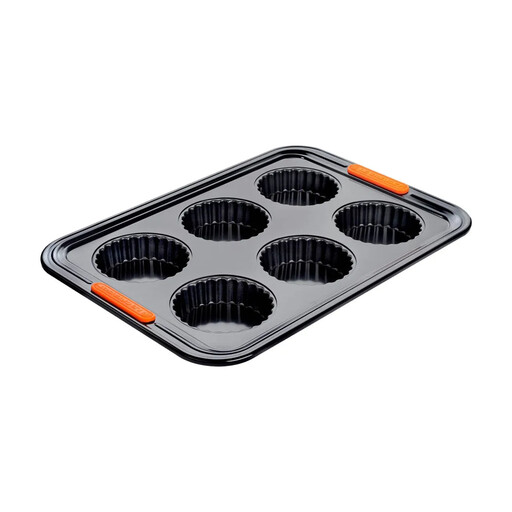
Why this product suits this profile: The carbon steel mould has six fluted cavities for individual tarts, quiches and small sweet or savoury pastries.
The manufacturer specifies carbon steel, a reinforced rim construction and oven suitability up to 240 °C. According to the product information, the mould is not dishwasher-safe.
Six cavities; reinforced rim with silicone inserts for handling with oven gloves.
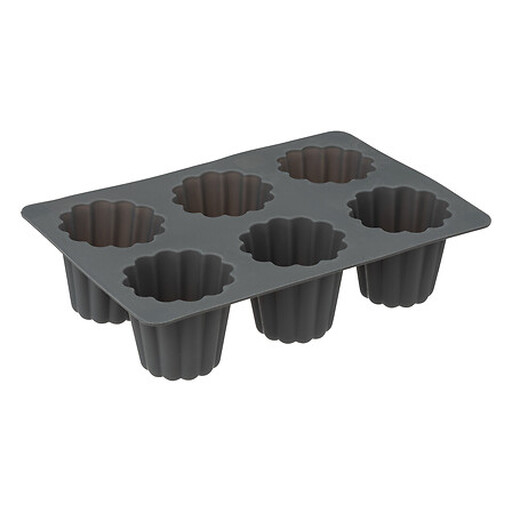
Why this product suits this profile: The Cannelé mould with deep, fluted cavities is ideal for anyone who wants to prepare French pastry specialities or individual desserts.
The product description explicitly states that it can be used in the oven, microwave and freezer, and that it is dishwasher-safe.
Measures 31 × 17 × 6 cm; flexible mould for easy removal and space-saving storage.
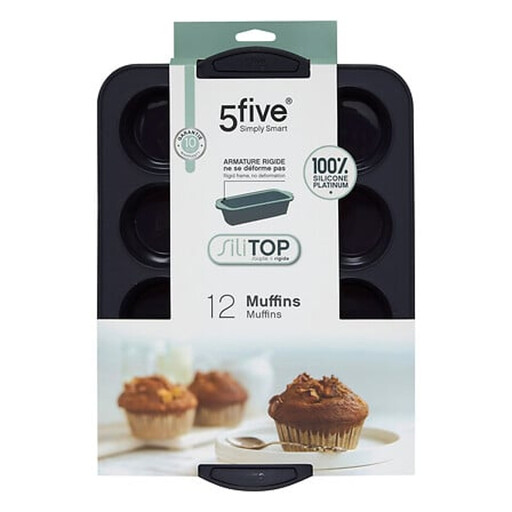
Why this product suits this profile: Twelve cavities and an integrated steel frame make it easier to bake several muffins or cupcakes at once.
The reinforcing steel frame addresses the typical lack of stability of soft silicone moulds when carrying them to the oven.
12 cavities; measures 33.1 × 23.7 × 4.1 cm and is stated to be suitable for use in the oven.
We have put together a complete, regularly updated list of products that fully meet these strict selection criteria and the safety regulations applicable in the EU.
This depends on the recipe and the material. With low-fat mixtures or very delicate designs, lightly greasing the mould can make removal easier. Many products are described as non-stick or easy-release. The manufacturer’s specific care and usage instructions should always take priority.
There is no fixed service life that applies in every case. It depends on temperature, cleaning, storage and how the mould is handled around sharp objects. Cracks, sticky areas, deformation or visible material damage are signs that the mould should no longer be used.
Some models are designed for this, while others are not. Look for an explicitly stated temperature range. According to the product description, the heart-shaped moulds can be used from -40 °C to 230 °C; for other models, the relevant product information should be checked.