For long virtual stints, an adjustable load-cell brake is worth considering if your pedals and seat are securely supported and the connection is compatible with your existing setup. If your rig can’t safely support firm braking, consider a position-sensing brake instead. Modular or hydraulically enhanced sets offer other adjustment options, but may require additional parts. The number of monitors you use doesn’t determine which pedal technology you need.
Who are the different pedals suited to?
Drivers with a fixed rig and long stints
If you want to repeat your braking inputs over longer sessions, make sure your pedals and seat are securely mounted and that you can adjust the brake resistance to suit you. Fanatec and Thrustmaster describe different adjustment options for their respective pedal models.
Drivers with limited pedal space
If space is tight, pedal spacing, foot position and seat support are important factors to consider. Thrustmaster lists adjustable height, angle and spacing for the T-LCM, while MOZA describes mounting options for the CRP2 series.
Upgraders with an existing wheelbase
If you’re adding to an existing setup, check the pedal model, platform and connection method together. Fanatec and Thrustmaster describe different USB and wheelbase connections depending on the model.
What should you consider when choosing?
Position-sensing brake
A good fit if: Your setup can’t safely support firm braking, or you’d like to practise with less resistance.
Trade-off: An adjustable resistance setting doesn’t make this a load-cell brake.
Adjustable load-cell brake
A good fit if: Your pedals and seat are securely mounted and you want to adjust brake resistance for repeated inputs.
Trade-off: Connection methods vary by model; a load cell doesn’t guarantee faster lap times.
Modular or extended rig set
A good fit if: You want to adjust your pedal position or brake feel on a fixed rig.
Trade-off: Check the pedal count, variant and any additional modules you need individually.
| What matters |
What to check before buying |
Who should pay particular attention? |
| Consistent brake feel |
Compare the sensor technology, the springs or elastomers included and how adjustable they are. |
If I want to tune brake resistance for repeatable inputs during long stints, the specific adjustment options matter to me. Around 36% of consumers put brake feel first. |
| Mounting and pedal position |
Check the mounting points, seat support and the adjustable height, angle or spacing of the variant in question. |
If space is limited or I need a stable foot position, I’m particularly concerned that the pedals and seat won’t give way under braking. Around 29% of consumers prioritise mounting and seating position. |
| Connection to your existing setup |
Check compatibility with your PC or exact console, wheelbase, cable routing and the game in question. |
If I want to integrate a pedal set with my existing wheelbase and platform, the specific combination needs to be compatible. For around 21% of consumers, system connectivity is the main consideration. |
| What’s included and expansion options |
Check the number of pedals in your chosen variant, as well as whether you need a clutch and which additional modules are explicitly compatible. |
If you need a clutch or may want to modify your setup later, check exactly what’s included. Around 14% of consumers prioritise the number of pedals and expansion options. |
Which buying and connection mistakes should you avoid?
-
Confusing the sensor’s rated load with the force needed from your foot
For the CSL Elite Pedals V2, Fanatec distinguishes between a sensor rated load of over 200 kg and up to 90 kg of force applied to the pedal plate. A single figure in kilograms doesn’t reliably describe how the brake will feel.
Compare the specific measurement being quoted, the adjustment options and the mounting requirements rather than focusing only on the highest figure.
-
Fitting a stiff brake to a rig that gives way
If the pedal plate or seat moves under braking, it’s difficult to make use of the resistance you want. The right mounting setup also depends on the setting you choose.
Check your pedals, seat and mounting points together before setting the brake resistance.
-
Assuming PC USB confirms compatibility with every console or game
Connection options vary between models. Thrustmaster also documents a specific case where an F1 game on PC doesn’t recognise T-LCM pedals connected separately via USB.
Check your pedals, wheelbase, platform and game together in the exact combination you plan to use.
-
Assuming a modular two-pedal set includes a clutch
The CRP2 base set described by MOZA includes an accelerator and brake, but not a clutch as standard.
Check what’s included with your chosen variant and whether you need a clutch pedal for the cars you’ll be simulating.
Which brands and pedal ranges are worth considering?
Fanatec
The CSL Elite Pedals V2 are a three-pedal load-cell set with adjustable brake resistance and pedal spacing.
- Fanatec lists PC USB and RJ12 to a supported Fanatec wheelbase as connection options.
- The figure of up to 90 kg of force applied to the pedal plate applies to the V2 and shouldn’t be assumed to apply to other CSL pedals.
Thrustmaster
The T3PM and T-LCM use different braking technologies, so they should be assessed separately.
- Thrustmaster lists four resistance settings for the T3PM and adjustable pedal positions for the T-LCM.
- With the T-LCM, you’ll need to choose the right connection method for your PC or wheelbase.
MOZA Racing
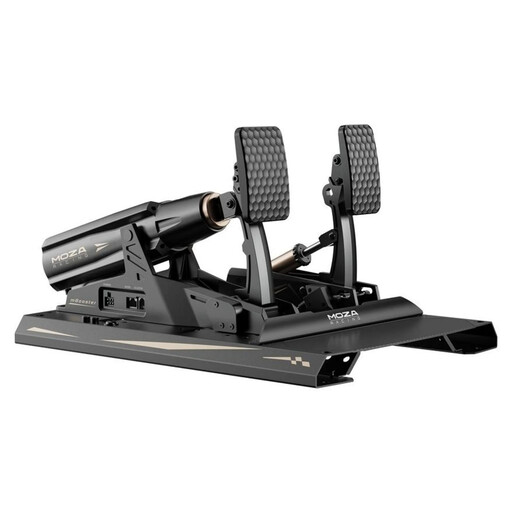
The CRP2 series is aimed at drivers looking for an adjustable accelerator and brake set for a fixed rig.
- MOZA describes its adjustment options and a load-cell sensor with a rated figure of 200 kg.
- The sensor rating isn’t the same as the force required from your foot; the documented base set doesn’t include a clutch.
SIMAGIC
The P1000 family includes variants for different pedal layouts and planned adjustments to brake feel.
- SIMAGIC describes options including the two-pedal P1000-F, inverted versions and hydraulically enhanced models.
- The features and any additional parts required depend on the exact variant; the manufacturer’s claims about brake feel aren’t independent measurements.
Logitech G
The PRO Racing Pedals are described as a modular three-pedal set with a load-cell brake.
- Logitech lists interchangeable springs and elastomers, as well as pedals that can be repositioned horizontally.
- The product description referenced is for the US market and doesn’t indicate availability in Germany.
Pedals for your training setup
Joybuy’s selection of sim racing products for training, with a focus on repeatable braking inputs and a fixed rig setup.
 No image available
MOZA Racing RS082 Pedals, Terrace, Black, Aluminium
Designed for repeatable braking inputs and a fixed training setup; before use, check that you can mount the rig securely.
The product name lists aluminium, 15 Bit, and USB Type-A to USB Type-B and USB Type-C.
Joybuy
Frequently asked questions
Do I need special pedals because I use multiple monitors?
No. Using multiple monitors doesn’t mean you need a particular type of pedal. iRacing explains how to set up three monitors through its display and graphics settings; choose your pedals based on the brake, mounting and connection.
How do I connect T-LCM pedals without mixing up the two connection methods?
Thrustmaster recommends using either USB to your PC or RJ12 to your wheelbase, and disconnecting the other cable. According to the manufacturer, a PC USB connection is required to adjust the settings using the T-LCM Calibration Software.
Do I need an additional manufacturer’s warranty to claim my statutory rights for faulty goods?
No. According to consumer information from the European Union, purchases from a trader come with a minimum statutory period of two years for claims relating to faulty goods. A commercial guarantee may provide additional cover, but can’t reduce your statutory rights. If the distance-selling contract applies, you generally have 14 days from delivery to cancel; exceptions and possible return costs should be taken into account.
Can you put unwanted electronic racing pedals in household waste in Germany?
No. The German Environment Agency advises that unwanted electrical equipment must be disposed of separately from household waste. Return options include recycling centres and, subject to the relevant take-back rules, retailers.


