When choosing pedals for practising repeated braking points, start by checking the connection and how securely they can be mounted. Then consider the braking feel you want and how many pedals you need. The load-cell brake on the Fanatec CSL Elite Pedals V2 measures the force applied rather than just pedal travel, so you’ll need a set-up that suits your chosen braking force. Having multiple monitors doesn’t, by itself, mean you need a particular type of pedal.
Which pedals are right for you?
Drivers practising their braking points
If you drive the same urban circuit repeatedly, an adjustable brake can help you tailor the resistance to your footwork. Also check that the mounting and connection suit your set-up; Fanatec and Thrustmaster offer different options depending on the model.
Drivers without a permanent rig
If you rearrange your space after driving, secure support and the right seating position are important. Fanatec says its CSL base set can be braced against a wall or a solid surface, while Heusinkveld requires a full rig for the Sprint.
Drivers with an existing PC, console or steering wheel
If you want to keep using your current set-up, check that the pedal model, platform and wheelbase are compatible. Fanatec and Thrustmaster specify different connection options, so USB or RJ12 on its own doesn’t guarantee compatibility.
What should you look for when buying?
First check that the pedals and seat are secure and that the pedals can connect to your set-up. Then decide which brake settings and pedal layout best suit the way you practise.
| Criterion |
What to check before buying |
Who is this especially important for? |
| Braking points |
Check the sensor type and the adjustment options for the spring, elastomer and calibration on the specific model. |
If I drive the same circuit repeatedly, I want to hit and release the brake in a controlled way. Around 33% of consumers put repeatable control of braking points first. |
| Stability |
Compare the mounting method, pedal plate, seat distance and rig requirements. |
If my space isn’t permanently set up, I want to be able to brace the pedals securely when braking. Around 27% of consumers put stability first. |
| Connection |
Check the pedal model, PC or console, wheelbase and intended cable connection together. |
If I want to keep using my PC, console or steering wheel, the connection has to match my existing set-up exactly. Around 20% of consumers put device compatibility first. |
| Throttle and foot position |
Check the throttle spring, pedal spacing, number of pedals and what’s included with the version you’ve chosen. |
If I want precise throttle control after tight corners and pedals I can reach comfortably, the layout matters just as much as the feel. Around 20% of consumers prioritise throttle control and foot position. |
Common buying mistakes
-
Assuming the kilogram figure is the foot force you need
For the Heusinkveld Sprint, the manufacturer distinguishes between the brake sensor’s rated load and the actual braking force: it specifies 120 kg for the sensor and a maximum actual braking force of 65 kg. These figures describe different things.
Compare the sensor’s rated load, the force at the pedal plate and the adjustable resistance separately, rather than using them to estimate the foot force you’ll need.
-
Assuming USB means compatibility with every console
The connection options depend on the specific pedal model, platform and, where relevant, wheelbase. For the T-LCM pedals, Thrustmaster recommends using one connection at a time: USB to a PC or RJ12 to a wheelbase.
Before buying, check which connection the manufacturer recommends for your complete device and steering-wheel set-up.
The CSL base set may need additional hardware for a standalone USB connection to a PC; depending on the model, you may also need a compatible wheelbase.
-
Expecting a clutch or load-cell upgrade to be included in the base set
The Fanatec CSL base set initially includes two pedals; the MOZA CRP2 in the “Throttle+Brake” version doesn’t include a clutch. The load-cell kit for CSL pedals is also a separate upgrade.
Before you decide, check the number of pedals, brake type and what’s included with the exact version you’re considering.
A separately sold clutch module or upgrade kit may mean extra set-up work.
-
Buying a stiff brake without the right set-up
Heusinkveld requires a full rig for the Sprint. According to the manufacturer, the optional baseplate doesn’t remove this requirement.
Before choosing a model, check that your mounting surface, seat and fixings are suitable for the pedals.
The Sprint pedals require a suitable full rig.
Key brands to consider
Fanatec
The CSL pedals are a two-pedal base set with a separate load-cell upgrade; the CSL Elite Pedals V2 are a three-pedal load-cell alternative.
- Fanatec says the CSL base set can be mounted securely or braced against a wall or solid surface.
- The CSL base set needs additional hardware for standalone USB use with a PC. A USB cable for a standalone PC connection is included with the CSL Elite Pedals V2.
Thrustmaster
The T-LCM is a three-pedal set with a load-cell brake and interchangeable springs.
- Thrustmaster specifies adjustable pedal height, angle and spacing, as well as interchangeable springs.
- For the connection, support recommends either USB to a PC or RJ12 to a compatible wheelbase, not both at once.
MOZA Racing
The CRP2 suits buyers who want plenty of control over brake feel and may want to add a clutch later.
- For the “Throttle+Brake” version, MOZA specifies a 200 kg load-cell sensor and a range of adjustment options.
- The sensor rating doesn’t tell you how much foot force is required. This base version doesn’t include a clutch.
Logitech G
The PRO Racing Pedals offer an adjustable three-pedal layout, for example to suit different drivers sharing a rig.
- According to Logitech G, the springs or brake elastomers can be swapped, and the pedal modules can be moved sideways.
- These adjustment options don’t guarantee compatibility with every console or a third-party wheelbase.
Heusinkveld
The Sprint is a set of PC pedals for a permanent, rigid cockpit; the two- and three-pedal versions differ in what’s included.
- This model is designed for drivers who want to use their pedals with a full rig.
- Heusinkveld requires a full rig, even when using the optional baseplate. Also check whether you need the two- or three-pedal version.
Related offers at Joybuy
The Joybuy offers below are racing wheel sets with pedals, not a selection of pedal sets sold individually.
 No image available
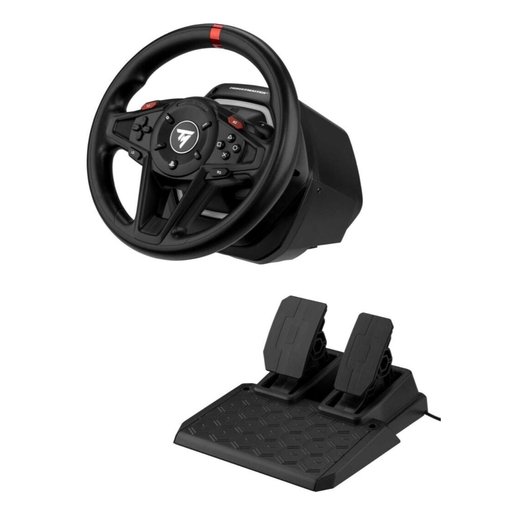
Thrustmaster T128-P Force Feedback Racing Wheel, black (PC/PS4/PS5)
A good choice if you’re looking for a racing wheel set with throttle and brake pedals. The set includes T2PM pedals with magnetic technology and 12-bit precision; the listed platforms are PC, PS4 and PS5.
View at Joybuy
 No image available
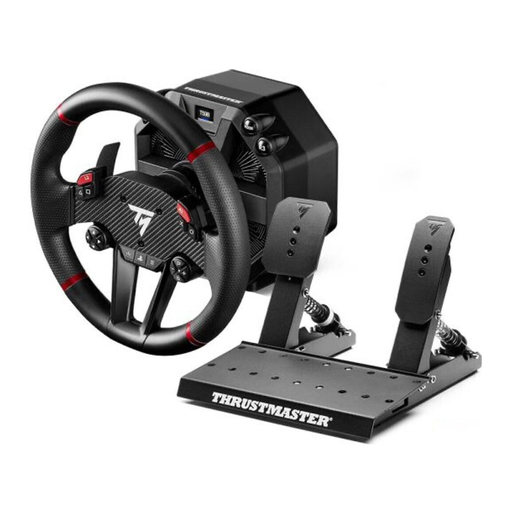
Thrustmaster T598-P Direct Axial Drive Force Feedback Racing Wheel (PS5/PS4/PC)
An option if you’re looking for a racing wheel set with pedals and stated compatibility with PC, PS4 or PS5. The set includes Raceline Pedals LTE with a metal construction and HEART sensors; the pedal set is described as suitable for a load-cell brake upgrade. Check what’s included with the specific version you’re buying.
View at Joybuy
Frequently asked questions
Do I need special pedals because I use multiple monitors?
No. The number of monitors alone doesn’t determine which pedals you need. Choose based on the braking mechanism, mounting, number of pedals and device connection, and set up your monitors separately.
How do I set up the T-LCM brake after changing a spring?
After changing the brake resistance, Thrustmaster specifies calibration on a PC via USB; the RJ12 cable shouldn’t be connected during calibration. Then check the input and pedal mapping in the game you’re playing.
Does the MOZA CRP2 base set include a clutch?
No. The “Throttle+Brake” version includes a throttle and brake, but no clutch. If you need a clutch pedal, check the compatible module sold separately and what’s included with the specific version you’re buying.
What are my rights when buying new pedals online in Germany?
For a standard distance sale, you generally have a 14-day right to cancel, although statutory exceptions may apply. If the goods are faulty, your statutory rights are against the seller and are separate from any voluntary guarantee. For new goods, Verbraucherzentrale information confirms that statutory warranty rights apply; the EU explains that the minimum period is two years from the date you receive the goods.


