Class leader using two pans
If two batches with different finish times are running at once, a model that displays two countdowns simultaneously can help. TFA Dostmann lists this feature for the 38.2025, while ADE describes it for the KT102.


For one pan and batches blanched one after another, a digital single-countdown timer is enough; a memory function makes it easier to set the same time again. If two batches with different finish times are running at once, a model specifically described as having a dual countdown is a better choice. A timer only tracks the time and is no substitute for preparation suited to the type of vegetable.
If two batches with different finish times are running at once, a model that displays two countdowns simultaneously can help. TFA Dostmann lists this feature for the 38.2025, while ADE describes it for the KT102.
If you repeatedly set the same short time, a memory function could come in handy. TFA Dostmann lists this feature for its digital 2-fach Timer 38.2025.
When timing one batch at a time, a clearly audible alarm and a display that’s easy to see from your workstation are important. Tescoma, Hama and WMF list different alarm and control features for their respective models.
The key question is whether you need to monitor one finish time after another, or two different times at once.
| What you need | What to check before buying | Who it matters most to |
|---|---|---|
| Two batches at once | Check whether two countdowns can run simultaneously and be displayed separately. | If I need to keep an eye on two pans with different finish times, I don’t want to switch between the times. Around 40% of consumers prioritise running batches in parallel. |
| Repeated timings | Check whether a memory function is listed for the specific model and whether the countdown is easy to restart. | When preparing consecutive batches for the same length of time, I want to be able to set the timer again quickly. Around 30% of consumers prioritise repeated batches. |
| Hearing the alarm | Compare the stated volume settings and visual signals with where you plan to use the timer. | In a shared cookery classroom, I want to notice the signal without unnecessarily disturbing others. Around 20% of consumers prioritise an alarm that’s suitable and easy to notice. |
| Positioning and batteries | Check whether the magnet or stand suits your workstation, and which batteries are required or included. | If my work surface or mounting options vary, I want to position the timer appropriately and have it ready to use before the class starts. Around 10% of consumers prioritise positioning and power supply. |
A count-up timer is no substitute for a second, independently settable finish time. If two pans are in use at once, having just one countdown may mean you have to keep changing the times.
If you’re preparing two batches at once, look for an explicit statement that the timer can run two countdowns simultaneously.
A timer only measures the time you set. For fresh pulses, the German Federal Institute for Risk Assessment gives a rule of thumb of at least 30 minutes’ cooking time; a brief blanch is no substitute.
Follow the preparation instructions and cooking time for the type of vegetable and recipe, and use the timer only to keep track of time.
A magnet is only useful on a suitable surface. If there’s nowhere appropriate to attach it, you’ll need another way to position the timer.
Check your intended workstation and look for a stand if needed. TFA Dostmann and ADE list a stand for their respective dual timers.
The digital 2-fach Timer 38.2025 is worth considering for two timings running at once and repeated settings.
The 00002949 digital kitchen timer is an option for a single countdown, with a choice of alarm modes.
The PRESTO 636076.00 is a digital timer for individual cooking intervals.
The Silit Attimo is a digital timer with a touch display.
According to ADE, the KT102 is a digital dual kitchen timer for tasks running in parallel.
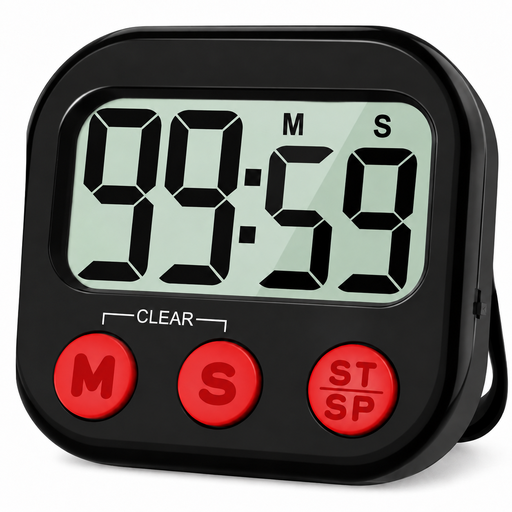
Digital single-countdown timers for blanching one batch at a time.
 No image available
For timing one blanching batch at a time, when a single countdown is all you need.
The product name specifies a setting of up to 99 min 59 sec and adjustable volume.
Base the start time on the specific recipe and vegetable. The German Federal Centre for Nutrition describes immersing vegetables in boiling water for a few minutes before cooling them in iced water when preparing them for freezing. This does not give one standard timing for every type of vegetable.
No. A short countdown on its own doesn’t show that fresh beans have been cooked thoroughly enough. The German Federal Institute for Risk Assessment gives a rule of thumb of at least 30 minutes’ cooking time for fresh pulses (as at 23 January 2024); this recommendation applies to the preparation of the relevant pulses.
Check the battery type and what’s included with the specific model, then test the display and alarm before the class starts. TFA Dostmann states that two AAA batteries are required for the 38.2025 and are not included; according to the manufacturer, the Tescoma PRESTO 636076.00 comes with one AAA battery.
For a consumer purchase in Germany, the seller is responsible for the statutory warranty. The consumer advice centre describes a general two-year warranty; this is separate from any voluntary manufacturer’s guarantee. For a purchase organised for business purposes, you should check the specific contract terms separately.
No. The German Environment Agency recommends collecting old electrical equipment separately. Remove the batteries if possible and take them to a battery collection point separately.