Ready to take with you
You want to pop a pre-portioned pack into your bag for work, school or your commute. First, check whether you plan to eat the cereal dry or will have milk, yoghurt and crockery at your destination.


If there’s no time to measure out a portion in the morning, a multipack confirmed to contain individually wrapped cereals, such as Kellogg's Variety, is ideal for a quick breakfast on your own. The dry portions are easy to take with you; if you want cereal with milk or yoghurt, you’ll need to bring those along too, and possibly some crockery. If ingredients and nutritional information matter more to you than ready-portioned packs, compare specific varieties and plan to portion them yourself.
You want to pop a pre-portioned pack into your bag for work, school or your commute. First, check whether you plan to eat the cereal dry or will have milk, yoghurt and crockery at your destination.
You’d rather portion your cereal yourself if the ingredients or sugar and fibre information matter more to you than having a ready-made mini pack. Compare the nutritional information for the specific varieties.
Before buying, check whether ingredients such as wheat, barley, milk or nuts are relevant to you. Always go by the labelling on the pack you’re actually buying.
First, decide whether you need the portions to be pre-packed. Then compare the ingredients and nutritional information, and consider what you’ll need to eat the cereal while you’re out.
| Criterion | What to check | Who it matters to |
|---|---|---|
| Ready-portioned packs | Check that the cereal is individually wrapped and see how many mini packs are in the multipack. Find out whether you’ll need milk or crockery. | If I can’t portion it out in the morning, I want a dry serving I can take with me. Around 42 % of consumers put ready-portioned packs first. |
| Ingredients and nutrition | Compare sugar and fibre per 100 g and per planned serving; also read the ingredients list for the specific variety. | For my regular breakfast, I’m happy to portion it myself if I can choose the specific recipe. Around 33 % of consumers prioritise ingredients and nutritional information. |
| Varieties and suitability | If you’re buying a variety pack, check every variety it contains and the pack’s current allergen information. | With a multipack, I want to be able to choose varieties I enjoy and whose ingredients suit me; if I have allergies, the labelling is crucial. Around 25 % of consumers prioritise this choice or check. |
The mini pack saves you measuring out a portion, but it doesn’t automatically include milk, yoghurt, a bowl or a spoon.
Before buying, consider whether you want to eat the cereal dry or whether you’ll have the extras at your destination.
Wholegrain content alone doesn’t tell you how much sugar a serving contains. Nestlé states that Cini Minis contains 33 % wholegrain and 7,2 g of sugar per 30-g serving without milk.
Compare the nutritional information for the specific variety per 100 g and per planned serving, rather than judging it on one feature alone.
Kellogg's Variety lists wheat and barley; other allergens may also be present. Take particular care to check the individual products in a variety pack.
Check the current ingredients and allergen information every time you buy, not just the product image or details from an earlier pack.
Kellogg's Germany describes Variety as a selection of individually wrapped cereals; the Kellogg's shop sells a pack containing eight mini packs.
Nestlé Cereals Germany offers various product ranges, including Cini Minis, Fitness, Lion and Cheerios.
Cini Minis is a Nestlé cereal range with a cinnamon flavour. Nestlé states that the product shown contains 33 % wholegrain.
Seitenbacher offers muesli mixes with a range of ingredients and nutritional information to help you choose a portion to pack yourself.
familia’s Swiss muesli range features various product lines, including organic muesli and varieties with information about their sugar content.
Müller is a retailer with a muesli and cereal category, not a cereal brand of its own.
These multipacks are for anyone who wants to take dry cereal portions with them without having to measure some out in the morning. If you want breakfast with milk or yoghurt, you’ll need to bring those separately.
 No image available
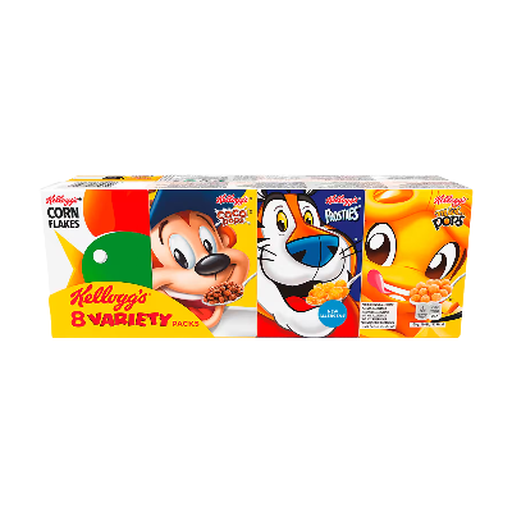
The individually wrapped cereals are a handy choice if you don’t want to measure out a portion in the morning.
The pack contains eight mini packs, with a total weight of 205 g. If you want to eat them with milk or yoghurt, you’ll need to bring that separately; if you have allergies, check the current labelling.
 No image available
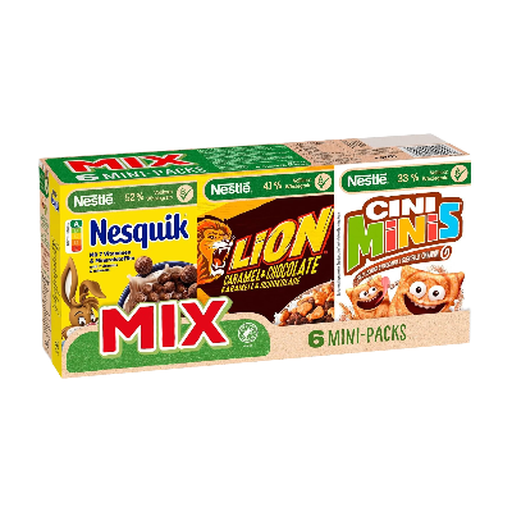
The mini packs are worth considering if you want to take dry cereal with you without portioning it yourself.
The total pack weight is 200 g. Check the pack for the weight of each mini pack, along with the ingredients and allergen information for the varieties inside.
No. An individually wrapped dry portion doesn’t automatically include milk, yoghurt or eating utensils. If you don’t want to eat the cereal dry, remember to plan how you’ll bring the extras with you.
Read the ingredients and allergen information on the pack you’re buying, and check every product in a variety pack. Under EU labelling rules, allergens must be highlighted in the ingredients list on pre-packed foods; Kellogg's Variety, for example, lists wheat and barley.
No, they describe different things: “no added sugar” refers to added sugar, while “low sugar” refers to the sugar content. So, compare the ingredients list and sugar information per 100 g for the specific variety, rather than treating the two claims as equivalent.
Check how many individually wrapped portions there are and, if possible, the weight of each one. The ingredients, allergen information and nutritional details can then help you assess the varieties in the pack and your planned portion.