Solo diners short on time
If you want to make a single serving at work or on the go, a pre-portioned cup saves you weighing everything out. You’ll still need the liquid specified on the pack and time for the porridge to stand.


If you want a single serving of porridge without weighing it out, a cup or sachet is a better choice than a bulk pack that you portion yourself. If organic certification matters to you, check the label on the specific variety. Ingredients and allergens should be checked regardless of the pack format. A larger organic pack can be a good option if you’re planning several meals and want to decide the portion size yourself.
If you want to make a single serving at work or on the go, a pre-portioned cup saves you weighing everything out. You’ll still need the liquid specified on the pack and time for the porridge to stand.
If you want to choose the portion size, liquid and any extra ingredients yourself, an organic base mix could be a good option. Check its specific organic certification and ingredients list; a bulk pack isn’t a ready-portioned meal.
If you’re comparing protein content or need to avoid certain ingredients, the details for each variety matter more than the word ‘porridge’ on the front. Pay particular attention to the ingredients, allergens and nutritional information per 100 g and per serving.
First decide whether you want a pre-measured portion or a pack for several meals. Then compare the organic certification and ingredients of the specific varieties.
A good choice if: You want to prepare a single serving without weighing it out. According to dm, Davert’s organic Apple and Cinnamon Oat Cup contains 65 g.
Worth bearing in mind: You still need to prepare a cup of porridge: for the Davert cup mentioned, dm recommends adding hot milk or a milk alternative and leaving it to stand for five minutes.
A good choice if: You want to take a pre-measured portion with you and put it into your own container. Kölln says its High Protein porridges come in portion sachets that can be prepared with water.
Worth bearing in mind: A portion sachet isn’t automatically organic and doesn’t come with a cup, so check both details for the variety you choose.
A good choice if: You make porridge regularly and want to choose the amount each time. Alnatura offers an organic oat and spelt porridge in a 500-g pack.
Worth bearing in mind: The pack contains several portions that you’ll need to measure out yourself. Alnatura’s recipe also contains spelt, almonds and hazelnuts.
| Criteria | What to check | Who it matters to |
|---|---|---|
| Portion and preparation | Serving size, amount of liquid needed and standing time; check whether it’s a cup or sachet. | I want to make just one meal without weighing out oats. For around 46% of consumers, having a convenient single serving is the priority. |
| Organic certification and ingredients | For pre-packed organic products from the EU, check for the EU organic logo, inspection body code and origin of the ingredients. Also read the ingredients list. | When shopping at a health food shop, I want to know whether this particular variety is organic and be able to put my own mix together. This is a priority for around 36% of consumers. |
| Protein and suitability | Compare protein per 100 g and per serving, as well as the ingredients and allergens. If you have coeliac disease, look for an explicit gluten-free label. | My choice depends either on the stated protein content or on avoiding certain ingredients. For around 18% of consumers, one of these specific dietary needs is the main reason for buying. |
You can use a 350- or 500-g pack on your own, but it isn’t pre-portioned for exactly one meal.
Check the net weight and whether the product is sold as an individual cup, portion sachet or mix that you portion yourself.
The brand, shelf placement and packaging colour don’t replace the certification on the specific product. For pre-packed organic food from the EU, the Federal Ministry of Agriculture, Food and Home Affairs specifies the EU organic logo, inspection body code and origin of the ingredients.
Check these details on the pack itself if you’re specifically looking to buy organic porridge.
Fruit, protein and base mixes can have different ingredients and nutritional values. A single highlighted figure doesn’t tell you everything about the recipe.
Read the ingredients list and nutritional information for the variety in question, and compare like with like – for example, per 100 g and per serving as prepared.
These labels answer different questions. The Federal Centre for Nutrition advises people with coeliac disease to choose oats with an explicit gluten-free label, indicating that their production has been appropriately controlled.
If you have specific dietary requirements, check the ingredients and allergen information for the product itself. Don’t rely on organic or vegan claims in place of a gluten-free label if you need one.
The organic oat and spelt porridge is a mix that you portion yourself, not a single serving.
Kölln offers High Protein porridge in portion sachets.
The Blueberry Protein Porridge comes in a 500-g pack for you to portion as you like.
Haferhimmel Berry Porridge is a 350-g mix that you portion yourself.
Brüggen lists porridge as part of its cereal range.
These products offer pre-measured amounts of porridge for individual meals. If you’re specifically looking for organic porridge, check the certification on the relevant pack before choosing.
 No image available
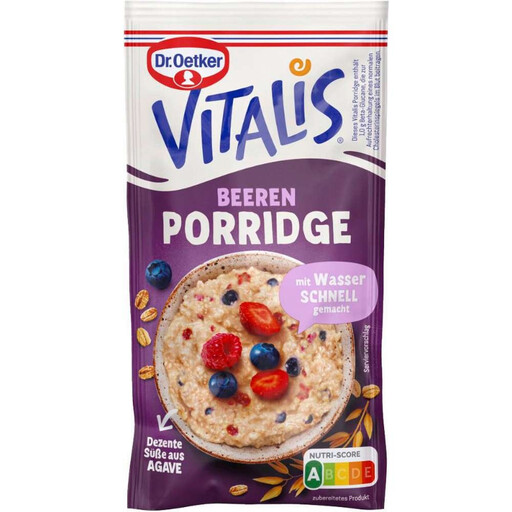
For a single pre-measured meal when you don’t want to portion it yourself.
The pack contains 53 g. Before buying, check the preparation instructions and, if you’re specifically looking for an organic product, check for the EU organic logo, inspection body code and origin of the ingredients.
 No image available
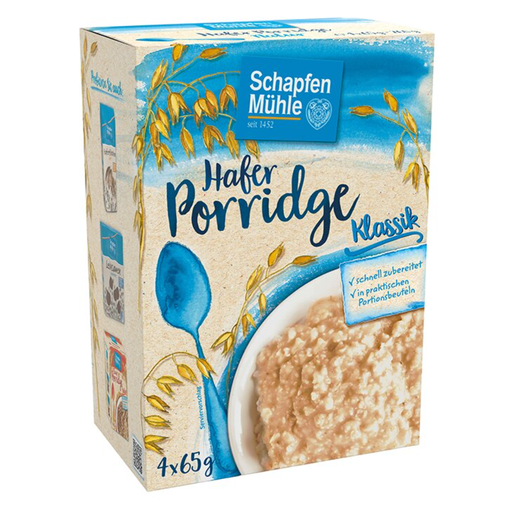
For several pre-measured meals when you don’t want to take a portion from a bulk pack each time.
The pack contains four 65-g portions. Check the water quantity and standing time, and, if you’re specifically looking for an organic product, check the label on the pack itself.
For pre-packed organic porridge from the EU, check the EU organic logo, inspection body code and origin of the ingredients on the specific pack. The Federal Ministry of Agriculture, Food and Home Affairs lists these as part of organic labelling; natural-looking packaging isn’t a substitute.
Not necessarily. According to dm, Davert’s Apple and Cinnamon Oat Porridge Cup needs to be made with hot milk or a milk alternative and left to stand for five minutes. Check the instructions for other cups and make sure you have the liquid you need.
No. The Federal Centre for Nutrition advises people with coeliac disease to use only oats explicitly labelled gluten-free because of their production process. Organic or vegan claims are not a substitute for this label.
No. Allergens that have been deliberately used and must be declared belong in the ingredients information; additional statements about possible traces refer to unintended cross-contamination. Lebensmittelklarheit notes that precautionary allergen statements are not uniformly regulated by law. So check both on the pack in question.