What to look for when buying
First, decide whether you’ll be able to mix anything up at your campsite. Then consider the container, ingredients and storage requirements for the portion you’re choosing.
Ready-to-eat jar
A good fit if: You want to eat without water or preparation; Nabio describes its Porridge Bowl Mango & Chia as ready to eat.
The trade-off: A glass jar is heavier and more prone to breaking than a lightweight sachet of dry porridge.
Cup to prepare
A good fit if: You want to eat from the portion cup and can provide the liquid specified on the pack.
The trade-off: According to the manufacturer, Davert Porridge-Cup needs 150 ml of boiling milk or a plant-based alternative, followed by five minutes to stand.
Single-serve sachet
A good fit if: You want to take a pre-portioned serving of dry porridge and eat it from your own cup.
The trade-off: The sachet doesn’t replace a bowl or spoon; according to the manufacturer, the Kölln product we checked can be made with cold or hot water.
| Consideration |
What to check when buying |
Who it matters to |
| Preparing it on site |
Does the pack explicitly say ‘ready to eat’? If not, what liquid and temperature does the preparation method require? |
Without a camping stove or reliable access to water, I want to be able to eat straight away. This may be the top priority for around 36% of consumers. |
| Portion and tableware |
Is an eating vessel included, or will you also need a cup and spoon? Is it individually portioned? |
At a cramped campsite, I don’t want to portion from an opened bulk pack, and I’d prefer to use as little tableware as possible. This may be the most important consideration for around 29% of consumers. |
| Ingredients and allergens |
Read the ingredients list and the allergen and ‘may contain’ warnings for the exact variety; compare nutritional values using the information per 100 g or per serving. |
If I need to avoid certain ingredients or pay close attention to what’s in my food, the right recipe matters more to me than the packaging format. Around 21% of consumers may want to check this first. |
| Supplies for several days |
Compare pack sizes and storage instructions, as well as how easy it will be to keep an opened pack clean and dry. |
For several days at a festival, I want to pack enough portions without an open mix getting damp. This may be the main concern for around 14% of consumers. |
Porridge cup on Joybuy
This single cup could work for festival camping if you’re looking for a portioned porridge mix. Check the preparation instructions before packing it: having its own container doesn’t make a cup ready to eat.
 No image available
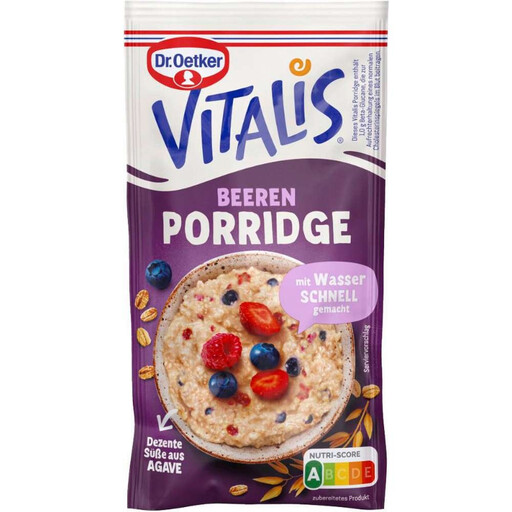
Dr. Oetker Vitalis Berries Porridge Oats, 53 g
A single-serve porridge mix in a cup, so you don’t have to portion it out from a bulk pack.
Pack information: 53 g. Before your camping trip, check what liquid you’ll need, how long it takes to prepare, and the ingredients and allergen warnings for the pack you’ve chosen.
View on Joybuy
Frequently asked questions
Can I eat a porridge cup at a festival without a camping stove?
Not every cup is suitable: according to the manufacturer, Davert Porridge-Cup needs 150 ml of boiling milk or a plant-based alternative, followed by five minutes to stand. If you can’t heat anything, look for a product explicitly labelled ready to eat, such as a suitably labelled bowl.
Can I use cold water for every single-serve porridge?
No. Kölln says the High Protein Porridge we checked can be mixed with hot or cold water, while Davert’s cup we checked needs boiling milk or a plant-based alternative. Always follow the instructions for the specific variety.
Is vegan porridge automatically free from grain allergens?
No. Davert describes its porridge cup as vegan, but it contains oats; Nabio Porridge Bowl Mango & Chia also contains oats and spelt. If needed, check the ingredients and allergen warnings on the specific pack.
How should I store porridge when festival camping?
Follow the product’s storage instructions: Davert says the dry cup we checked should be stored in a dry place, away from heat. If you’re bringing ingredients that need refrigeration, such as fresh milk, make sure you can keep them cold; for transport, the Verbraucherzentrale recommends using cool boxes or ice packs, among other options.


