
Lieferung heute & morgen

Qualitätsgarantie

Willkommens-Angebote freischalten: KOSTENLOSE Lieferung | Bis zu 80 % RABATT | Kostenlose 30-Tage-JoyPlus-Testphase
App herunterladen
A sinus inverter 12V to 230V converts direct current from a vehicle or leisure battery into alternating current for 230-volt appliances. This means you can run laptops, chargers, televisions, fans or smaller household devices while on the road. However, the wattage printed on the box isn’t the only thing that matters. The connection type, output waveform, battery capacity and safety features all determine whether a 12V 230V voltage converter is truly right for your everyday needs.
A 300W inverter can deliver 300 watts of continuous power, but a car’s cigarette lighter socket is often only rated for around 150 watts. The BESTEK 300W model explicitly points out that the vehicle socket may have this limitation. For higher loads, you’ll need a direct connection to the battery with appropriate fusing.
The same applies to a 2000W or 3000W inverter – the 12-volt side draws very high currents:
Efficiency losses, voltage drops and inrush currents can push the actual demand even higher. Thin cables or unsuitable fuses can become overloaded as a result.
Many products list continuous power and peak power separately. The DATOUBOSS model is described as having 3000 watts rated power and 6000 watts peak power. The peak power is only intended for brief start-up surges, such as those from motors or compressors. A device that draws high power continuously should not regularly push the inverter to its rated limit.
USB-A, USB-C or USB-C PD are handy charging options, but they are not the same as a 230-volt socket. For USB-C PD, the inverter, charging cable and device all need to support the required charging profile. Claims of “fast charging” should therefore be checked against the actual wattage.
A pure sine wave inverter produces a sinusoidal output voltage similar to the mains grid. This type is often a better choice for sensitive electronics, audio systems, power supplies, fan motors or certain chargers than an inverter with a modified sine wave. However, it doesn’t guarantee compatibility with every device.
Look for the following specifications:
The BESTEK 300W model specifies an output voltage of 230 V ±5 percent and a frequency of 50 Hz ±3 percent.
For smartphones, cameras, tablets and a laptop, a compact car inverter with 300 watts is often sufficient. Coffee machines, microwaves, heaters, hair dryers or power drills, on the other hand, typically require much more power and can generate high inrush currents. The product description for the BESTEK 300W model explicitly excludes devices such as coffee machines, microwaves, power drills, hair dryers and irons.
For a motorhome, boat or solar installation, 2000 or 3000 watts can make sense – provided the battery, cable cross-section, fuse and installation are all designed for it. The inverter’s power rating alone doesn’t tell you how long the battery can run a device. A rough calculation is:
Battery capacity in watt-hours × efficiency ÷ device power consumption = approximate run time
A suitable inverter with battery protection should include at least several of the following functions:
An inverter with LCD display can show input voltage, output voltage, frequency, load level or warning messages. This makes monitoring easier in a motorhome, on a boat or with a mobile solar setup. A fan will produce audible noise depending on load and temperature; automatic speed control can reduce noise at lower loads.
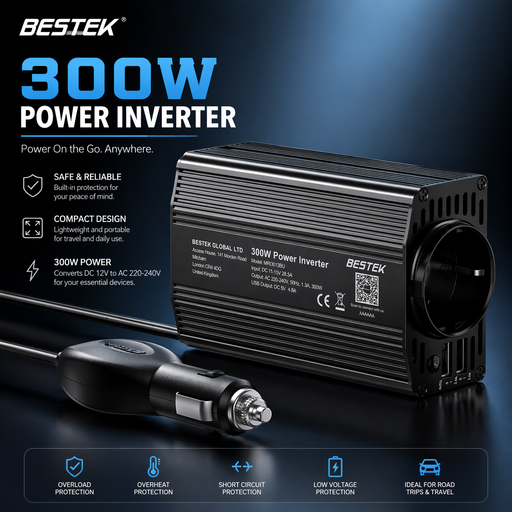
Why this product fits the profile: For occasional use in the car, camping or charging small electronics, the compact size, cigarette lighter plug and two USB ports are the key features.
The description mentions protection against over- and under-voltage, over-temperature, overload and short-circuit. However, the vehicle socket’s power limit must still be observed.
300 watts rated power, two USB ports and a built-in fan; weight stated as 451 grams.
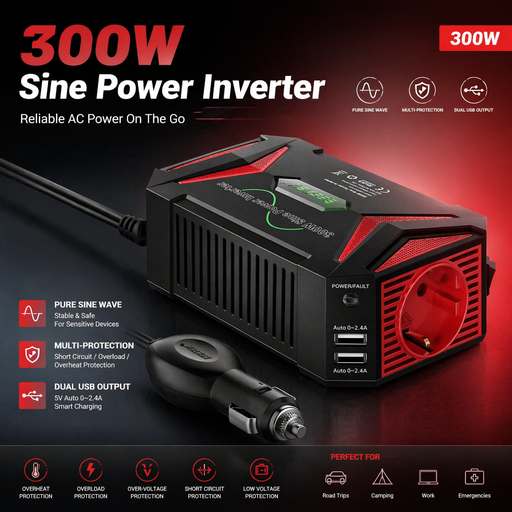
Why this product fits the profile: The pure sine wave is designed for powering laptops, televisions, hi-fi systems and other sensitive electronics.
The output specifications state 230 V ±5 percent, 50 Hz ±3 percent and a pure sine wave output. This reduces uncertainty compared to vague marketing claims about compatibility.
TÜV-certified model according to the product name, two USB ports and a 24-month after-sales warranty as per the description.
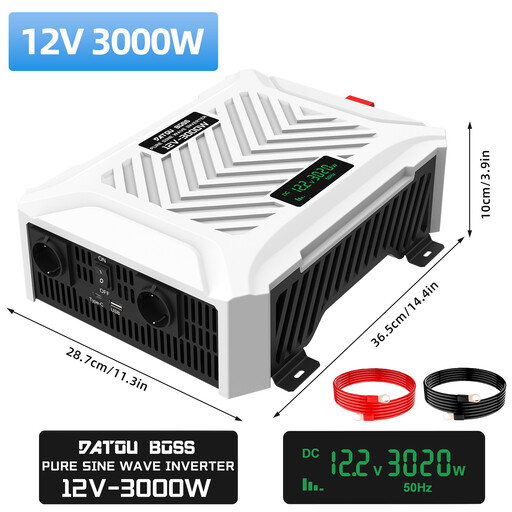
Why this product fits the profile: For motorhomes, boats, solar setups and applications with several high-power devices, the 3000-watt rated power is the key consideration.
Rated and peak power are listed separately. An LCD display, two fans and protection against overload, under-voltage, over-temperature, short-circuit and reverse polarity make monitoring easier.
3000 watts continuous power, 6000 watts peak power and a stated efficiency of over 92 percent.
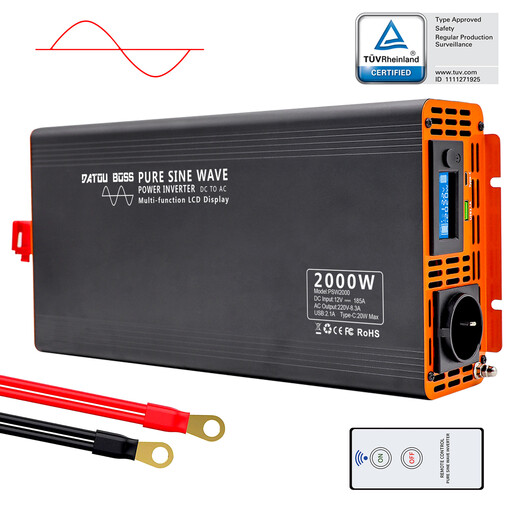
Why this product fits the profile: The combination of 2000 watts rated power, LCD display, remote control, USB-A and USB-C makes it ideal for mobile installations where regular monitoring is needed.
The display shows battery voltage, output voltage, frequency, power and protection alerts, according to the description. A cable connection to the battery is required for this power class.
2000 watts rated power, 4000 watts peak power, USB-C port and a stated efficiency of over 90 percent.
Before connecting anything, check the instruction manuals for both the inverter and the device you intend to power. A high-power camping inverter should not be left loose inside an enclosed storage space. It needs a dry, well-ventilated location away from flammable materials. On a boat, you’ll also need to consider moisture, salt air and proper mounting.
Connecting to a battery requires suitable cables, fuses and cable lugs. The polarity must be correct. Never connect an inverter to the mains grid via an unfused multi-socket adapter or a makeshift household installation. If you’re planning a fixed 230-volt installation in a motorhome or boat, you should follow the relevant technical regulations and involve a qualified electrician.
We’ve put together a full, regularly updated list of products that meet these strict selection criteria and the safety regulations in force across the EU.
Add up the power consumption of all the devices you want to run at the same time, and allow a margin for inrush currents. For chargers and smaller electronics, a 300W inverter may be enough. Heaters, coffee machines or power tools usually need much more power and a direct battery connection.
It depends on the battery capacity, state of charge, efficiency and load. A 12-volt battery with 60 Ah stores roughly 720 watt-hours in theory. With a starter battery, you shouldn’t use all of that – you need enough left to start the vehicle. For longer use, a dedicated leisure or lithium battery with suitable charging electronics is a better choice.
Not necessarily. Simple power supplies or some chargers may work with a modified waveform. However, for sensitive electronics, motors, audio systems and devices with demanding power supplies, a pure sine wave offers the technically more suitable output. Always follow the device manufacturer’s specifications.