
Lieferung heute & morgen

Qualitätsgarantie

Willkommens-Angebote freischalten: KOSTENLOSE Lieferung | Bis zu 80 % RABATT | Kostenlose 30-Tage-JoyPlus-Testphase
App herunterladen
Making the most of a small bathroom or powder room presents a common challenge. There's often not enough space for towels, toiletries, and other essentials. A narrow bathroom cabinet can be a functional solution, turning unused corners and niches into valuable storage space. This guide introduces various models and provides practical tips to help you choose the right bathroom storage.
Before making a decision, consider a few objective criteria to ensure the cabinet meets your needs.
The crucial factor for a narrow cabinet for niches is a perfect fit. Measure the available space—width, depth, and height—precisely. Remember to account for any baseboards or door frames that might limit the footprint. A niche cabinet for the bathroom is often only 20 to 40 cm wide, allowing it to utilise areas that would otherwise remain empty. Check the product dimensions carefully to find a suitable solution.
The bathroom is a high-moisture environment, making the choice of material critical. Many cabinets are made from MDF (Medium-Density Fibreboard) panels finished with a water-resistant lacquer or coating. These surfaces are not only more resistant to moisture but are also easy to clean. Look for terms like "lacquered MDF" or "water-resistant surface," as these indicate suitability for the bathroom environment.
Consider what you need to store. A bathroom side cabinet with drawers is ideal for keeping small items like cosmetics or hygiene products organised and out of sight. Open shelves, on the other hand, offer quick access to towels or decorative items. A slim bathroom dresser often combines both, providing flexible storage options. The choice depends on your personal organisational preferences.
Here is a look at three models that are well-suited as a bathroom cabinet for small bathrooms due to their compact dimensions and functionality.
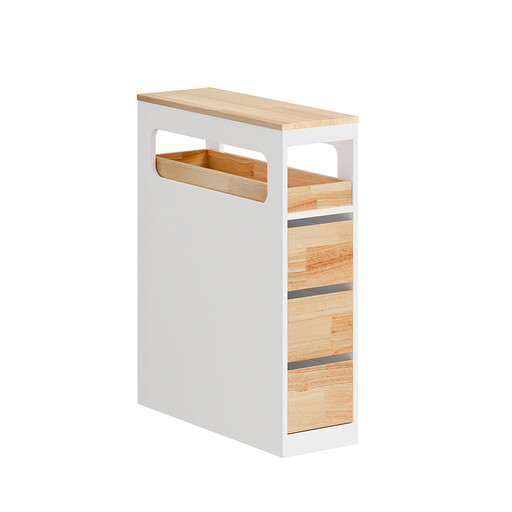
What sets this model apart At just 23 cm wide, this cabinet is exceptionally narrow and highly flexible, thanks to its four castors (two of which have brakes). It can be moved easily, which simplifies cleaning the floor underneath or rearranging the room.
Advantages:
Who is it for? This model is an excellent choice for those seeking an extremely flexible and mobile storage solution for very narrow gaps, who want the ability to simply roll the cabinet aside when needed.
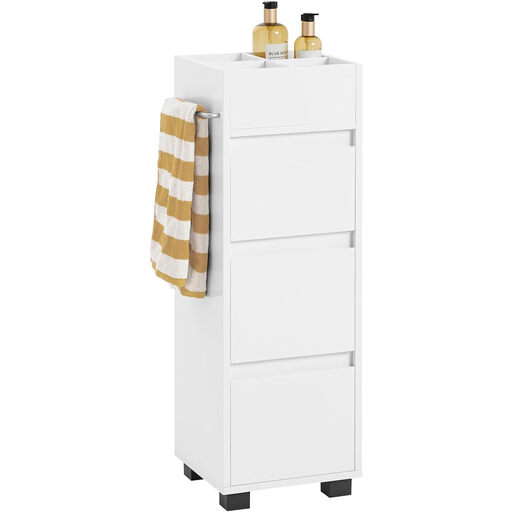
What sets this model apart The SoBuy BZR29-W combines different storage types within a small footprint of just 30 x 30 cm. The mix of three drawers and four open shelves makes it a versatile organisational system. A special feature is the side-mountable towel rail.
Advantages:
Who is it for? Ideal for users looking for an all-in-one solution for a corner or small niche, who need both closed and open storage as well as a place to hang towels.
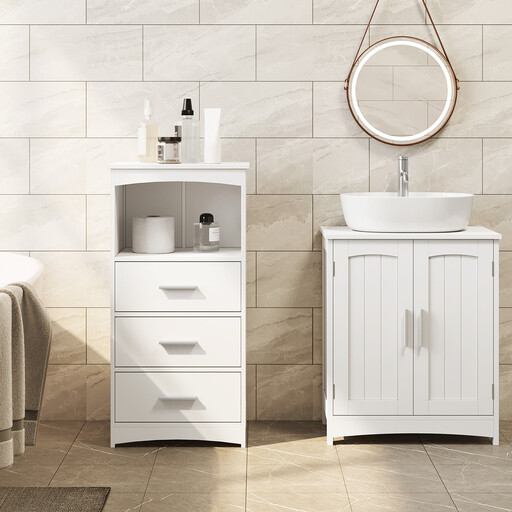
What sets this model apart With a width of 40 cm, this bathroom dresser offers slightly more drawer space than ultra-narrow models, while remaining compact with a depth of 26.5 cm. The construction from E1-grade MDF panels is finished with a water-resistant coating. An anti-tip device for wall mounting provides additional stability.
Advantages:
Who is it for? This model is a great fit for individuals who primarily need closed storage in drawers and have a niche of at least 40 cm wide. Its shallow depth also makes it suitable for narrow walkways.
If the models presented don't exactly match your vision or you prefer a different configuration, other alternatives are available. Furniture pieces with a uniform appearance are a popular option.
Discover a selection of other models in the White Three-Drawer Storage Unit category to find the perfect solution for your home.
Look for materials designed for humid environments. MDF or engineered wood panels with a complete, seamless lacquer finish or a melamine resin coating offer good protection against penetrating moisture. Additionally, regularly ventilating the bathroom after showering or bathing helps reduce humidity and extend the lifespan of the furniture.
While standard bathroom cabinets often have a depth of 35 cm or more, slim models are specifically designed for limited spaces. Their depth is frequently between 20 and 30 cm. This allows them to be placed in narrow passages or behind doors without obstructing the path.
For taller and simultaneously narrow cabinets, wall mounting is recommended to increase stability and prevent potential tipping. For this reason, many manufacturers include an anti-tip device that allows for secure anchoring to the wall. This is especially important in households with children.