
Lieferung heute & morgen

Qualitätsgarantie

Willkommens-Angebote freischalten: KOSTENLOSE Lieferung | Bis zu 80 % RABATT | Kostenlose 30-Tage-JoyPlus-Testphase
App herunterladen
By Joybuy Product Recommendation Officer, August 29, 2026
A narrow hallway presents a challenge for many households: where to put shoes without blocking the walkway and creating a cluttered look? A suitable shoe cabinet designed specifically for narrow hallways seems to be the solution. However, the market is full of models whose promises often don't hold up in practice. Before you make a decision, it's important to know the typical pitfalls that can lead to a bad purchase.
This guide will help you identify the crucial features and find a functional and durable solution for your entryway shoe storage.
Many products look appealing at first glance but reveal their weaknesses only in daily use. Pay special attention to these three points to avoid disappointment:
To make an informed decision, you should focus on objective criteria. These three parameters are crucial for the functionality of a slim shoe cabinet.
For a hallway shoe cabinet to be considered slim, a depth of under 30 cm is a good benchmark. Models with a depth of 24 cm or less are ideal for keeping the walkway clear. There are two basic designs here:
tip-out cabinet is often only 17 to 25 cm deep, making it the top choice for very narrow corridors.modern shoe cabinet with classic doors requires a bit more depth (usually from 28 cm) and additional space to open the doors. In return, they often offer a more robust look and a flat top surface for storage or display.The stability of a piece of furniture depends directly on its material and construction. Look for solid workmanship from MDF or high-quality particleboard. A crucial safety feature is the included anti-tip kit, which secures the cabinet to the wall. This prevents it from tipping over and ensures a firm stand, even when all compartments are fully loaded. A hallway wardrobe that also integrates shoe compartments should always be anchored to the wall as well.
Instead of relying on the advertised number of shoe pairs, check the internal dimensions of the compartments and the adjustability of the shelves. A shoe rack with doors that offers height-adjustable or removable shelves is far more practical. This allows you to adapt the interior to your individual shoe collection—from flat sandals to ankle-high boots. A small shoe cabinet can thus offer a surprising amount of storage space if it is intelligently designed.
Here are some models that are suitable for different needs and living situations, based on objective criteria.
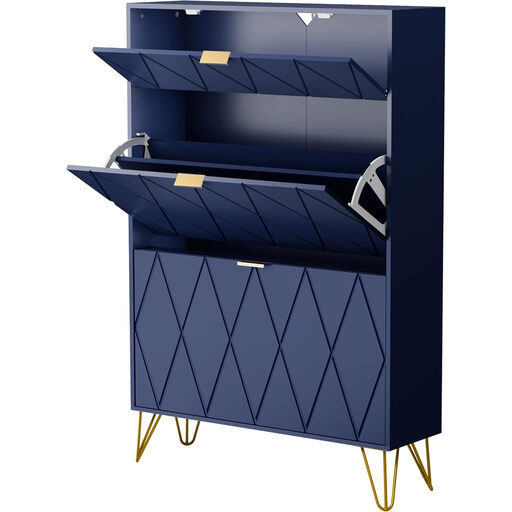
Why This Fits Their Persona: Ideal for residents of city apartments with very narrow entryways where every centimetre counts. The slim, tip-out design makes optimal use of height without protruding into the room.
With a depth of just 24 cm, this model solves the problem of bulky furniture in the hallway. The tip-out compartments are specifically designed for space-saving vertical storage.
Maximum space efficiency thanks to its tip-out design. An additional drawer provides space for keys and small items. Includes an anti-tip kit for stability.
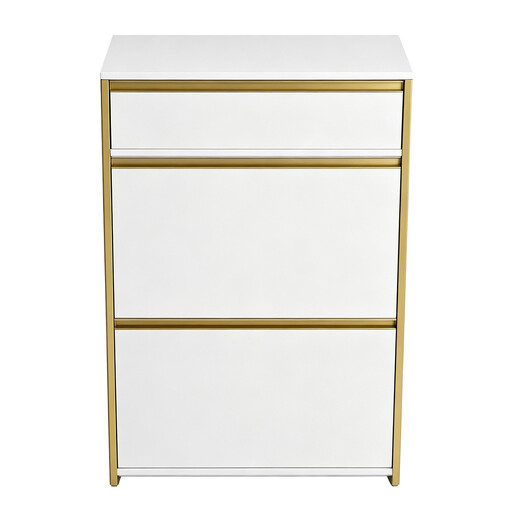
Why This Fits Their Persona: For those seeking a solution that is not only functional but also aesthetically pleasing. The modern `white shoe cabinet` with gold accents blends seamlessly into a stylish living environment and doesn't look like a purely utilitarian piece of furniture.
This model tackles the problem of impractical layouts with height-adjustable and removable shelves. This allows the interior space to be flexibly adapted to different types of shoes.
Combines a slim 24 cm depth with a flexible interior layout. The included anti-tip kit ensures necessary stability. The drawer offers additional storage.
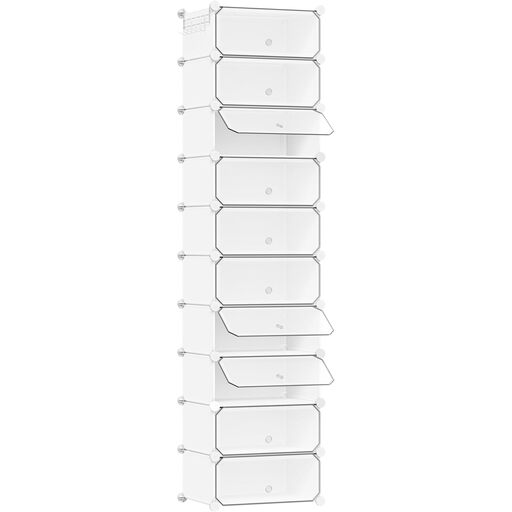
Why This Fits Their Persona: Perfect for individuals whose storage needs change or who are looking for a solution for niches, sloped ceilings, or the space under the stairs. The system can be reconfigured and rebuilt as needed.
This system completely bypasses the problem of rigid compartments and unrealistic capacity claims. You can determine the size of the compartments yourself by leaving out dividers to create space for boots or storage boxes.
Fully modular design for maximum adaptability to your space and storage needs. The PP plastic panels are waterproof and easy to clean.
We have compiled a complete, real-time list of products that fully satisfy these strict selection criteria and UK safety regulations.
1. How deep should a shoe cabinet be for a narrow hallway? For most narrow hallways, a maximum depth of 30 cm is recommended. Models like tip-out shoe cabinets with a depth of 24 cm or less are optimal, as they barely protrude into the walkway and do not restrict movement.
2. What is the difference between a tip-out cabinet and a shoe chest? A tip-out cabinet stores shoes in tilting compartments, usually at an angle or vertically. This allows for a very slim profile. A shoe chest has classic doors and shelves where shoes lie flat. It is typically deeper but often offers a more robust appearance and a continuous top surface.
3. How many shoes really fit in a shoe cabinet? The actual capacity heavily depends on shoe size and type. As a rule of thumb: plan for more space for men's shoes (size 8+ UK) and boots than the manufacturer states. Models with adjustable shelves offer the best way to adapt the available space to your personal shoe collection and realistically maximise capacity.