
Lieferung heute & morgen

Qualitätsgarantie

Willkommens-Angebote freischalten: KOSTENLOSE Lieferung | Bis zu 80 % RABATT | Kostenlose 30-Tage-JoyPlus-Testphase
App herunterladen
A narrow hallway presents a common challenge for many households: where to store shoes without blocking the walkway or creating clutter? A slim shoe cabinet, specifically designed for this purpose, is often the solution. However, not every model lives up to its promises. Many buyers find themselves dealing with wobbly construction, impractical compartments, or misleading capacity claims. This guide will help you avoid the typical pitfalls and find a functional, durable solution for your entryway.
Before you make a decision, you should be aware of the most common problems that arise with low-quality models. These issues often render the furniture useless after a short time or make daily life more difficult.
To make an informed choice, focus on objective, measurable criteria. These three parameters are crucial for the functionality and longevity of a slim shoe cabinet.
A slim shoe cabinet should have a depth of under 30 cm. For particularly tight spaces, models with a depth of less than 25 cm are ideal. Measure your hallway carefully, and don't forget to account for the swing radius of the flaps. A tip-out cabinet has an advantage here over a hallway shoe chest with hinged doors, as the flaps only tilt forward a few centimetres, barely obstructing the walkway.
Look for furniture made from MDF (E1) boards. This material is denser and more stable than conventional particle board, ensuring greater durability. Another essential feature is the included anti-tip kit. This wall-mounting device is required by law and prevents the cabinet from tipping forward under load or when the compartments are opened.
A well-designed interior is the key to maximum efficiency. Models with adjustable or removable dividers offer the necessary flexibility to accommodate everything from flat sandals to high-top boots or hiking shoes. This allows you to make optimal use of the available storage space and adapt the compartments to your individual shoe collection.
Instead of making a one-size-fits-all recommendation, we have identified models that meet specific requirements and avoid the pitfalls mentioned above.
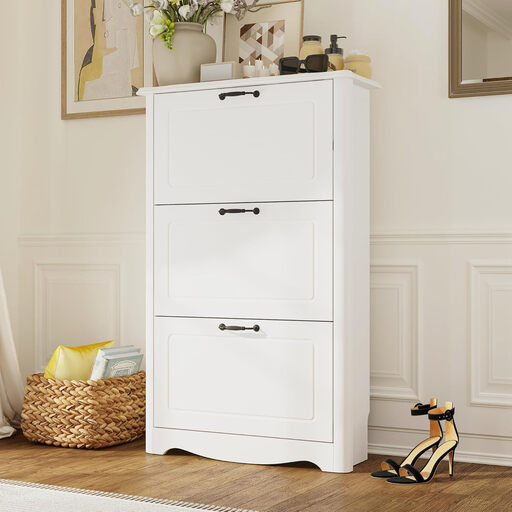
Why This Fits Their Persona: This model offers solid core functionality for anyone seeking a straightforward and efficient solution. Its classic design as a white tip-out cabinet blends discreetly into most entryways.
The shelves are adjustable and removable. This solves the problem of rigid compartments and allows for storing larger shoes or boots.
A good balance of capacity and compact dimensions (26.5 cm depth). The construction from high-density MDF board provides the necessary stability.
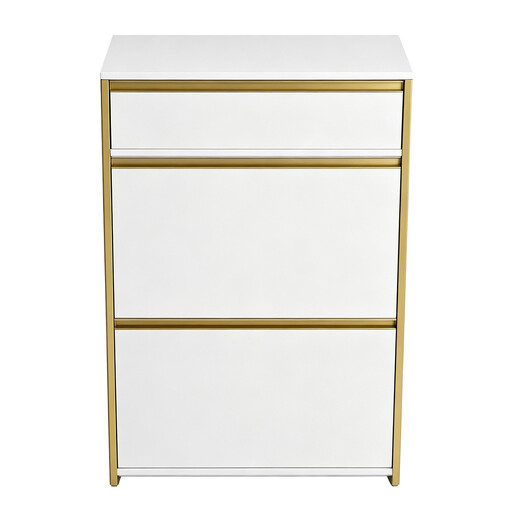
Why This Fits Their Persona: Ideal for modern apartments where every centimetre counts and design plays a key role. The combination of white and gold accents creates an elegant look without being overpowering.
With a depth of only 24 cm, this model is extremely space-efficient and solves the problem of bulky furniture in tight passages. The included anti-tip kit ensures the necessary stability.
A combination of very shallow depth, modern design, and an additional drawer for keys or accessories. The interior compartments are also adjustable.
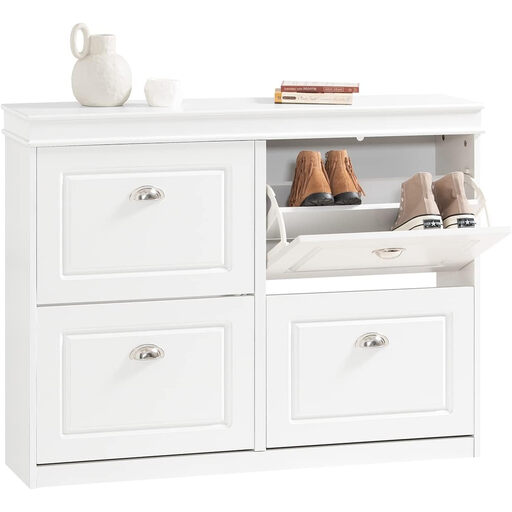
Why This Fits Their Persona: When many shoes need to be stored in a small space, maximum capacity at a minimal depth is essential. This four-flap model is designed to organise an entire family's footwear in the hallway.
This model avoids the trap of misleading capacity claims by offering genuinely high storage through its 105 cm width and four separate flaps, all while remaining extremely slim with a 24 cm depth.
High storage capacity at a minimal depth. The robust construction from MDF (E1) and the mandatory anti-tip kit ensure the necessary stability even when fully loaded.
We have compiled a complete, up-to-date list of products that fully meet these strict selection criteria and German safety regulations.
1. How deep is a typical slim shoe cabinet? A shoe cabinet is considered slim if its depth is under 30 cm. Particularly space-saving models for very narrow hallways have a depth of 24 cm or less. Be sure to measure the available space on your intended wall before purchasing.
2. Can boots or large shoes also fit in a tip-out shoe cabinet? That depends on the specific model. Standard tip-out cabinets are often designed only for low-profile shoes up to a certain size. Look for product descriptions that explicitly mention adjustable or removable shelves. This feature allows you to flexibly adapt the interior and accommodate taller footwear like ankle boots or large sneakers.
3. Is wall mounting mandatory for a tip-out shoe cabinet? Yes, securing the cabinet to the wall using the provided anti-tip kit is strongly recommended for safety reasons and is essential for a stable footing with many products. Due to their shallow depth and high centre of gravity, tip-out cabinets are prone to tipping, especially when the upper compartments are opened. Wall mounting provides stability and protects against accidents.