
Lieferung heute & morgen

Qualitätsgarantie

Willkommens-Angebote freischalten: KOSTENLOSE Lieferung | Bis zu 80 % RABATT | Kostenlose 30-Tage-JoyPlus-Testphase
App herunterladen
A narrow hallway doesn't have to be an obstacle to staying organised. The right piece of furniture can transform an entrance from a disorganised shoe-chaos into a tidy and welcoming space. A slim shoe cabinet is the ideal solution for this. However, the selection is vast, and not every model lives up to its promise. As your Joybuy Product Recommendation Officer, I'll help you avoid common purchasing pitfalls and make an informed decision.
Many buyers focus solely on price or design, overlooking crucial functional flaws. These three points often lead to disappointment:
To avoid buyer's remorse, you should check three core aspects before making a decision. These define whether a space-saving shoe cabinet will truly be functional in everyday life.
For a true shoe cabinet for a narrow hallway, a depth of no more than 25 cm is the key benchmark. Such models barely protrude into the room, maintaining an open, clear passage. To provide enough space for shoes at this shallow depth, a tilt-out cabinet design is often the most effective solution. Here, the shoes are stored at an angle, which drastically reduces the required depth.
The longevity of a slim shoe chest heavily depends on the material.
A closed shoe rack protects shoes from dust and ensures a tidy appearance in the entryway. However, pay attention to the details of entryway shoe storage. The shoe capacity stated by manufacturers often refers to small women's shoes. For shoe sizes above EU 43 (UK 9, US 10), the actual capacity can decrease by up to 30%. Also, check if the design allows for indirect ventilation—for example, through small gaps in the back panel or special openings—to ensure air circulation.
Here are three models tailored to different needs and living situations that cleverly avoid the pitfalls mentioned.
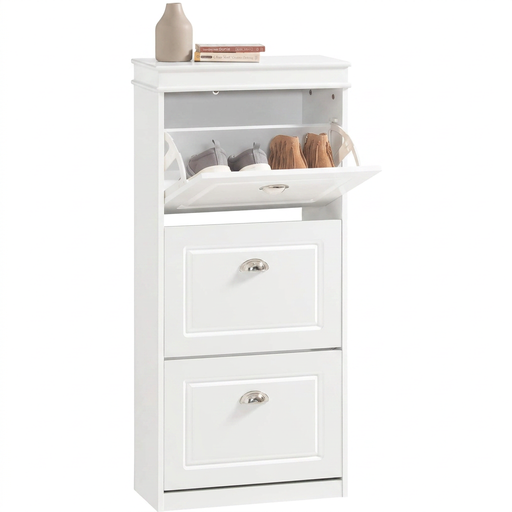
Why this model works: This is the quintessential solution for narrow hallways. As a classic white tilt-out cabinet, its minimalist design fits into almost any entryway and specifically solves the space problem.
With a depth of just 24 cm, this model directly addresses the pitfall of misleading depth specifications. The MDF construction and the included anti-tip kit ensure the necessary stability.
Maximum space-saving thanks to its extremely shallow depth. The closed design ensures a consistently tidy look in the hallway.
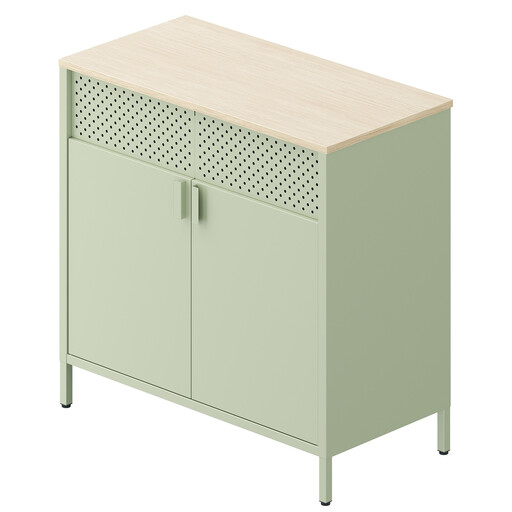
Why this model works: Ideal for anyone needing to store not just flat shoes but also boots, hiking shoes, or accessories like shoe polish. The steel construction is extremely durable, and the adjustable shelf offers maximum flexibility.
The perforated panel design of the door ensures good ventilation and prevents odour build-up. The robust steel construction and classic hinges are more durable than simple tilt-out mechanisms.
High durability and flexibly adaptable storage space. Also suitable for items that won't fit in a standard tilt-out shoe cabinet.
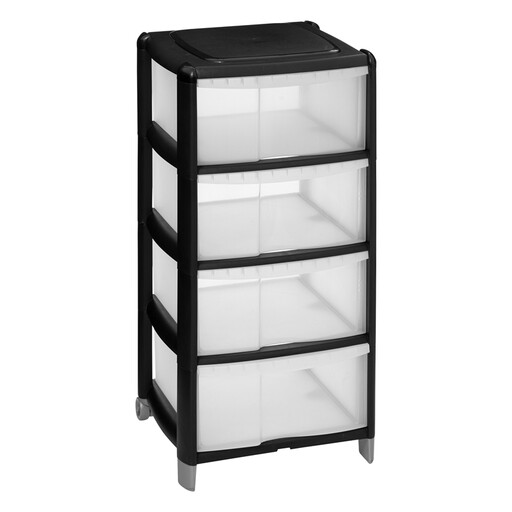
Why this model works: A highly affordable and flexible solution for students, first apartments, or as additional storage in the basement or utility room. The castors provide excellent mobility.
This model forgoes complex tilt-out mechanisms. The simple drawer system is not prone to mechanical failure and offers simple yet functional storage.
Very low purchase price, high mobility due to castors, and versatile use for other items like scarves, hats, or office supplies.
We have compiled a complete, up-to-date list of products that meet these strict selection criteria and relevant quality standards.
The capacity stated by manufacturers usually refers to narrow shoes in size EU 38 (UK 5). For larger shoe sizes (from EU 43 / UK 9) or wider models like trainers, the actual capacity often decreases by 30-50%. Ankle-high shoes or boots generally do not fit in a standard tilt-out cabinet. It is advisable to check the internal dimensions of the compartments.
In most cases, unfortunately not. The diagonal depth of the tilt-out compartment is the limiting factor. For very large shoes, a slim shoe chest with classic, straight shelves is often the better choice, even if it requires a bit more depth. Measure your longest pair of shoes before buying to be sure.
Yes, absolutely. Due to their design (tall and narrow), these cabinets have a high centre of gravity and can tip over easily. This poses a significant safety risk, especially in households with children. High-quality models always come with an appropriate anti-tip kit for wall mounting. Installation is essential for safe use.