
Lieferung heute & morgen

Qualitätsgarantie

Willkommens-Angebote freischalten: KOSTENLOSE Lieferung | Bis zu 80 % RABATT | Kostenlose 30-Tage-JoyPlus-Testphase
App herunterladen
A narrow hallway and scattered shoes are a common challenge in many homes. A slim shoe cabinet seems like the ideal solution for creating order. However, the selection process is fraught with pitfalls that can quickly turn a practical purchase into a regrettable one. Certain design flaws or misleading specifications can render the furniture useless after a short time or cause it to fall short of expectations from the very beginning.
This guide will show you the critical features to look for, helping you make an informed decision and find a model that will keep your entryway organised for the long term.
Before you decide on a model, you should be aware of the typical weaknesses that often only become apparent after the purchase.
To avoid making a bad purchase, focus on the following three core parameters. These will determine the functionality and durability of your new space-saving shoe storage.
The external depth is the key feature of a slim shoe cabinet for a narrow hallway. Models with a depth of under 25 cm are particularly space-saving. However, don't just look at the external dimensions; also check the usable internal depth and height of the compartments.
The material is crucial for the cabinet's stability and longevity.
The design determines how you use the cabinet in your daily life.
Here are some recommendations tailored to different needs and living situations.
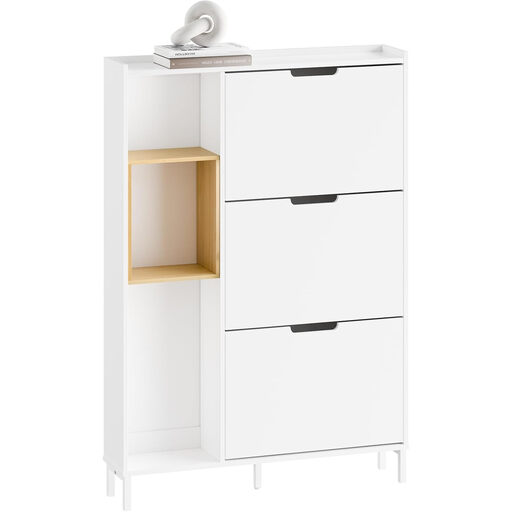
Why this model fits: Ideal for those who need to utilise every centimetre in an extremely narrow entryway. The design combines enclosed storage with open shelves for decor or everyday items.
The material combination of MDF (E1) and carbonised bamboo is more resistant to moisture than simple particleboard. The open frame construction on the side contributes to its stability.
With a depth of just 19 cm, it is extremely space-saving. The combination of a tip-out cabinet and a side shelf offers versatile usage options.
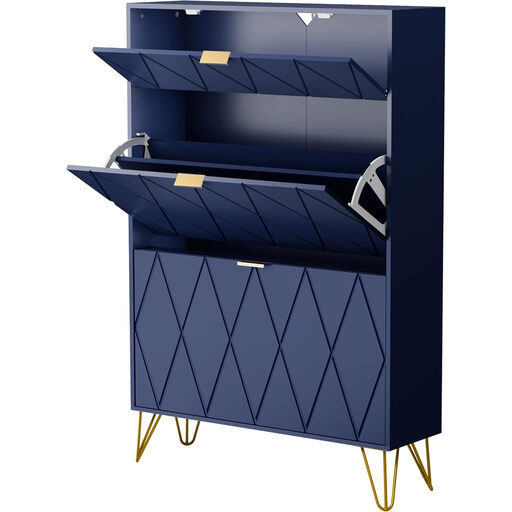
Why this model fits: For anyone looking for a functional piece of furniture that is also a visual statement. The combination of blue and gold accents adds a modern, stylish touch to the hallway.
This model is explicitly equipped with an anti-tip device, which counteracts the problem of instability. The construction from high-quality MDF boards provides a solid base.
The eye-catching design makes the cabinet a decorative element. The combination of two tip-out compartments and an additional drawer offers versatile storage space.
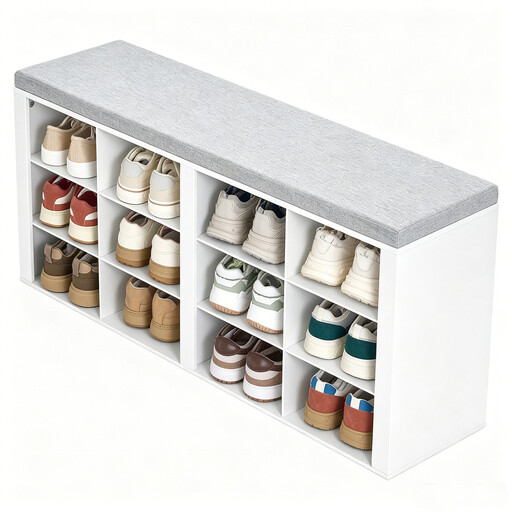
Why this model fits: Perfect for those who need not only storage in their entryway but also a comfortable seat for putting on shoes. It is a classic shoe cabinet with bench solution.
The height-adjustable shelves solve the problem of insufficient storage. This allows compartments to be flexibly adapted for boots or taller shoes, which is not possible with rigid tip-out compartments.
The combination of a shoe rack and a padded bench is highly functional. The stated load capacity of the seat of 150 kg is a verifiable measure of stability.
We have compiled a complete, up-to-date list of products that fully meet these strict selection criteria and safety regulations.
For very narrow hallways, models with a depth of under 25 cm are ideal. Tip-out cabinets, at 17 to 24 cm, are often the slimmest options. However, it is advisable to check before buying whether the internal dimensions of the tip-out compartments are sufficient for your shoe size.
The capacity stated by the manufacturer is a guideline, usually based on women's shoes in size 38-40 EU. For larger shoe sizes (from 44 EU), boots, or wide sports shoes, you should expect 20-30% fewer pairs to fit. Models with adjustable or removable shelves offer the most flexibility here.
Wall mounting is highly recommended. Due to their shallow depth and potentially high centre of gravity, slim cabinets are prone to tipping. Most models come with an anti-tip device. For safety reasons, this should always be used, especially in households with children or pets.