
Lieferung heute & morgen

Qualitätsgarantie

Willkommens-Angebote freischalten: KOSTENLOSE Lieferung | Bis zu 80 % RABATT | Kostenlose 30-Tage-JoyPlus-Testphase
App herunterladen
A narrow hallway presents a common challenge for many households: where to store shoes without cluttering the entrance or creating a tripping hazard? A slim shoe cabinet seems like the ideal solution. However, the selection process has its pitfalls, which can quickly turn a supposed organisational aid into a source of frustration. As your Joybuy Product Recommendation Officer, I'll help you identify the typical traps and make an informed decision.
Many buyers focus solely on a shallow depth, overlooking crucial quality features. This often leads to three prevalent issues:
To avoid these problems, you should check three technical parameters before deciding on new hallway shoe storage.
Measure the available space precisely. A good slim shoe cabinet has a depth of under 25 cm, with some models even under 20 cm. However, don't just focus on depth; consider stability as well. An essential feature is an anti-tip device. This is a bracket used to anchor the furniture to the wall to prevent it from tipping over. Check the product description to see if this hardware is included.
The stated number of shoe pairs is just a guideline. The internal dimensions of the flap compartments or shelves are what truly matter. Look for details on the maximum shoe size or the internal depth of the compartments in the product specifications. If you primarily want to store larger shoes, boots, or high heels, an open hallway shoe rack or a model with adjustable shelves might be the more practical alternative.
For longevity in the entrance area, the material is crucial. Furniture made from MDF boards (E1 standard) is generally denser and more stable than simple particleboard. Even more important is the surface finish. A lacquer or melamine resin coating protects the wood from moisture and makes the white shoe cabinet or one in another colour more resistant to scratches and easy to clean.
Based on these criteria, we have identified several models that offer a well-thought-out solution for different needs and living situations.
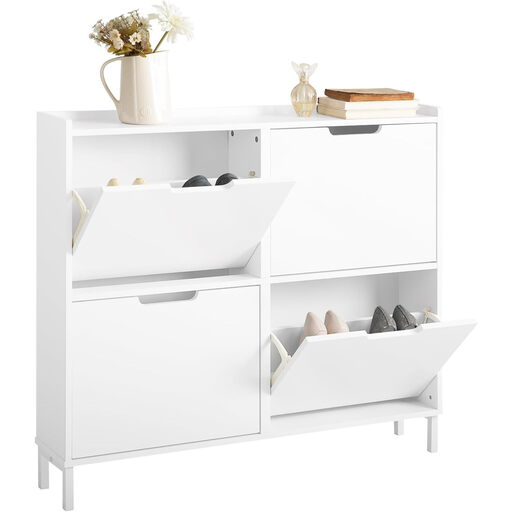
Why This Fits Their Persona: At 100 cm wide, this model offers ample storage for the whole family's shoes, yet its minimal 19 cm depth takes up very little space in the walkway. It's ideal for bringing order to a busy hallway.
The E1-grade MDF construction and the included anti-tip device directly address the problem of instability. The four separate flaps allow for organised storage.
Extremely shallow depth of 19 cm combined with high capacity. The top surface provides additional space for keys or decorations.
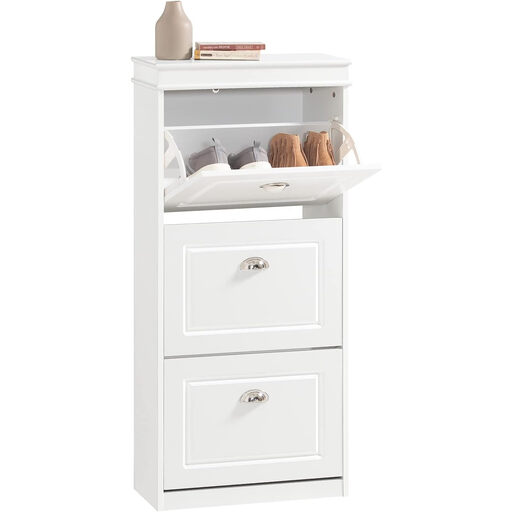
Why This Fits Their Persona: This tall and narrow model (53 cm wide) makes optimal use of vertical space. It fits perfectly into small niches next to the front door or in the narrow corridors of one- to two-person households.
Made from FSC-certified MDF (E1), it bypasses the problem of low-quality materials. The depth of 24 cm offers a good compromise between space-saving design and internal volume.
Efficient use of vertical space. The lacquered surface is easy to maintain, and the included anti-tip device ensures necessary stability.
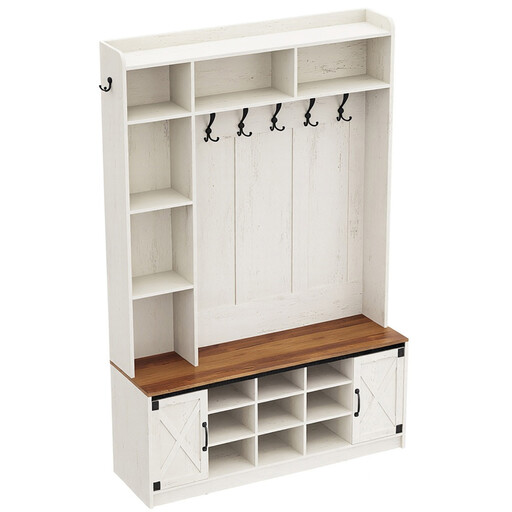
Why This Fits Their Persona: For anyone looking to organise not just shoes, but also jackets, bags, and scarves. This hall tree combines multiple functions to create a complete, organised dressing zone in the entrance area.
The open shoe shelves completely bypass the problem of ill-fitting flaps. Boots or larger shoes fit here without issue. The stable overall construction replaces multiple individual pieces of furniture.
Multifunctional 6-in-1 design: coat rack, shoe shelf, bench, and storage all in one. According to the manufacturer, the bench has a load capacity of up to 150 kg.
We have compiled a complete, up-to-date list of products that fully meet these strict selection criteria and UK safety regulations.
This heavily depends on the specific model. Many standard shoe cabinets become tight for shoe sizes above 9.5 UK / 10.5 US. It is advisable to check the internal dimensions of the compartments in the product description. Some manufacturers specify a maximum shoe size. As an alternative for very large shoes or boots, open shoe racks or shoe cabinets with adjustable shelves instead of flaps are suitable.
Most high-quality, slim shoe cabinets come with an anti-tip device. This is usually a small bracket or a strap that is screwed to the top of the cabinet and to the wall. Installation is straightforward and described in the instructions. This step is essential for the stability and safety of the furniture and should not be skipped.
For the hallway, where furniture is often exposed to moisture and heavy use, a robust material is important. MDF (Medium-Density Fibreboard) boards of the E1 standard are a good choice as they are dimensionally stable and durable. A sealed surface, for example, through lacquer or a melamine resin coating, is crucial. It protects the wood from moisture from wet shoes and makes cleaning easier.