
Lieferung heute & morgen

Qualitätsgarantie

Willkommens-Angebote freischalten: KOSTENLOSE Lieferung | Bis zu 80 % RABATT | Kostenlose 30-Tage-JoyPlus-Testphase
App herunterladen
A narrow hallway or a small entryway presents a challenge for many households: where to put shoes without creating tripping hazards or making the space feel cluttered? A slim shoe cabinet, by design, can offer a functional and aesthetically pleasing solution. It makes optimal use of the available space and ensures a tidy appearance.
This article introduces various models for space-saving shoe storage and provides objective criteria to help you with your selection. The goal is to give you a solid basis for making an informed decision so you can find the right solution for your hallway.
Before you decide on a model, several functional aspects should be considered. These will help narrow down the selection to products that truly fit your needs and spatial constraints.
In a narrow hallway, the depth of the furniture is crucial. Measure the available space accurately and ensure that doors can still open easily and the passageway remains clear. A slim shoe cabinet typically has a depth of less than 30 cm. So-called tip-out shoe cabinets for the hallway are particularly space-saving, often with a depth of only 17 to 25 cm. These models utilize the height of the room to accommodate many shoes.
Consider how many pairs of shoes you want to store. A tall shoe cabinet offers a lot of vertical storage on a small footprint. The design affects both the look and the functionality:
Especially in small entryways, multifunctional furniture is practical. A hall tree with shoe storage, for example, combines hooks for jackets and shelves for shoes in a single piece of furniture. Some models also offer a top shelf for keys, mail, or decorations, thus functioning as practical small entryway furniture.
Here is a selection of different models that are suitable for narrow spaces due to their design and functionality.
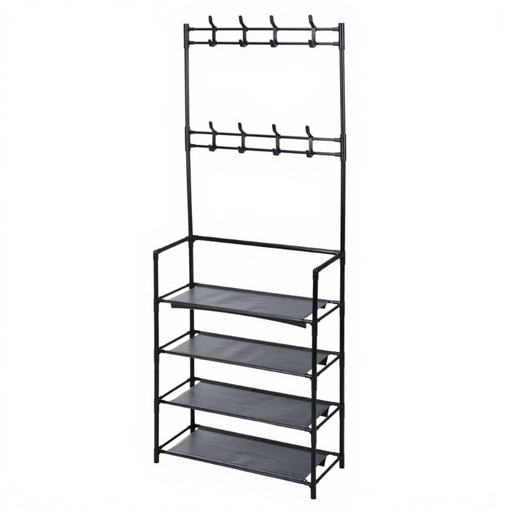
Why it stands out: This model is a combination of a coat rack and a shoe rack. With a depth of only 20 cm, it is extremely slim yet offers space for jackets, bags, and shoes.
Advantages:
Who is it for? Ideal for those looking for an all-in-one solution for a small entryway who want to store both jackets and shoes in one place.
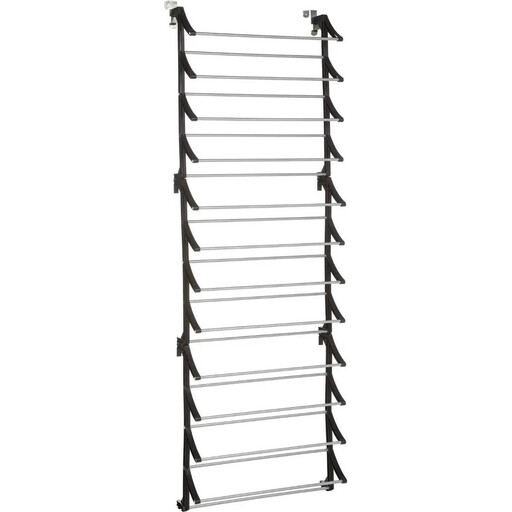
Why it stands out: This shoe rack utilizes an often-overlooked space: the door. It is simply hung over the door and requires no floor space, making it an extremely space-saving shoe storage solution.
Advantages:
Who is it for? Perfect for renters or people with very limited space who want to store a large shoe collection invisibly behind a door (e.g., in a storage room or bedroom).
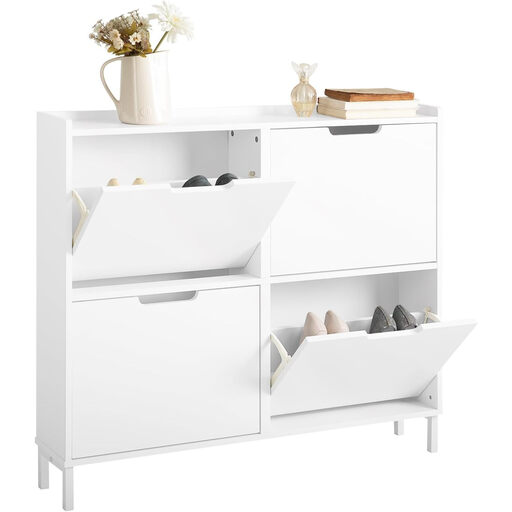
Why it stands out: As a classic tip-out shoe cabinet for the hallway, this model impresses with its extremely shallow depth of only 19 cm and its closed, modern design.
Advantages:
Who is it for? For anyone who values a clean and minimalist aesthetic in their hallway and wants to store their shoes dust-free and out of sight.
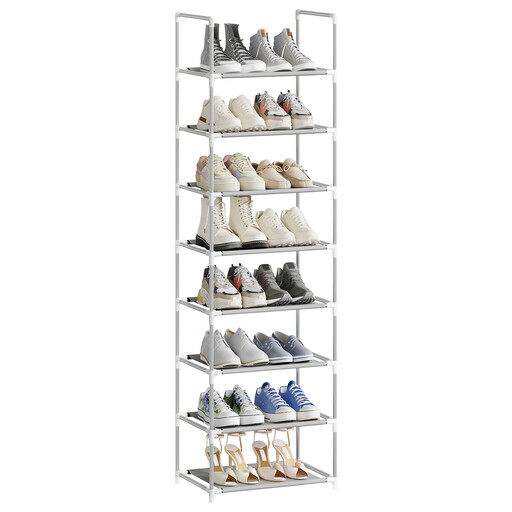
Why it stands out: This tall and narrow rack efficiently utilizes room height. Its modular design allows for flexible adaptation to different shoe types, including boots.
Advantages:
Who is it for? For budget-conscious buyers looking for a flexible and open storage solution for various shoe types who want to maximize the use of their room's height.
The products presented cover a range of different needs. If you haven't found the right solution for your taste or specific dimensions yet, there are many more designs and sizes to discover.
If you are looking for more models, you can find a larger selection of functional solutions for your entryway in our Shoe Storage category.
1. How deep is a slim shoe cabinet typically? A shoe cabinet is considered slim when its depth is generally under 30 cm. Particularly space-saving models, like tip-out cabinets, are often only between 17 cm and 25 cm deep, making them ideal for very narrow hallways.
2. What is the advantage of a tip-out shoe cabinet? A tip-out shoe cabinet is a special type of shoe cabinet where shoes are stored slightly tilted in pivoting compartments rather than flat. This allows for an extremely shallow construction depth, making it ideal for narrow passageways without blocking the path.
3. What furniture is generally suitable for a small entryway? For small entryways, multifunctional and slim furniture is the best choice. This includes a slim shoe cabinet, a tip-out shoe cabinet for the hallway, a compact hall tree with shoe storage, or narrow console tables. This type of small entryway furniture makes optimal use of limited space without cluttering it.