
Lieferung heute & morgen

Qualitätsgarantie

Willkommens-Angebote freischalten: KOSTENLOSE Lieferung | Bis zu 80 % RABATT | Kostenlose 30-Tage-JoyPlus-Testphase
App herunterladen
A narrow hallway, a small entryway, and the daily chaos of scattered shoes—it's a familiar situation for many. Where do you put all the trainers, boots, and sandals when space is limited? A slim shoe cabinet is often the perfect solution to restore order without sacrificing valuable floor space.
This article serves as your guide. We'll introduce various models and explain the key criteria to help you find the ideal shoe storage for your small hallway. Our goal is to identify a solution for your home that is both functional and visually appealing.
Before making a decision, a few practical considerations can be helpful. The following points will guide you in finding the right model for your needs.
The most crucial factor for a narrow entryway cabinet is its depth. Measure the available space in your hallway precisely, making sure to account for the swing clearance of any doors or flaps. Models with a depth of under 25 cm are ideal for very narrow passages. A shoe cabinet with a 20 cm depth, or even less, can be enough to store several pairs of shoes out of sight. The width and height will determine the overall capacity and how the piece of furniture fits into the room.
The type of storage affects both ease of use and suitability for different types of shoes.
A piece of furniture in the entryway shapes the first impression of your home. A light colour can make a small room feel larger and more welcoming. A shoe cabinet in white is therefore a popular choice, as it easily integrates into various interior design styles. Pay attention to the material: MDF (Medium-Density Fibreboard) is a common material that offers stability and is easy to maintain. Additional features, like a top surface for storage or an integrated drawer, provide practical value for keys, mail, or decorative items.
Here is a selection of models that are well-suited for tight spaces, thanks to their slim depth and thoughtful design.
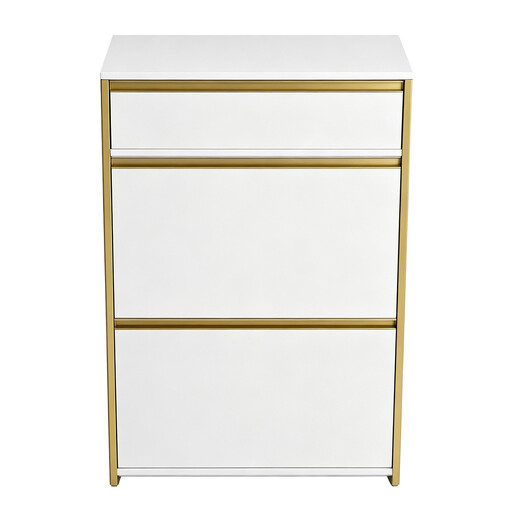
Why It Stands Out: This model combines enclosed storage with a practical drawer and an open shelf. The combination of a white body and gold accents gives it a modern yet elegant look.
Advantages:
Who Is It For? For those looking for a multifunctional solution that not only stores shoes but also serves as a decorative piece and storage surface in the entryway.
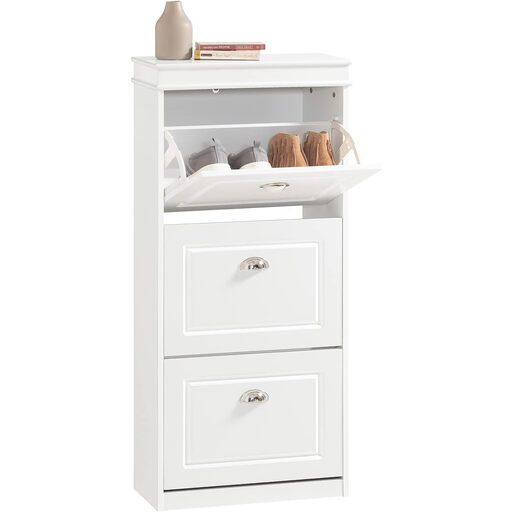
Why It Stands Out: As a classic tip-out shoe cabinet, this model makes optimal use of vertical space. With a depth of just 24 cm, it fits into even the narrowest of corridors.
Advantages:
Who Is It For? For families or shared households that need to store a large number of shoes neatly and out of sight within a minimal footprint.
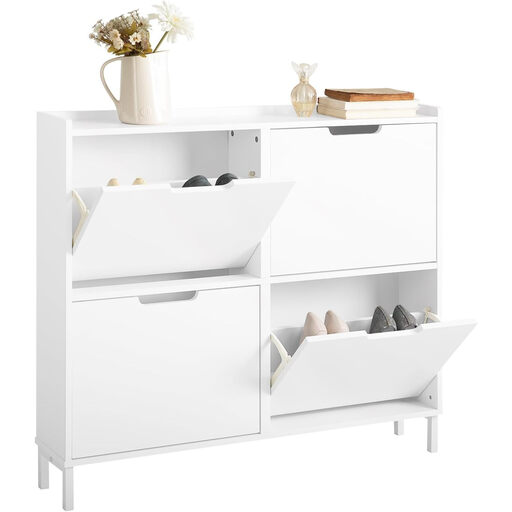
Why It Stands Out: With an exceptionally slim depth of just 19 cm, this model is one of the narrowest options on the market. Its 100 cm width also provides considerable storage volume.
Advantages:
Who Is It For? For anyone with a very narrow hallway who wants to utilise a wide stretch of wall to achieve maximum shoe storage.
The models featured here are specialised for narrow spaces. If you're looking for furniture with more flexibility, perhaps for other rooms or with additional organisational features, a shelf with a drawer could be an interesting alternative. These often offer a combination of open compartments and enclosed storage.
Discover more shelves with drawers here
1. How deep should a slim shoe cabinet be? The ideal depth depends on the available space. Models with a depth between 17 cm and 25 cm are considered particularly slim and are well-suited for narrow hallways. Measure your space carefully before buying and ensure you leave enough room to walk past.
2. What is a tip-out shoe cabinet and what are its advantages? A tip-out shoe cabinet is a type of cabinet where shoes are stored in compartments behind a tilting flap. Its main advantage is an extremely slim profile, as the shoes are stored vertically or at a slight angle rather than horizontally. This makes a tip-out shoe cabinet for the hallway a highly space-saving solution.
3. How many shoes fit in a slim shoe cabinet? The capacity varies depending on the size of the cabinet and the type of shoes. For example, a slim tip-out cabinet with 3 drawers can hold 9 to 12 pairs of flat shoes (like trainers or ballet flats). Models with shelves are often more flexible for larger shoes like ankle boots but may hold fewer pairs in the same amount of space. Check the manufacturer's specifications for guidance.