
Lieferung heute & morgen

Qualitätsgarantie

Willkommens-Angebote freischalten: KOSTENLOSE Lieferung | Bis zu 80 % RABATT | Kostenlose 30-Tage-JoyPlus-Testphase
App herunterladen
A narrow hallway or a small entryway presents a common challenge for many households: where to put shoes without creating tripping hazards or a messy look? A slim shoe cabinet is often the perfect solution to restore order and make the most of limited space. This guide will help you navigate the options and introduces various models that are ideal for entryway shoe storage thanks to their space-saving designs.
Before making a decision, there are several practical aspects to consider. The right choice depends on your available space, the number of shoes you own, and your aesthetic preferences.
Space-saving shoe storage comes in different designs, each offering specific advantages:
Measure your intended space precisely—depth is the most critical dimension for a shoe cabinet in a narrow hallway. Slim models often have a depth of less than 25 cm. Also, consider how many pairs of shoes you need to store. The manufacturer's capacity rating is a good guideline, but it's usually based on average shoe sizes.
The material affects not only the durability but also the overall look. Models made from MDF are sturdy and available in many designs. For example, a shoe cabinet in white can visually brighten a small, dark hallway, making it appear larger. Metal or plastic elements add modern accents and are often easy to maintain.
Here is a selection of models that are well-suited for narrow spaces due to their design and functionality.
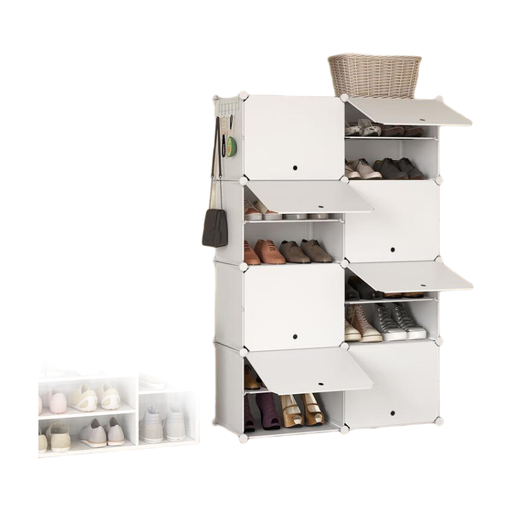
Why it stands out: This shoe rack impresses with its modular, interlocking system. It can be configured flexibly to suit your space and needs—whether vertically, horizontally, or split into several smaller units.
Advantages:
Who is it for? For those who need a flexible, high-capacity solution for entryway shoe storage and want to adapt the layout to their specific space.
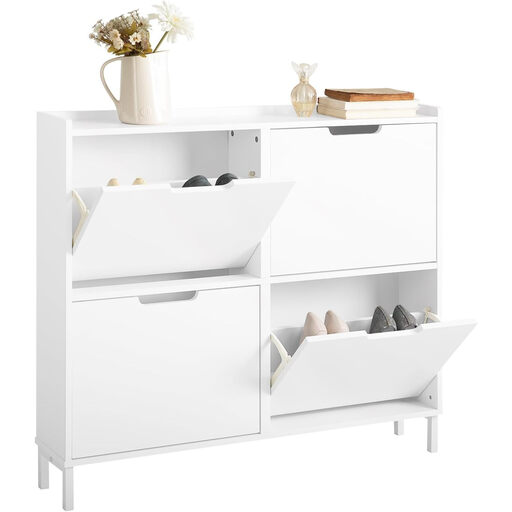
Why it stands out: With a depth of just 19 cm, this tip-out shoe cabinet is an extremely space-saving option. It makes optimal use of vertical space, making it perfect for particularly narrow passageways.
Advantages:
Who is it for? Ideal for residents of apartments or houses with a very narrow hallway who are looking for a discreet and elegant shoe storage solution.
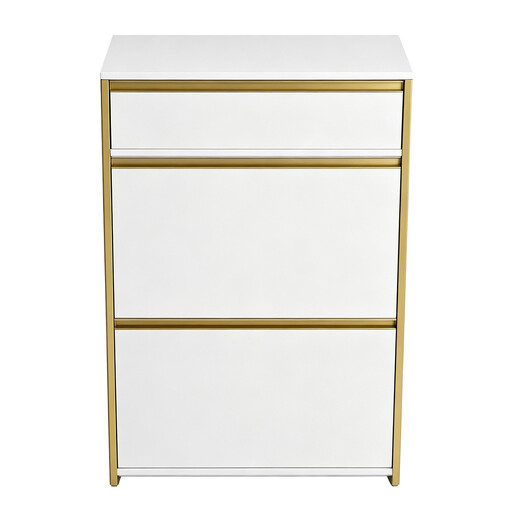
Why it stands out: This model combines the functionality of a classic shoe cabinet with an additional drawer and a decorative design. The white and gold finish adds a modern touch to any entryway.
Advantages:
Who is it for? For users who are not just looking for pure space-saving shoe storage, but also a stylish piece of furniture that blends harmoniously into a modern living environment and offers extra storage.
The models featured here are primarily designed for low-top shoes, sneakers, and similar footwear. If you need a solution for storing tall boots, other organisers specifically designed for the height and shape of boot shafts may be more suitable.
? Explore our selection of Boot Storage Organisers to find the right solution for your needs.
A slim shoe cabinet usually has a depth between 17 cm and 30 cm. Ultra-slim models, like tip-out cabinets, are often less than 20 cm deep because the shoes are stored vertically at an angle. Classic cabinets with doors typically require a depth of 24 cm or more.
The main advantage of a tip-out cabinet is its closed front. It conceals your shoes, protects them from dust, and creates a very tidy look in the hallway. In contrast, an open shoe rack for the hallway offers better ventilation and quicker access but can appear visually cluttered.
That depends on the specific model. Many slim shoe cabinets are designed for standard-height shoes. Models with adjustable or removable shelves, like the HaluPeit cabinet featured above, may be able to accommodate ankle boots. However, they are generally unsuitable for knee-high boots. Specialised storage solutions are available for that purpose.