
Lieferung heute & morgen

Qualitätsgarantie

Willkommens-Angebote freischalten: KOSTENLOSE Lieferung | Bis zu 80 % RABATT | Kostenlose 30-Tage-JoyPlus-Testphase
App herunterladen
A slim shoe cabinet can keep your entrance tidy without making the walkway unnecessarily narrow. But in small homes, narrow hallways and busy households, width isn’t the only thing to consider. The actual depth, interior layout, weight capacity and secure fixing are all important too.
A shoe cabinet may look compact from the outside, but its compartments might not suit larger shoe sizes, boots or high-top trainers. If you’re considering a tilt-out shoe cabinet, check that the doors open far enough and find out how much internal height each compartment offers.
A slim shoe rack with a depth of around 25 to 30 cm or less will fit in many hallways. However, storage space may be limited when the doors are closed. For families, a taller model with several compartments is often more practical than a very low unit with just a few shelves.
Tall, narrow furniture has a higher centre of gravity. A shoe cabinet with anti-tip protection should therefore be secured to the wall, especially in homes with children. The floor should also be level, and you should follow the assembly instructions in full. A high stated weight capacity is no substitute for proper fixing.
Measure more than just the available wall width. Also check:
Models around 23 to 30 cm deep are often easier to fit into a narrow hallway. A shoe bench with storage also needs enough space in front of it for you to sit comfortably.
A shoe cabinet with adjustable shelves can be adapted more easily to suit flat shoes, trainers, sandals and boots. Removable shelves are especially useful if your needs change over time. Also check whether the stated capacity suits your shoe size and preferred way of storing footwear.
Open compartments make shoes easy to reach and help air circulate. Closed flaps, on the other hand, keep clutter out of sight. A combination of open and closed storage can work well for everyday shoes you wear often.
For engineered wood, descriptions such as MDF or chipboard alone don’t tell you everything about quality. The finish, edges, fixings and maximum load are more important. A coated surface can make cleaning easier, but you should still avoid leaving moisture on it.
Look for:
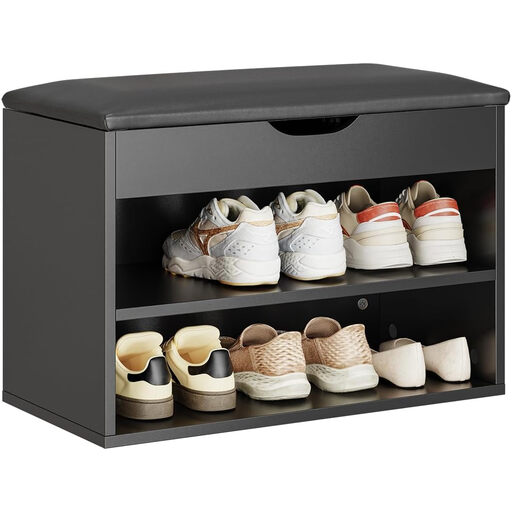
Why it suits this type of home: Measuring 60 × 30 × 43 cm, this shoe bench combines a seat, open shoe rack and concealed compartment. It’s a good fit for small entranceways where you need several functions in a compact space.
The dimensions and maximum static load of up to 113 kg are clearly stated. The open compartment means you don’t have to rely on narrow flaps for shoes you wear often.
Seat cushion with PU leather upholstery, concealed storage compartment, open shoe compartment and compact footprint.
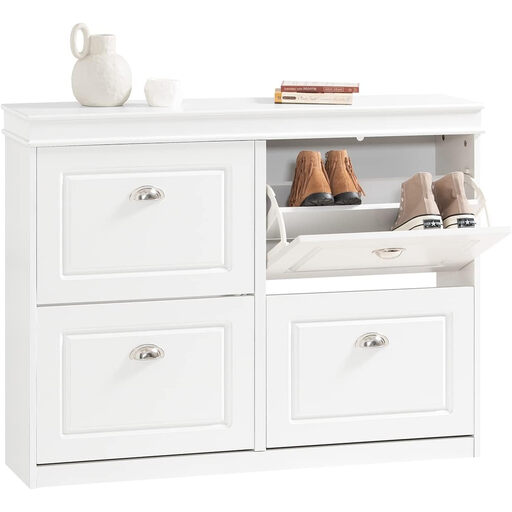
Why it suits this type of home: At around 105 cm wide and 83 cm high, with a depth of just 24 cm, this tilt-out shoe cabinet offers concealed storage for hallways where depth is limited.
Its shallow depth is clearly stated. Four flaps and eight storage sections keep footwear organised, while the anti-tip fittings allow you to secure it to the wall.
Four flaps, eight shoe shelves, MDF construction and a stated load capacity of up to 50 kg.
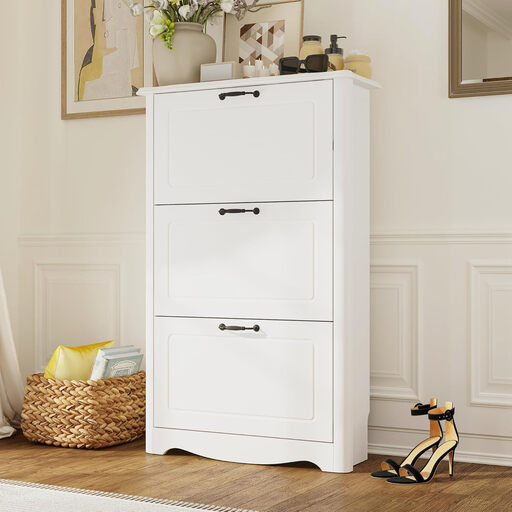
Why it suits this type of home: Three flaps and removable or adjustable shelves give you a flexible layout for different types of footwear. Its stated depth of 26.5 cm makes it a practical option for narrow entranceways.
Adjustable shelf heights reduce the risk of larger shoes or boots not fitting in the compartments. According to the product description, the coated surface can be wiped clean.
Three flaps, six storage sections, adjustable compartments and MDF construction with metal handles.
We’ve put together a complete, regularly updated list of products that meet these strict selection criteria and fully comply with the safety regulations in force in the EU.
Position the shoe cabinet in its final spot first, then check that the doors or flaps can open fully. Tall models should be secured to a suitable wall using the anti-tip fittings, following the instructions. If you have delicate flooring, use the felt or plastic feet provided.
To help your shoe cabinet last longer:
A depth of around 23 to 30 cm works well in many narrow hallways. Before buying, check your shoe size, how far the flaps open and how much walkway space will remain. Very shallow models aren’t necessarily suitable for every type of shoe.
A tilt-out shoe cabinet keeps shoes out of sight and gives your hallway a tidier look. An open shoe rack, on the other hand, makes shoes quicker to reach and allows better air circulation. The right option depends on whether you value keeping shoes hidden or having them close to hand every day.
Securing tall, narrow furniture to the wall is a sensible precaution. In homes with children, make sure the supplied shoe cabinet with anti-tip protection is fixed in place according to the assembly instructions. A level floor and even weight distribution are important too.