
Lieferung heute & morgen

Qualitätsgarantie

Willkommens-Angebote freischalten: KOSTENLOSE Lieferung | Bis zu 80 % RABATT | Kostenlose 30-Tage-JoyPlus-Testphase
App herunterladen
A narrow hallway presents a common challenge for many households: where to store shoes without blocking the walkway or creating a cluttered look? A slim shoe cabinet promises a solution, but the market is vast, and not every model lives up to its claims. Before you make a decision, it's crucial to understand the typical weaknesses that can quickly turn a supposed organizational aid into a daily frustration.
As your Joybuy Product Recommendation Officer, I'm here to help you distinguish valuable features from empty marketing promises. This guide focuses on the facts, enabling you to make an informed choice for your entryway shoe storage.
Many products look practical at first glance but reveal their flaws only through daily use. Pay close attention to these three points to avoid a bad investment:
To avoid the problems mentioned above, you should base your selection on objective parameters. A good, space-saving hallway cabinet or shoe chest is defined by well-thought-out features.
The most critical value is the overall depth of the cabinet. Measure the available space in your hallway precisely and plan for enough room to walk past comfortably.
The stated shoe capacity is often a theoretical value based on small shoe sizes. More important is the flexibility of the interior. Look for adjustable or removable shelves. This is the only way to adapt the storage space to your needs, accommodating everything from flat sneakers to taller hiking boots or ankle boots. Modular systems often offer the greatest freedom here.
The material determines longevity and stability.
Here are some models tailored to specific needs and spatial situations that meet the criteria discussed.
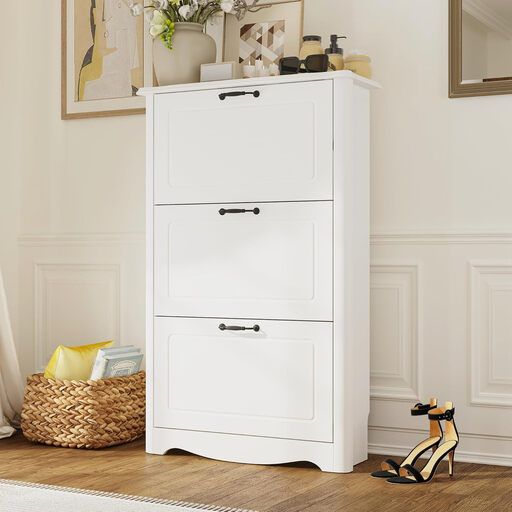
Why This Fits Their Persona: Ideal for users seeking a proven, discreet, and efficient solution. The classic, modern white tip-out design blends seamlessly into most entryways and keeps shoes completely hidden behind a closed front.
The MDF board construction is designed for everyday use. The compartments feature adjustable dividers, mitigating the problem of ill-fitting internal dimensions for different shoe sizes.
Extremely slim depth of 26.5 cm, perfect for the tightest spaces. The closed front ensures a consistently tidy appearance.
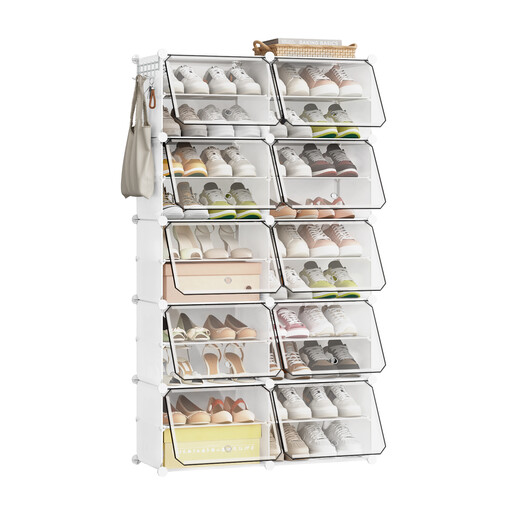
Why This Fits Their Persona: Perfect for anyone needing a customisable solution for sloped ceilings, alcoves, or a growing shoe collection. The modular DIY system can be configured in height and width as needed.
Flexibility is key here. By removing divider panels, you can create compartments for boots or large shoes, solving the problem of rigid internal dimensions. The structure of metal frames and ABS connectors ensures stability.
Fully customisable layout with a depth of just 30 cm. The water-resistant PP panels are impervious to moisture and easy to clean.
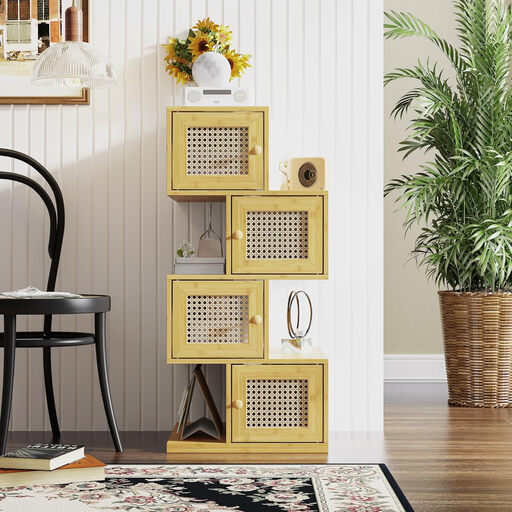
Why This Fits Their Persona: For users who don't want to compromise on style, even in the hallway. The combination of natural bamboo and woven rattan adds a warm, homely accent that stands out from standard furniture.
The sturdy bamboo frame offers greater stability than many particleboard constructions. The rattan doors are breathable, which helps prevent moisture and odour build-up inside—a clear advantage over completely sealed cabinets.
Exceptionally slim profile with a depth of just 25.4 cm. The high-quality, natural materials provide an appealing look and feel.
For even more space-saving ideas, especially for utilising vertical space, we have compiled additional solutions that meet our strict selection criteria.
For most narrow hallways, models with a depth of under 30 cm are a good choice. If space is extremely limited, tip-out shoe cabinets are ideal, as their depth often ranges from just 17 to 25 cm. It is essential to measure the available space accurately before buying, taking into account the swing radius of any doors or flaps.
This is a critical point. Many models, especially slim tip-out cabinets, are designed for a maximum shoe size of 42 to 44. With larger shoes, the heels or toes often hit the back, preventing the flap from closing properly. Check the specifications for the internal compartment depth or specifically look for models with adjustable or removable elements. Modular systems often offer the most flexibility here.
Yes, wall mounting is strongly recommended and provided for with most models. Due to their shallow depth and greater height, these cabinets have a high centre of gravity and are prone to tipping. For safety, the included anti-tip hardware should always be installed to ensure stability and prevent accidents.