
Lieferung heute & morgen

Qualitätsgarantie

Willkommens-Angebote freischalten: KOSTENLOSE Lieferung | Bis zu 80 % RABATT | Kostenlose 30-Tage-JoyPlus-Testphase
App herunterladen
A narrow hallway presents a common challenge: where to put your shoes without blocking the walkway or creating a cluttered mess? A slim shoe cabinet offers a functional and aesthetic solution. It makes optimal use of limited space, ensuring your entryway always looks tidy and welcoming.
This article serves as your guide. We will introduce a selection of models that stand out for their space-saving dimensions, design, and functionality. Our goal is to provide you with objective information to help you find the perfect solution for your hallway.
Before you decide on a model, several criteria should be considered to ensure the cabinet meets your needs.
The most crucial feature of a shoe cabinet for a narrow hallway is its depth. Measure your available space accurately and plan for enough room to fully open doors or flaps without obstructing the path. Models with a depth of less than 30 cm are considered particularly space-saving. A special type is the slim tip-out shoe cabinet, where shoes are stored vertically in tilting compartments. Such models can often have a depth of under 25 cm, making them ideal for very narrow corridors.
Consider how many pairs of shoes you need to store. Capacity is often stated in pairs of shoes but can vary depending on shoe size and type. A space-saving shoe cabinet with adjustable or removable shelves offers the flexibility to store everything from flat sneakers to taller ankle boots. A shoe cabinet with doors protects shoes from dust and creates a calm, uncluttered look in the hallway.
The shoe cabinet should blend harmoniously with your interior design concept. A modern white shoe cabinet can make small, dark hallways appear brighter and more spacious. Materials like engineered wood with a melamine resin coating are easy to clean and durable. For those who want to make a statement, a designer shoe cabinet with details like metallic handles, unique surface textures, or a combination of different materials is an excellent choice.
Here is a selection of models that meet different requirements for space, storage, and design.
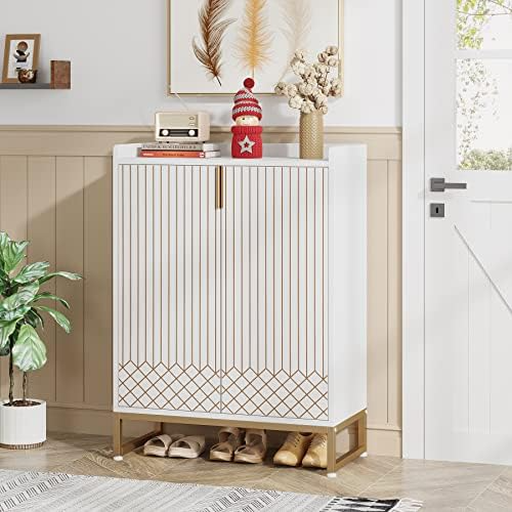
Why it stands out: This model combines high capacity with an elegant, modern design. The closed doors with a diamond pattern and gold accents give it a high-end look, while its 35 cm depth is still suitable for many hallways.
Advantages:
Who it's for: For those looking for a modern white shoe cabinet with plenty of storage who value an appealing design with luxurious accents.

Why it stands out: With its louvered doors and rustic walnut finish, this cabinet brings a touch of farmhouse charm to your entryway. The adjustable shelves make it particularly flexible.
Advantages:
Who it's for: For lovers of farmhouse or rustic style who need a flexible and well-ventilated storage solution for various types of shoes.
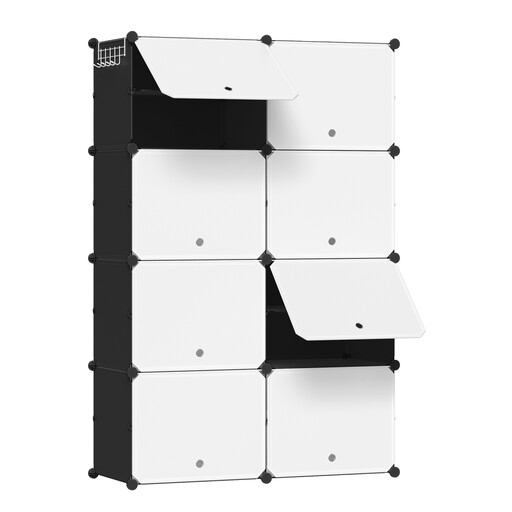
Why it stands out: This system is the definition of flexibility. The individual PP plastic cube modules can be assembled as desired—as a tall tower, a wide sideboard, or several small units.
Advantages:
Who it's for: For those seeking an extremely adaptable and cost-effective solution with maximum storage, who don't mind a plastic finish. Ideal for utility rooms, basements, or unconventional living situations.
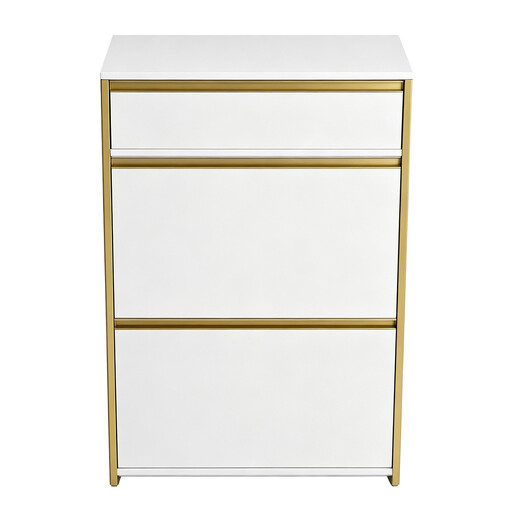
Why it stands out: With a depth of only 24 cm, this model is a true slim tip-out shoe cabinet and an excellent choice for extremely narrow hallways. The minimalist design in white and gold looks very modern.
Advantages:
Who it's for: For anyone who needs a shoe cabinet for a very narrow hallway and prefers an elegant, minimalist look. Perfect for urban living with limited space.
Haven't found the right model yet, or want to explore more solutions for organizing your entryway? Our comprehensive category offers a wider selection of furniture and storage systems.
? Explore more products for Hallway & Shoe Storage
A shoe cabinet is considered slim if its depth is significantly less than the usual 35-40 cm. Models with a depth of 25 to 30 cm are a good choice for most narrow hallways. So-called tip-out cabinets can even have a depth of under 25 cm, making them the most space-saving option.
A classic shoe cabinet with doors has horizontal shelves where shoes are placed upright. A tip-out shoe cabinet, on the other hand, has tilting compartments (flip drawers) where shoes are stored at a slight angle or vertically. This design allows for a much shallower cabinet depth.
The capacity largely depends on the height, width, and design of the cabinet. Compact tip-out cabinets for very tight niches often hold 8 to 12 pairs of shoes. Taller and wider, yet still slim, models can easily accommodate 20 to 25 pairs or, in the case of modular systems, even over 30 pairs of shoes.