Buyers with a narrow kitchen space
If space is limited, the design and full appliance dimensions need to fit the available floor space or recess. Check the height, depth, door clearance and connections too.


First, choose a design whose full dimensions, door clearance and connections suit your kitchen. Then test whether the basket layout and adjustable features work with your own bowls in everyday use; place settings alone won’t tell you. To compare running costs, look at each model’s Eco consumption figures, programme duration and noise level.
If space is limited, the design and full appliance dimensions need to fit the available floor space or recess. Check the height, depth, door clearance and connections too.
If you want to wash bowls, cups and cutlery together, the specific basket layout and adjustable features matter – not just the number of place settings.
If you use the dishwasher regularly or it’s near your living area, compare each model’s stated Eco consumption figures, programme duration and noise level.
First, check that the design and full appliance dimensions suit the space you have in mind. Then consider how your own bowls will fit, along with the operating figures that matter in your day-to-day life.
Suitable if: you have a suitable space for it and don’t want the appliance hidden behind a kitchen door.
Keep in mind: the appliance will be visible, and its height, depth and connections need to work in the space you’ve chosen.
Suitable if: you want the appliance to sit under an existing worktop, but not to be hidden completely behind a kitchen door.
Keep in mind: the recess height and installation dimensions need to fit; installation services may be offered separately.
Suitable if: you have a suitable installation recess and kitchen door.
Keep in mind: semi-integrated models have visible controls, while fully integrated models hide them behind the door. Check whether the matching furniture door is included.
| What to consider | What to check when buying | Who should pay particular attention? |
|---|---|---|
| Design and available space | Check the appliance’s height, width and depth, door clearance, kitchen door and connections against the specific installation instructions. | If space is limited, the appliance, door and connections all need to fit the intended spot before I commit. Around 33% of consumers say getting the right fit is their biggest concern. |
| Space for bowls | Measure your bowls and check the basket positions, adjustable features and that the spray arm can move freely. | I want to be able to load my breakfast bowls alongside cups and cutlery, rather than relying on the place-setting capacity alone. Around 27% of consumers put space for bowls first. |
| Energy and water consumption | Compare the kWh per 100 Eco cycles and litres per Eco cycle on the EU energy label; take your expected load into account too. | If I run the dishwasher regularly, I want to compare consumption based on how I’ll use it, rather than looking at the purchase price alone. Around 20% of consumers give running costs the most weight. |
| Noise and programme duration | Check the noise level and Eco programme duration on the label; for shorter programmes, refer to the figures for the specific model. | If the dishwasher is near my living area or I need the dishes ready by a certain time, noise and programme duration matter. Around 20% of consumers prioritise noise or wash speed. |
The width doesn’t tell you whether the height, depth, door clearance and connections will suit your space. Dimensions also vary between individual freestanding and integrated models.
Measure the entire space, including room for the door to open, and compare it with the installation instructions for your chosen model.
Depending on your kitchen, you may need additional adjustments or separately priced installation services.
The stated capacity doesn’t guarantee that your bowls will fit neatly in the baskets alongside cups and cutlery.
Measure your bowls and check the basket positions, adjustable features and that the spray arm can move freely.
For a comparison of running costs, the specific Eco consumption figures matter too. The Eco programme takes longer, and how efficiently the dishwasher runs also depends on loading it correctly.
Compare energy and water consumption on the same label basis, check the programme duration and see which delivery and installation services are included in the specific offer.
Examples of 45 cm freestanding and fully integrated models.
Examples of 45 cm undercounter and fully integrated models.
45 cm integrated models in fully and semi-integrated designs.
45 cm integrated and undercounter models; the G 5790 SCVi SL is an example of a fully integrated model.
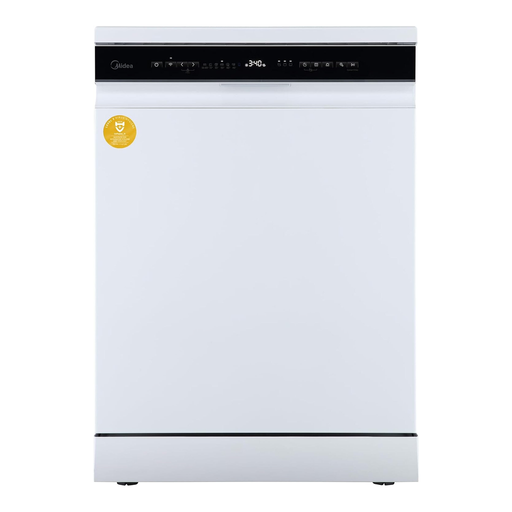
45 cm freestanding models; the MDWEF1034DW-WE is one example.
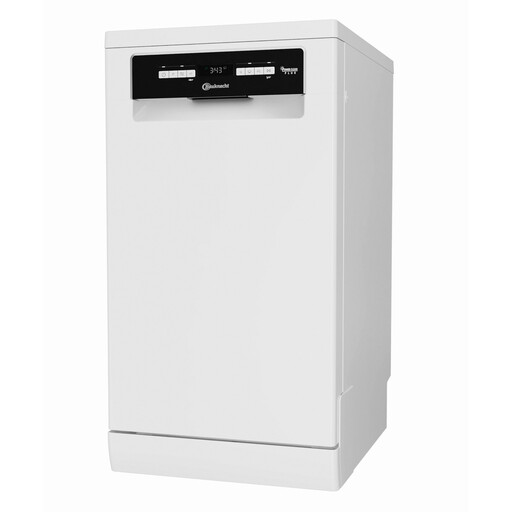
The models below are freestanding dishwashers listed as 45 cm wide. Before choosing one, compare its full dimensions with the space you have available.
 No image available
This freestanding model could suit you if you have a suitable space for it.
9 place settings and 5 programmes.
Eco figures: 70 kWh per 100 cycles, 9 l per cycle and a programme duration of 235 minutes; noise level: 47 dB.
Dimensions: 84.5 × 44.8 × 60 cm (H × W × D).
 No image available
The height-adjustable upper basket may help when planning how to load the dishwasher; try your own bowls to see whether they fit.
10 place settings and a height-adjustable upper basket.
Eco figures: 59 kWh per 100 cycles and 8.9 l per cycle; noise level: 44 dB.
Dimensions: 600 × 448 × 850 mm (D × W × H).
 No image available
The adjustable basket and cutlery drawer are worth considering when loading your bowls.
9 place settings, 6 programmes, an adjustable basket and a cutlery drawer.
Eco figures: 70 kWh per 100 cycles and 9 l per cycle; noise level: 47 dB.
Dimensions: 81.5 × 44.8 × 55 cm (H × W × D).
 No image available
This freestanding 45 cm model could suit your kitchen if the space and dimensions work; check the cutlery arrangement for the version on offer.
10 place settings, a height-adjustable upper basket and energy rating C.
Noise level: 44 dB.
Dimensions: 60 × 45 × 84.5 cm (D × W × H).
The manufacturer’s information mentions a cutlery drawer, while the product description lists a cutlery basket. Check which version is on offer before buying.
 No image available
The height-adjustable upper basket and cutlery drawer are worth considering when planning how to load the dishwasher; check how your bowls fit in the baskets.
10 place settings, a height-adjustable upper basket and a cutlery drawer.
Eco figures: 67 kWh per 100 cycles and 9 l per cycle; noise level: 44 dB.
Dimensions: 850 × 450 × 590 mm (H × W × D).
No. Measure your bowls and check the basket layout of the specific appliance; a height-adjustable upper basket or foldable supports can affect how you load it.
Bosch recommends checking your local water hardness and setting the water softener according to the appliance instructions. Follow the guidance for your specific model when using salt and rinse aid.
The EU energy label shows electricity consumption for 100 Eco cycles, water consumption per Eco cycle, programme duration and noise level. Also check which delivery and installation services are included in the specific offer.
Household dishwashers covered by the scheme use the EU energy label, with a scale from A to G. The European Commission has used this scale since 1 March 2021; the label doesn’t set a minimum efficiency rating that buyers have to meet.
Old electrical appliances must be collected separately. The German Environment Agency lists local collection points, which generally accept old electrical appliances free of charge; when buying a new appliance, check whether take-back is offered in your case.