Washing cutlery after a shift
If you want to load dishwasher-safe cutlery after work, the choice between a basket and a drawer, along with the available programmes, is worth considering.


First, choose a design that suits your available space, cabinet recess and kitchen door panel. Then consider whether a cutlery basket or drawer works best for your cutlery. If you need your cutlery again that evening, check whether the model has a documented quick programme. If you can leave the wash until the next day, noise levels and Eco consumption figures are useful points of comparison. Remember: the figures on the EU label relate to the Eco programme, not necessarily to a quick programme.
If you want to load dishwasher-safe cutlery after work, the choice between a basket and a drawer, along with the available programmes, is worth considering.
Check whether a freestanding, under-counter or integrated model will fit your existing kitchen, taking account of its height, plinth and cabinet door panel.
If you run the machine after an evening shift, the noise level of the specific model and whether it has a night programme may be important factors in your choice.
Start by checking the dimensions and installation type, then look at the cutlery layout and programmes. This makes it easier to compare models and find one that suits your kitchen and your routine after a shift.
| Consideration | What to check when buying | Who is this important to? |
|---|---|---|
| Loading cutlery | Cutlery drawer or basket; space for longer kitchen utensils | If I load cutlery and longer kitchen utensils together, I want a layout that works for both. Around 25% of consumers put cutlery loading first. |
| Fit and installation type | Check the appliance dimensions against the recess, plinth and cabinet door panel | With a narrow kitchen, I want to be sure the appliance and door panel will actually fit. Around 25% of consumers prioritise fit and installation type. |
| Short wait | Check for a documented quick programme and its conditions | If I need my cutlery again that same evening, a suitable quick programme matters to me. Around 20% of consumers put a short wait first. |
| Evening noise | Check the model's noise emissions and whether it has a night programme | If the machine runs late, I want to take its noise level and any night programme into account. Around 15% of consumers prioritise quiet washing. |
| Eco consumption | Compare kWh per 100 Eco cycles, litres per Eco cycle and programme duration | If I usually use the Eco programme, I compare consumption figures and factor in the longer wait. Around 15% of consumers put Eco consumption first. |
Freestanding, under-counter and integrated models have different requirements. Width alone won't tell you whether the height, depth, plinth and door panel will fit the space you have in mind.
Compare your available space with the installation diagram for the specific model, including the cabinet door panel and plinth. An unsuitable installation setup could mean extra fitting work.
The cycle figures shown on the EU label relate to the Eco programme. They don't tell you the consumption or results of a quick programme.
Compare Eco figures on a like-for-like basis, and check quick programme details separately if you need your cutlery back in a hurry.
The drawer tells you where the cutlery goes. How you load it also matters, as does whether the spray reaches every item.
Check that the layout suits your cutlery and follow the loading and safety advice in the instructions for each model, particularly when loading sharp items.
The slimline freestanding SPS4EMW02D is an example to consider if you're looking for a freestanding model with a cutlery drawer.
The SR61IX05KE and SR65EX09ME illustrate the different features available on slimline fully integrated models.
The MDWEF1034DW-WE is an example of a slimline freestanding model with a cutlery drawer and night programme.
The fully integrated FSE74527P is an example to consider if you're looking for a cutlery drawer and a documented choice of programmes.
The BSUO 3O33 PF X and BSBO 3O35 PF X illustrate slimline under-counter and semi-integrated designs.
The GV583C10 and GS541D10X are examples of slimline fully integrated and freestanding designs respectively.
The models below are slimline freestanding dishwashers. Before choosing, check the appliance dimensions and cutlery layout against your available space and the cutlery you usually wash.
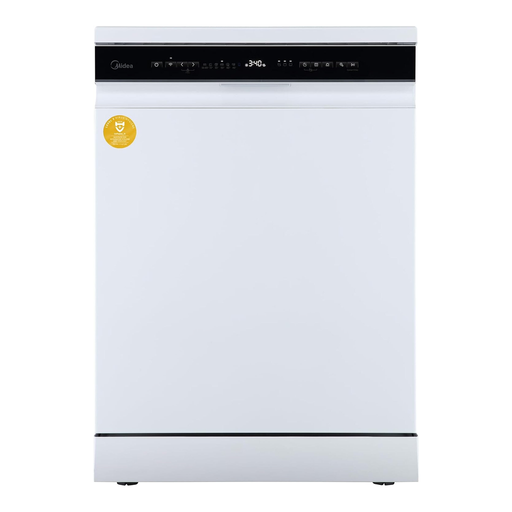 Image unavailable
The freestanding design and cutlery basket are a good fit if you want to wash cutlery in a slimline appliance.
45 cm wide; 10 place settings; height-adjustable upper basket; energy class C.
 Image unavailable
This freestanding 45-cm design is worth considering if you want a slimline model without a cabinet door panel.
9 place settings; 6 programmes; silver finish.
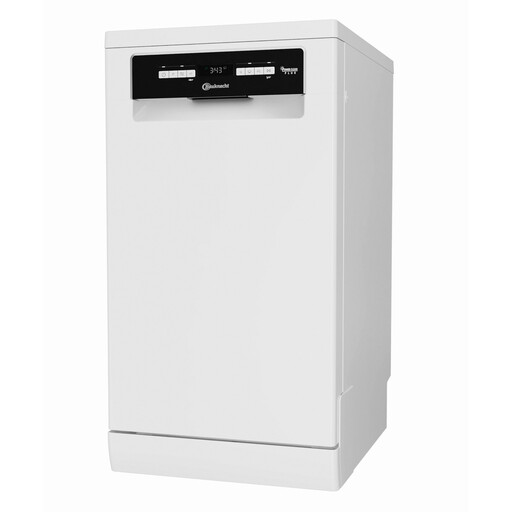 Image unavailable
This slimline freestanding model is an option if you prefer a cutlery drawer to a cutlery basket.
45 cm wide; 10 place settings; energy class D.
 Image unavailable
The freestanding 45-cm design suits a narrow space, as long as the full appliance dimensions fit.
10 place settings; energy class C.
No. Among other details, the EU label shows electricity consumption per 100 cycles, water consumption per cycle and the duration of the Eco programme. A quick programme is a separate model feature; check its details and conditions in the documentation for the specific appliance.
Check the design type, recess height and width, appliance depth, plinth and, if applicable, cabinet door panel dimensions against the model's installation diagram. For a freestanding model, also check whether it's suitable for the planned under-counter space.
Find out your local water hardness and set the water softener and regeneration salt according to the appliance and detergent instructions. The German Environment Agency notes that limescale deposits can affect efficiency and service life.
EU energy labelling rules apply to new household dishwashers covered by the regulations. According to the European Commission, retailers must also clearly display the label information when selling online. The label uses a scale from A to G and includes details such as Eco consumption, Eco duration, capacity and noise.
Your statutory rights against the seller are separate from any voluntary guarantee. The consumer advice centre also describes a right to repair that has applied to manufacturers since 31 July 2026 for certain appliances, including dishwashers. Check the fault and the applicable rules to find out what conditions apply in your case.