First, choose a design that suits the available space, kitchen recess and cabinet door. Then check that your largest dinner plates, along with the rest of your dishes, will fit in the baskets. For day-to-day running costs, compare the Eco consumption figures and noise levels for the specific models you’re considering. The place-setting capacity alone won’t tell you whether your plates will fit.
Who slimline dishwashers are suitable for
A small kitchen with a narrow recess
If space is limited, check the dimensions and design before looking at the features. The dimensions of specific models, such as those from Bosch Hausgeräte and Siemens Hausgeräte, can help you check whether they’ll fit in your existing recess.
A household with large dinner plates
If you want to load dinner plates and other dishes after your weekly shop, the basket layout matters. Check that your largest plates will fit and that the spray arms can rotate freely.
A household mindful of consumption
If you run your dishwasher regularly, compare the Eco figures for each model rather than looking only at its energy rating. The Verbraucherzentrale explains that electricity consumption per 100 Eco cycles is a useful basis for comparison.
What to look for when buying a slimline dishwasher
Freestanding
A good fit if: you have a suitable space with the necessary connections and don’t need to fit a cabinet door to the appliance.
Keep in mind: the height, depth and door clearance also need to work. External dimensions and features vary by model.
Semi-integrated
A good fit if: you have a suitable cabinet recess and door, but want the control panel to remain visible.
Keep in mind: the same appliance width doesn’t automatically mean the recess, door and connections will all line up. Bosch Hausgeräte lists dimensions of 815 × 448 × 573 mm for the SPI4EMS02D.
Fully integrated
A good fit if: you want to conceal the control panel behind a suitable cabinet door.
Keep in mind: check the door and recess against the installation instructions. A flexible basket layout won’t tell you whether your dinner plates will actually fit.
| What matters to you |
What to check |
Who it matters most to |
| The right design and dimensions |
Check the appliance height and depth, recess dimensions and door clearance. For integrated models, check the cabinet door too. |
I mainly want to make sure the appliance fits in my kitchen and that its door can open. Around 40 % of consumers prioritise finding an appliance that fits their available space. |
| Space for dinner plates |
Check the diameter of your largest plates, the basket position and whether the spray arms can rotate freely in the specific model. |
I want to make sure my dinner plates fit alongside bowls and other dishes. Around 30 % of consumers prioritise space for plates and mixed loads. |
| Electricity and water consumption |
Compare electricity consumption per 100 Eco cycles and water consumption per Eco cycle. Factor in how often you expect to use the dishwasher and your own tariff. |
If I run the dishwasher regularly, I want to compare consumption figures on the same Eco basis. Around 20 % of consumers prioritise running costs. |
| Noise while washing |
Compare the noise level in dB(A) for the specific model, especially if your kitchen is close to your living area. |
If my kitchen is close to my living area, I want to know how noisy the appliance is while it’s running. Around 10 % of consumers consider noise their most important buying priority. |
Common mistakes when buying
-
Choosing based only on a 45 cm width and place-setting capacity
The stated width and place-setting capacity don’t confirm that your largest dinner plates will fit in the basket or that the spray arms will have room to move freely.
Measure the available space and check the basket position in the model instructions using your largest plates.
-
Treating freestanding and integrated appliances as interchangeable
Each design has different requirements for the recess and cabinet door. The appliance width alone won’t tell you whether an integrated model will fit your kitchen units.
Decide which design you want, then check the installation drawing, kitchen dimensions and required door before ordering.
-
Assuming the energy rating reflects consumption on every programme
The stated comparison figures relate to the Eco programme and don’t automatically describe the consumption of other programmes.
Compare Eco figures on the same basis and consider which programmes you’re likely to use.
Brands and models to consider
Bosch
The models mentioned include freestanding and semi-integrated slimline designs.
- Bosch Hausgeräte lists a Vario-Flex basket system for the SPS4HKW49E.
- The semi-integrated SPI4EMS02D is listed as Class B, with 8,7 l of water per Eco cycle.
- These features apply to the models mentioned and can’t be assumed to apply to every appliance from the brand.
Beko
The freestanding BDFS26040XQ is a 45-cm model with an adjustable-height upper basket.
- Beko lists 10 place settings, energy class C and 8,9 l per Eco cycle for this model.
- The manufacturer’s information about plate sizes doesn’t replace checking the appliance with your own plates and the specific basket position.
Siemens
The SR65ZX22ME is a fully integrated slimline model with a flexible basket system.
- Siemens lists energy class C and 8,9 l of water per Eco cycle for this model.
- The manufacturer’s claims about improved drying aren’t an independent comparison with other models.
Miele
The G 5790 SCVi SL is a fully integrated 45-cm model with a cutlery drawer.
- Miele lists energy class C and 44 dB for this model.
- These figures don’t prove a loading or performance advantage over other brands.
Midea
According to Midea, the MDWEF1034DW-WE is a freestanding slimline model for 10 place settings.
- Midea lists 44 dB and external dimensions of 850 × 450 × 600 mm.
- The product information gives conflicting details about the cutlery features. Check what’s included with the specific offer before buying.
Freestanding slimline dishwashers at Joybuy
This selection includes freestanding slimline dishwashers for kitchens with a suitable space. The same width doesn’t necessarily mean the same basket layout or identical consumption figures.
 No image available
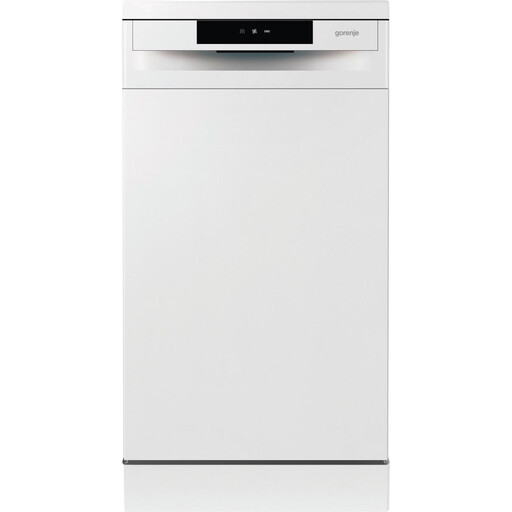
Gorenje GS520E15W, 45 cm, 9 place settings
A freestanding slimline design for a suitable space.
Listed consumption is 70 kWh per 100 cycles and 9 l per Eco cycle.
The description lists five programmes, including Eco and Intensive.
View at Joybuy
 No image available
Beko BDFS26040XQ, 45 cm, 10 place settings
The adjustable-height upper basket can be adapted to different loads.
This model is listed as energy class C, with 59 kWh per 100 cycles and 8,9 l per Eco cycle.
View at Joybuy
 No image available
Exquisit EGSP52109-E-030E, 45 cm, 9 place settings
The adjustable-height basket can be adapted to different loads.
Six programmes are listed, including Eco, along with 70 kWh per 100 Eco cycles and 9 l per Eco cycle.
The stated appliance dimensions are 81,5 × 44,8 × 55 cm.
View at Joybuy
 No image available
Bosch SPS4HKW49E Serie 4, 45 cm, 10 place settings
The Vario-Flex basket system, with an adjustable-height upper basket and fold-down supports, is designed for different types of load.
This model is listed as energy class E, with 76 kWh per 100 Eco cycles, 8,9 l per Eco cycle and 44 dB(A).
The stated dimensions are 84,5 × 45 × 60 cm.
View at Joybuy
 No image available
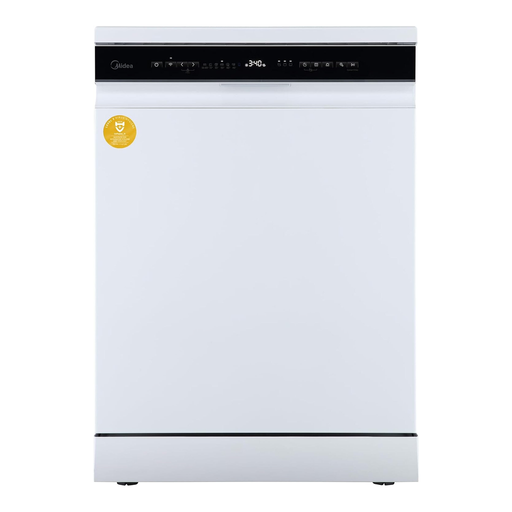
Midea MDWEF1034DW-WE, 45 cm, 10 place settings
A freestanding slimline design with an adjustable-height upper basket.
The product name lists energy class C and Aqua Stop; the stated dimensions are 60 × 45 × 84,5 cm.
Check the cutlery features included with the specific offer before buying.
View at Joybuy
Frequently asked questions about slimline dishwashers
What should I check before connecting a slimline dishwasher?
Measure the available space or recess, including its height and depth, and check that the door can open. Also check the water, drainage and electrical connections against the installation instructions for the specific model. A stated width of 45 cm alone doesn’t confirm that the appliance will fit.
Do I need to pre-rinse dinner plates before using the Eco programme?
No. The Umweltbundesamt advises against pre-rinsing dishes and recommends running the dishwasher as full as possible on the Eco programme. Load the dishes so the spray arms can rotate freely.
How can I compare the electricity costs of different dishwashers?
Use the stated kWh per 100 Eco cycles, your expected number of wash cycles and your electricity tariff. The Verbraucherzentrale uses Eco electricity consumption per 100 cycles as a basis for comparison; it doesn’t automatically reflect the consumption of other programmes.
What information does the EU energy label show for dishwashers?
The EU energy label for household dishwashers uses a scale from A to G and shows information including Eco consumption and noise levels. The European Commission explains the current scale for this product category.
What’s the difference between your statutory rights and a guarantee if something goes wrong?
Your statutory rights against the seller are separate from a voluntary guarantee. The Verbraucherzentrale explains that statutory rights are set out in law, while a guarantee is offered voluntarily.


