Who is a slimline dishwasher suitable for?

People with limited kitchen space

If a narrow recess or limited floor space restricts your choice of appliance, its design is the first thing to check. The German Environment Agency lists 45 cm models as a possible option for small kitchens, but you’ll still need to make sure the dimensions of the specific model suit your kitchen.

People with lots of mugs or mugs in different shapes

If you regularly wash tall or wide mugs, check the upper rack and its adjustment options against your own crockery. The stated number of place settings alone won’t tell you whether your mugs will fit.

People who wash up after a late shift

If you only start a wash late in the evening, the noise rating, delay-start function and when you’ll need your mugs again can all affect your choice. The consumer advice centre and EU energy label provide consumption and programme information to help you compare models.

What should you look for when buying?

What to consider What to check when buying Who is it most relevant to?
Design and space Check the available space or recess, the appliance’s full dimensions and the connections required against the specific model. When space is tight, I want to know first whether the dimensions and design will suit my kitchen. Around 25% of consumers prioritise the available space and appliance design.
Space for mugs Compare the height and shape of your mugs with the rack layout and adjustment options. I want to load my usual mugs without having to stack them awkwardly. Around 25% of consumers prioritise whether their mugs will fit.
Noise when washing up late Check the noise rating in dB(A), the noise emission class and, if available, the delay-start function for the exact model. If I start a wash after a late shift, I want to know how noticeable the appliance will be in my living space. Around 20% of consumers say quiet operation when washing up late is their main concern.
Energy and water consumption Compare kWh per 100 Eco cycles and litres per Eco cycle on the same programme basis. If I run the machine regularly, I want to compare the stated Eco consumption figures. Around 15% of consumers prioritise running costs.
How soon you’ll have your mugs back Check the programme list and the duration of the programme you want; don’t treat Eco figures as figures for a quick programme. If I need my mugs again that same evening, the duration of the programme I choose matters to me. Around 15% of consumers prioritise a short wait.

Common buying misconceptions

  • A 45 cm model is automatically the most efficient choice

    How well the appliance width matches your consumption also depends on how much washing-up you regularly have. The German Environment Agency advises against limiting your comparison to 45 cm if you have enough space and regularly run a full load.

    Compare your usual load with the Eco label figures for the specific models, rather than choosing based on width alone.

  • Place settings correspond to a fixed number of mugs that will fit

    Tall or wide mugs take up space differently from standardised crockery. The number of place settings therefore doesn’t prove that your mugs will fit comfortably.

    Check the rack layout, adjustment options and dimensions against the mugs you use most often.

  • Eco consumption figures also apply to quick programmes

    The stated consumption figures relate to the Eco programme and can’t automatically be applied to another programme.

    Compare consumption figures only on the same programme basis, and check the duration of the programme you actually plan to use.

  • A place in a ranking confirms current availability

    A position in a ranking doesn’t confirm that a model is currently available for delivery or that it’s still on sale. Siemens lists the SR43ES24ME under-counter dishwasher as no longer available.

    Before choosing, check the full model number and the product’s current status.

Brands and models to consider

Bosch

The freestanding 45 cm SPS6EMI21E may be worth considering if you’re looking for a freestanding model with adjustable racks.

  • Bosch gives the dimensions for this model as 845 × 450 × 600 mm, with energy efficiency class B and water consumption of 8,7 l per Eco cycle.
  • These manufacturer specifications don’t prove that every mug shape will fit, and they don’t apply to all Bosch dishwashers.

Siemens

The fully integrated 45 cm SR63EX25KE is worth considering for kitchens with a suitable recess and cabinet door.

  • For the SR63EX25KE, Siemens gives the dimensions as 815 × 448 × 550 mm, energy efficiency class B, 8,7 l per Eco cycle and varioSpeed Plus.
  • The dimensions and features apply to this model. Siemens lists the separate under-counter SR43ES24ME as no longer available.

Beko

The freestanding BDFS26040XQ is worth considering if you’re comparing models with an adjustable upper rack and a delay-start function.

  • Beko gives this model a capacity of 10 place settings, energy efficiency class C, water consumption of 8,9 l per Eco cycle and a noise rating of 44 dB(A).
  • Manufacturer claims about drying or speeding up a wash aren’t independent test results using your own load of mugs.

AEG

The fully integrated 45 cm FSE73407P may be worth considering if you have a suitable recess and are interested in glass holders.

  • AEG gives this model a capacity of 9 place settings, energy efficiency class D, water consumption of 9,9 l per Eco cycle and a noise rating of 44 dB(A).
  • The advertised SoftSpikes and SoftGrips don’t independently show how securely every mug shape will be held.

Joybuy products for smaller kitchens

These are freestanding 45 cm dishwashers for shoppers looking for a slimline freestanding model.

Beko BDFS26040XQ dishwasher

Beko BDFS26040XQ, 45 cm, 10 place settings, energy class C

For a freestanding 45 cm space, if you’d like to adjust the upper rack to fit mugs of different heights.

Beko gives this model a capacity of 10 place settings, energy efficiency class C, water consumption of 8,9 l per Eco cycle and a noise rating of 44 dB(A). The consumption figure relates to the Eco cycle.

Joybuy

Exquisit EGSP52109-E-030E dishwasher

Exquisit EGSP52109-E-030E, freestanding, 45 cm, 9 place settings

For a freestanding space, if you’re looking for a slimline model with Eco and quick programmes.

The product name lists 6 programmes, including Eco and a quick programme, as well as a delay-start function. The delay-start duration isn’t specified here.

Joybuy
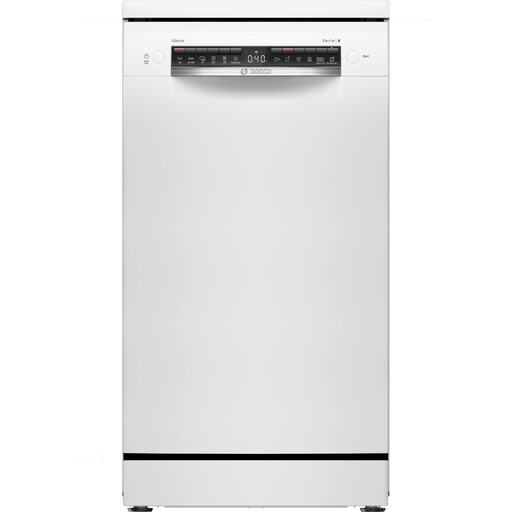
Bosch SPS4HKW49E Series 4 dishwasher

Bosch SPS4HKW49E Series 4, freestanding, 45 cm, energy class E

For shoppers comparing freestanding 45 cm models with the Vario Flex rack system listed in the product name.

The product name also lists AquaStop, extra drying and energy class E.

Joybuy
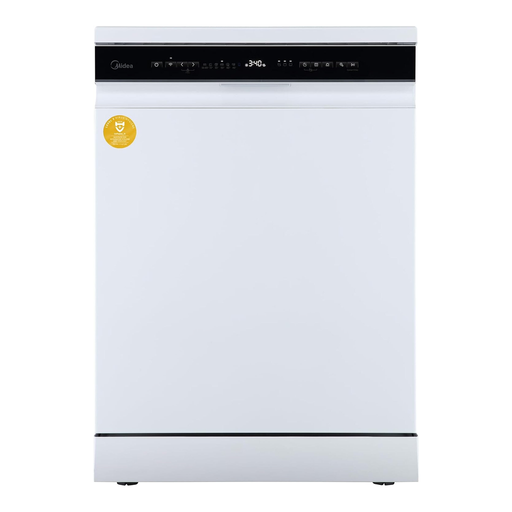
Midea MDWEF1034DW-WE dishwasher

Midea MDWEF1034DW-WE, freestanding, 45 cm, 10 place settings, energy class C

For a slimline freestanding space, if you want flexibility with the upper rack and start time.

The product name lists an adjustable upper rack, a cutlery basket and a delay-start function.

Joybuy
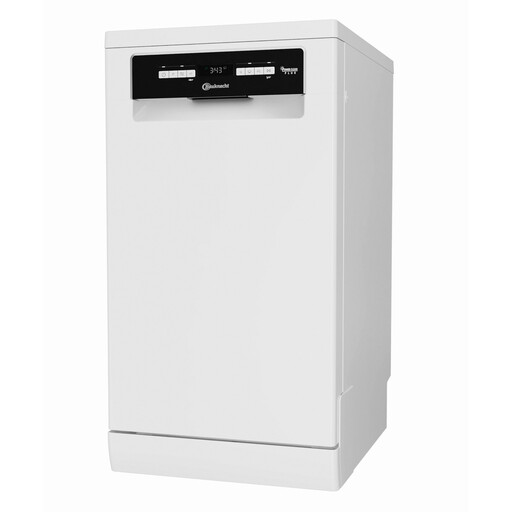
Bauknecht BSFO 3035 PF dishwasher

Bauknecht BSFO 3035 PF, freestanding, 45 cm, 10 place settings, energy class D

For a freestanding 45 cm space, if the features and energy class listed in the product name suit your needs.

The product name lists PowerClean and ActivDry. It doesn’t include details of the noise rating or programme duration.

Joybuy

Frequently asked questions

How can I check whether my mugs are dishwasher-safe?

Check the care instructions from the mug’s manufacturer; they should explicitly state whether it’s dishwasher-safe. According to the consumer advice centre, the glass and fork symbol indicates that an item is suitable for contact with food, not that it’s automatically dishwasher-safe.

Do I need to rinse mugs before using the Eco programme?

No. The German Environment Agency advises against pre-rinsing, especially with warm water. Its statement that using a dishwasher is more efficient than washing by hand applies to a fully loaded machine on the Eco programme.

Which consumption figures can I use to estimate my costs?

The EU energy label shows the electricity consumption for 100 Eco cycles and water consumption per Eco cycle. Use these figures alongside your estimated number of washes; you’ll also need your local tariffs to calculate a cost in pounds.

What’s important when using the dishwasher for the first time?

Find out your local water hardness and set the water softener according to the instructions for your specific appliance. The German Environment Agency explains why regeneration salt is important, while the manufacturer’s instructions cover the settings for each model.

Which energy label details are useful for comparing models?

For household dishwashers covered by EU rules, the energy label lets you compare details including Eco consumption, programme duration, capacity and noise. The label provides information for shoppers but doesn’t require you to choose a particular efficiency class.