Choose a slimline dishwasher by first working out how many plates you actually need to wash per load. Then check whether your largest plates fit in the racks: the place settings shown on the energy label don’t automatically tell you how many plates for your cookery class, along with your cookware, will fit. If you need the dishes again between class sessions, compare programme duration and suitability separately from the Eco figures, which apply to the Eco programme (Consumer Advice Centre; European Commission). Finally, consider where it will go, the connections you need and the right type of installation.
Who is a slimline dishwasher suitable for in a cookery class?
Class leaders with lots of plates
If you need to wash lots of plates per load, check the usable rack space against the diameter of your plates and how you plan to load them. Also consider whether you need to fit cutlery and cookware in at the same time.
Class leaders with short breaks
If you need the plates again before the next part of the class, programme duration and the suitability of the programme you’ll actually use are important factors. Eco figures don’t automatically apply to other programmes.
Class leaders with small kitchens
If space is limited, first decide between a freestanding appliance and a built-in model. The appliance dimensions, cabinet space and furniture door must all suit your kitchen.
What should you look for when choosing one?
First, check whether your typical class load will fit. Then compare the timing of your class sessions with the installation requirements.
| What matters |
What to check before buying |
Who will find this especially important? |
| Plate capacity and racks |
Use place settings as a standardised capacity measure, then plan how you’ll load the racks with your largest plates and the cookware you’ll need (Consumer Advice Centre). |
If I need to wash lots of plates for my class in one go, I want to know whether they’ll fit sensibly alongside the cutlery and cookware. That’s why around 36% of consumers focus on plate capacity and rack layout. |
| Reusing dishes between class sessions |
Check the duration and suitability of the programme you actually need; EU energy label figures refer to the Eco programme (European Commission). |
If the plates need to be ready for the next part of the class, I look for a suitable programme rather than focusing only on the Eco figure. Around 29% of consumers prioritise having their plates ready in time. |
| Space and installation |
Check the width, height and depth, door clearance and connections. For built-in models, also check that the cabinet space and furniture door are suitable for the intended location. |
In a small or already-fitted kitchen, I mainly want to make sure the appliance and its installation type will fit the available space. Around 21% of consumers put a suitable location and installation first. |
| Consumption and maintenance |
Compare kWh per 100 Eco cycles, litres per Eco cycle and programme duration on the same Eco basis (European Commission); adjust the water softener to suit your local water hardness (Consumer Advice Centre). |
If the dishwasher runs regularly, I want to take its consumption and maintenance needs into account for the way I use it. Around 14% of consumers prioritise running costs and maintenance. |
Which common buying mistakes should you avoid?
-
Assuming place settings equal the number of plates you use in class
The place setting figure doesn’t guarantee that the same number of large plates will fit in the arrangement you want. Cookware can also reduce the usable rack space.
Plan a typical class load using your largest plates and any other dishes you’ll need, and check how they fit in the racks.
If large plates or cookware take up more room than expected, you may need to run an extra load.
-
Treating Eco consumption and a quick programme as the same thing
The consumption and duration figures on the energy label refer to the Eco programme. They don’t automatically describe a shorter programme or show whether it’s suitable for your class load.
First decide when you’ll need the dishes again. Then check the programme duration and the appliance’s guidance for the load you have in mind.
-
Measuring only the appliance width
Width alone won’t tell you whether the height and depth will fit or whether the door can open fully. Built-in models also need a suitable cabinet space and furniture door.
Check the appliance dimensions, door clearance and connections. For a built-in model, also check how the furniture door is attached.
Depending on your kitchen, you may need to make changes to the space, cabinet opening or furniture door.
Which brands and models can help guide your choice?
Bauknecht
The BSFO 3O35 PF is an example of a slimline freestanding model for kitchens without a suitable built-in space or furniture door.
- Bauknecht lists a width of 45 cm, a cutlery drawer, Sensor+ and PowerClean for this model.
- It’s freestanding, so it won’t suit a kitchen that needs a fully integrated furniture door. Claims about PowerClean’s cleaning performance are made by the manufacturer (Bauknecht).
Beko
The BDSS28040XQ is an example of a slimline semi-integrated model with controls on the front of the appliance.
- Beko lists 10 place settings, an adjustable upper basket and fold-down plate supports for this model. The manufacturer states that the Eco programme uses 8,9 l per cycle.
- The installation space and furniture door need to be suitable. An advertised quick function doesn’t prove that consumption or cleaning results will be the same for every class load (Beko).
Bosch
The SPV6YMX08E is an example of a slimline fully integrated model with a flexible rack system.
- Bosch lists dimensions of 815 × 448 × 550 mm, efficiency class B and water consumption of 8,5 l per cycle on the 50 °C Eco programme for this model.
- The cabinet space and furniture door must suit the specific appliance. The consumption figure applies to the Eco programme listed, not to other programmes in general (Bosch).
Joybuy products for cookery classes
This selection features slimline freestanding dishwashers for kitchens with a suitable space for one.
 No image available
Beko BDFS26040XQ, 45 cm, freestanding
A freestanding slimline model is worth considering if you have a suitable space for it.
Listed in the product name: 10 place settings, energy class C and a stainless-steel look.
View at Joybuy
 No image available
Exquisit EGSP52109-E-030E, 45 cm, freestanding
This slimline freestanding model is designed for kitchens with a suitable space for it.
Listed in the product name: 9 place settings, 6 programmes, a silver finish, delay start, and Intensive and Eco modes.
View at Joybuy
 No image available
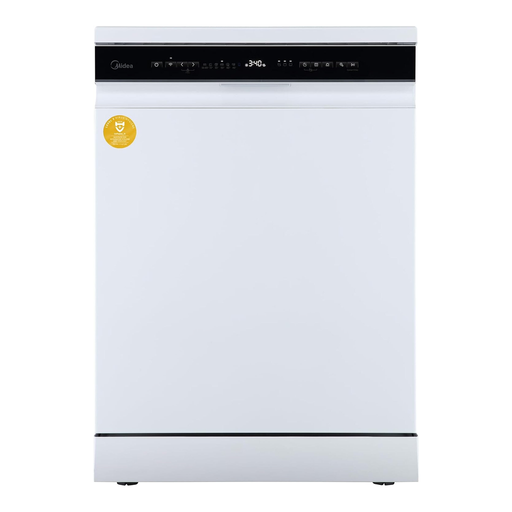
Midea MDWEF1034DW-WE, 45 cm, freestanding
A slimline freestanding dishwasher could be a good fit if you have the space and connections for one.
Listed in the product name: 10 place settings, a cutlery basket, an adjustable-height upper basket, Aqua Stop, delay start, white finish and energy class C.
View at Joybuy
 No image available
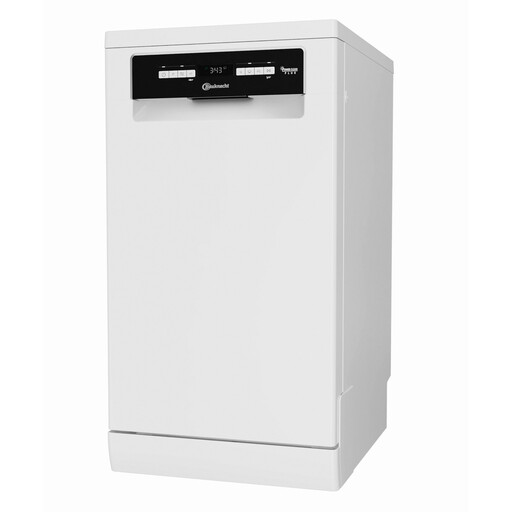
Bauknecht BSFO 3035 PF, 45 cm, freestanding
This freestanding model is an option if your kitchen has a suitable space for it.
Listed in the product name: 10 place settings, PowerClean, ActivDry and energy class D.
View at Joybuy
Frequently asked questions
Are 10 place settings enough for ten large plates used in a cookery class?
Not necessarily. Place settings are a capacity figure on the energy label. Check the plate diameter, rack layout and extra space needed for cookware on the specific appliance (Consumer Advice Centre).
Can I use the Eco consumption figures for a quick wash?
No. The energy label’s figures for electricity, water and programme duration refer to the Eco programme. For a different cycle, check the information for the specific appliance (European Commission).
What should I know before the first use and if I have hard water?
Set the water softener to match your local water hardness. Depending on the hardness, you may need to use regeneration salt. Don’t use table salt, and follow the instructions for your specific appliance (Consumer Advice Centre).
Is a manufacturer’s guarantee the same as statutory consumer rights?
No. For a consumer purchase, statutory rights are against the seller. A guarantee is an additional voluntary promise with its own terms and conditions (Consumer Advice Centre). If you’re buying as a business, check the specific contract terms separately.
Will a domestic dishwasher automatically meet the hygiene requirements for a paid cookery class?
No. You can’t determine this simply from the appliance’s width, Eco label or an advertised hygiene programme. If the class is run as a food business, the operator is responsible for meeting the applicable food law requirements (Federal Office of Consumer Protection and Food Safety). Check with the relevant food safety authority which requirements apply to your particular business. This does not mean there is a general requirement to use a specific type of dishwasher.


