Class leaders with limited kitchen space
You need an appliance that fits the available recess or floor space, and you’ll need to allow for the door opening and connections.


When space is limited, first make sure the appliance’s design suits the available space or kitchen recess. Then test-load it with the crockery you actually use in class to check whether the basket capacity and wash times are sufficient. Eco consumption figures don’t automatically apply to shorter programmes. If your class operates as a food business, you’ll need to assess its hygiene requirements independently of the claims made for a domestic appliance.
You need an appliance that fits the available recess or floor space, and you’ll need to allow for the door opening and connections.
You need to fit crockery and cooking utensils in between classes, so you’ll need to match the basket layout and programme duration to your schedule.
As well as choosing an appliance, you’ll need to assess whether its hygiene process is suitable for your specific business. Manufacturer programmes alone won’t tell you whether it meets your requirements.
Suitable if: you have a suitable space next to your kitchen units and don’t need to fit a cabinet door to the appliance.
Things to consider: the space, door opening and connections all need to work; place settings don’t tell you whether large bowls or pans will fit.
Suitable if: you have a suitable kitchen recess or cabinet door.
Things to consider: the recess dimensions, cabinet door and door opening must suit the specific model. Built-under and fully integrated appliances require different installation arrangements.
| Priority | What to check when buying | Who it matters most to |
|---|---|---|
| Fit and appliance design | Check the appliance and recess dimensions, door swing clearance, cabinet door and connection positions for the specific model. | If space is limited, the appliance must fit in my kitchen, including room for the door to open and for the connections. Around 33% of consumers put fit first. |
| Crockery capacity and wash time | Check the basket layout against your own plates, bowls, glasses and pans, and look up the programme duration for the specific model. | Between classes, I need space for the crockery I actually use and wash times that work with my schedule. Around 27% of consumers prioritise capacity and throughput. |
| Hygiene in a business setting | Check whether the class operates as a food business, then assess the intended cleaning process and whether the appliance is suitable for that business. | If food is prepared for others, the hygiene process must suit the business. Around 20% of consumers put hygiene first. |
| Running costs and maintenance | Compare consumption figures on the same Eco basis, and take the water hardness and care instructions for the specific appliance into account. | For regular wash cycles, I want to be able to estimate consumption and maintenance requirements. Around 20% of consumers prioritise running costs and maintenance. |
The standard place-setting capacity doesn’t necessarily reflect the mix of class crockery and larger cooking utensils you’ll actually need to wash.
Before you decide, check the basket layout against your own plates, bowls and pans.
If large utensils won’t fit in the basket, you may need extra wash cycles or to clean them separately.
Eco programme consumption figures don’t automatically apply to a shorter programme that fits your class schedule.
Compare Eco figures only on a like-for-like basis, and check programme duration separately.
According to the German Federal Institute for Risk Assessment, the hygienic results of dishwashing in the catering sector also depend on the washing process. The requirements of your specific business need to be assessed separately.
If your class operates as a food business, assess the cleaning process independently of product advertising.
Freestanding, built-under and fully integrated models differ in their dimensions and installation requirements.
Check the height, width, depth, cabinet door and door opening for the specific model.
Depending on the installation, you may need to adapt your kitchen or connections.
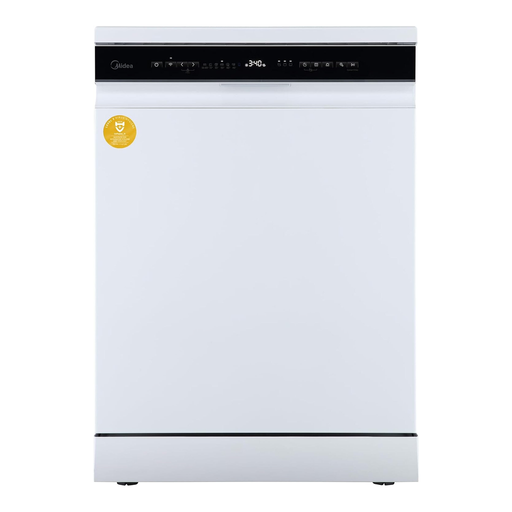
The MDWEF1034DW-WE is a freestanding slimline appliance for kitchens without a fitted cabinet door.
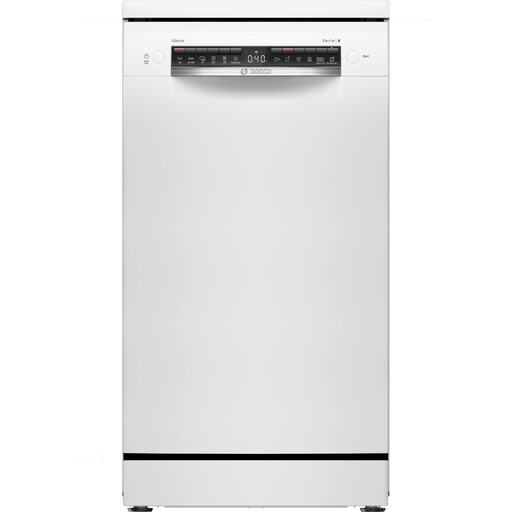
The freestanding BDFS26040XQ is a slimline alternative with an adjustable upper basket.
The freestanding SPS6EMI21E has a slimline design and a flexible basket system.
The SR63EX25KE is a slimline fully integrated model designed to be fitted with a matching kitchen door.
The fully integrated G 5790 SCVi SL is a slimline appliance with a cutlery tray.
The models below are freestanding slimline dishwashers for spaces without a fitted cabinet door.
 No image available
Could suit a freestanding slimline space if the basket works for your class crockery.
Capacity for 10 place settings; height-adjustable upper basket; six programmes. Fast+ is advertised as shortening programme duration.
The place-setting capacity doesn’t tell you whether large bowls or pans will fit.
 No image available
Could fit a freestanding slimline space if capacity for nine place settings is enough for your actual load.
Six programmes, including Intensive, Glass and Quick; height-adjustable basket and cutlery tray.
The stated capacity doesn’t show whether larger class utensils such as bowls or pans will fit.
 No image available
Could suit a narrow space if the basket layout and programme duration work for your class schedule.
Capacity for 10 place settings; height-adjustable baskets and flexible basket elements; a listed 1-hour programme at 65 °C.
The place-setting capacity doesn’t show whether large cooking utensils will fit.
 No image available
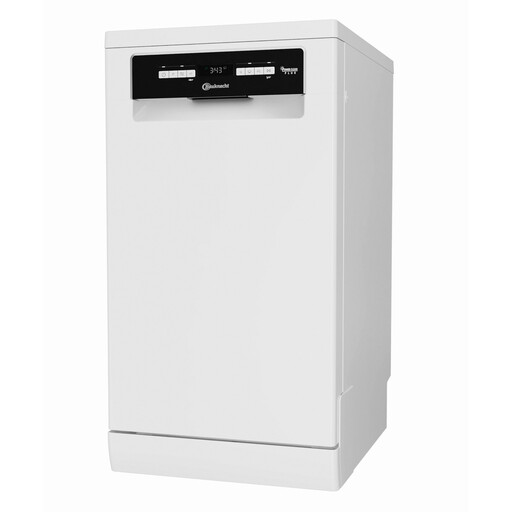
Could suit a freestanding slimline space without a fitted cabinet door.
Capacity for 10 place settings; height-adjustable upper basket; cutlery basket; delay start.
The place-setting capacity doesn’t show whether large class utensils will fit.
 No image available
Could suit a narrow space if the basket layout works for your class load.
Capacity for 10 place settings; height-adjustable upper basket; integrated cutlery tray; eight standard programmes and one sensor programme.
The place-setting capacity doesn’t show whether large bowls or pans will fit.
Not necessarily. Use the place-setting capacity as a point of comparison, then check whether your own bowls, pans and planned crockery changes will fit the basket layout.
Find out the local water hardness and set the water softener according to the instructions for your specific appliance. Bosch’s first-use instructions apply to Bosch appliances and aren’t general guidance for other models.
Compare electricity use per 100 Eco cycles and water use per Eco cycle on the same label basis. Also allow for detergent and, depending on the appliance settings and instructions, salt and rinse aid if required.
The German federal government portal states that food businesses producing, processing or distributing food must register with their local food safety authority. You can’t tell from the description alone whether a particular class falls into this category; a private gathering isn’t automatically the same thing.
No. A programme name alone doesn’t prove that an appliance is suitable for a business hygiene process. The German Federal Institute for Risk Assessment notes that hygienic dishwashing results in catering depend, among other things, on temperature, water quality and contact time. This does not amount to specific approval or a general ban on domestic appliances.