First, choose between a freestanding and an integrated model, then check that its dimensions, location or housing niche, and connections are right for your kitchen. Next, make sure the cutlery drawer or basket suits your utensils and the rest of your crockery. Compare consumption figures on the same Eco programme basis. When handling raw and ready-to-eat ingredients, it’s still important to use separate utensils and clean them thoroughly, as recommended by the German Federal Institute for Risk Assessment.
Who is a slimline model suitable for?
A small kitchen with a fixed space
If space is tight in your kitchen, first check that the appliance’s width, height, depth and connections will fit where you plan to put it. Germany’s Federal Environment Agency identifies slimline models as a possible solution when space is limited.
Lots of cutlery when batch cooking
If you regularly have cutlery and smaller kitchen utensils to wash alongside plates and pans, check how they fit in the specific appliance. The models described here from Bosch, Bauknecht and Miele feature cutlery drawers.
Separate preparation of raw ingredients
If you prepare raw and ready-to-eat ingredients, plan to use separate utensils and clean them thoroughly between tasks. Germany’s Federal Institute for Risk Assessment recommends using separate kitchen utensils.
What should you look for when buying?
Slimline freestanding dishwasher
A good fit if: you have a suitable space with the right connections and don’t plan to use a suitable built-in niche.
Things to consider: Width alone won’t tell you whether the appliance will fit under your worktop. Height, depth and interior layout vary by model.
Slimline fully integrated dishwasher
A good fit if: you have a suitable niche and cupboard door, and want the appliance integrated into your kitchen units.
Things to consider: The niche dimensions, door and installation must suit your kitchen. You can’t assume that the requirements for a freestanding model will also apply.
| What matters |
What to check when buying |
Who it matters most to |
| Style and space requirements |
Check the appliance and niche dimensions, door opening, cupboard door, and water, drainage and electricity connections at the installation location. |
If space is limited, I want to be sure the style and connections will fit. This is a priority for around 29% of consumers who are mainly concerned about space and installation. |
| Cutlery and kitchen utensils |
Check whether there’s a cutlery drawer or basket, the position of the upper basket, and space for long utensils, based on the kind of load you usually have. |
If I load cutlery, longer kitchen utensils and other dishes together, the layout needs to work for me. Around 29% of consumers prioritise how cutlery is organised. |
| Cleaning after food preparation |
Check whether the utensils are dishwasher-safe and what programmes are available. Use separate utensils for raw and ready-to-eat ingredients. |
If I prepare raw and ready-to-eat ingredients, I want to clean used utensils thoroughly and avoid cross-contamination. Around 21% of consumers prioritise kitchen hygiene. |
| Consumption and additional services |
Compare kWh per 100 Eco cycles and litres per Eco cycle on the same basis. Check programme duration, noise levels, delivery and installation services separately. |
If I use the appliance frequently, I want to take its consumption figures and any services needed for installation into account. Around 21% of consumers prioritise costs and consumption. |
Which mistakes should you avoid?
-
Assuming a 45 cm width guarantees a good fit for built-in installation
A freestanding model and a fully integrated one have different installation requirements. The width category alone won’t tell you whether the dimensions, niche and cupboard door will all fit together.
Measure the space or niche and check the specific appliance style, door opening and connections before choosing a model.
-
Assuming a cutlery drawer and basket are interchangeable
Different cutlery options are listed for the MDWEF1034DW-WE model. A drawer and a basket affect how you can arrange cutlery and other dishes.
Before buying, ask for confirmation of the features included with the specific version in its product documentation.
-
Assuming energy label figures apply to every programme
Electricity and water figures relate to the Eco programme and are given using different measures. They don’t automatically show the consumption of an intensive or quick programme.
The North Rhine-Westphalia Consumer Advice Centre recommends checking electricity consumption per 100 Eco cycles. Compare like-for-like units and consider which programmes you’re likely to use.
-
Confusing an advertised hygiene programme with separate food preparation
Programme features don’t replace the need to use separate kitchen utensils for raw and ready-to-eat ingredients. Germany’s Federal Institute for Risk Assessment recommends using separate utensils.
Keep utensils separate and clean used items thoroughly between tasks. Also check whether they’re dishwasher-safe.
Brands to consider
Bosch
The SPS2HMI42E freestanding model is a slimline appliance with a cutlery drawer.
- Bosch Home Appliances lists dimensions of 845 × 450 × 600 mm, energy efficiency class E and water consumption of 9,5 l per Eco cycle for this model.
- Hygiene level claims relate to named programmes and aren’t a general promise that every load will be disinfected.
Beko
The BDFS26040XQ freestanding model combines a slimline design with a cutlery drawer and height-adjustable upper basket.
- Beko lists a capacity of 10 place settings, energy efficiency class C, 8,9 l per Eco cycle and 44 dB(A) for this model.
- These figures apply to the model specified. For a fair comparison, usage and programme basis need to be the same.
Bauknecht
The BSFO 3O35 PF freestanding model is a 45 cm appliance with a cutlery drawer.
- Bauknecht lists dimensions of 85 × 45 × 59 cm and energy efficiency class D for this model.
- PowerClean cleaning performance claims come from the manufacturer. Check delivery and any optional installation package separately.
Miele
The fully integrated G 5590 SCVi SL Active Stainless Steel offers a built-in option with a cutlery drawer and delay start.
- Miele lists energy efficiency class E and 45 dB for this model.
- The niche and cupboard door must fit. Manufacturer claims about quick wash results aren’t an independent assessment.
Midea
The MDWEF1034DW-WE freestanding model is described as a 45 cm appliance with a cutlery option.
- Midea lists a capacity of 10 place settings and dimensions of 850 × 450 × 600 mm for this model.
- The cutlery features are described differently in different listings. Check the specific version rather than assuming from the model name that it comes with a drawer or basket.
Joybuy products for narrow spaces
The products below are slimline freestanding dishwashers. Compare their dimensions, capacity and cutlery options with your available space and the kind of loads you usually wash.
 Image unavailable
Beko BDFS26040XQ
For a slimline freestanding space if you’re looking for a capacity of 10 place settings.
45 cm; 10 place settings; energy efficiency class C; stainless steel look.
View at Joybuy
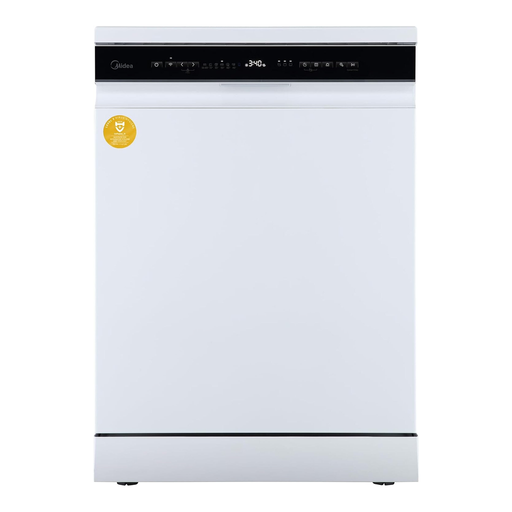 Image unavailable
Midea MDWEF1034DW-WE
This could suit you if you’d prefer to put cutlery in a basket rather than a separate drawer. Check that the version on offer includes this feature.
45 cm; 10 place settings; cutlery basket; height-adjustable upper basket; energy efficiency class C.
View at Joybuy
 Image unavailable
Exquisit EGSP52109-E-030E
For a slimline freestanding space if a capacity of 9 place settings suits the loads you usually wash.
45 cm; 9 place settings; 6 programmes; silver.
View at Joybuy
 Image unavailable
Bosch SPS4HKW49E Series 4
An option for a slimline freestanding space. Check that its interior layout suits the cutlery and crockery you usually wash.
45 cm; Vario Flex Basket System; AquaStop.
View at Joybuy
Frequently asked questions
Which figures on the energy label can I compare directly?
Compare figures on the same programme basis. The energy label for household dishwashers shows, among other things, electricity consumption per 100 Eco cycles, water consumption per Eco cycle, Eco programme duration, place settings and noise levels. It doesn’t show the consumption of an intensive programme.
Is a hygiene programme enough if I prepare ingredients in advance?
Don’t rely on a programme name alone. Germany’s Federal Institute for Risk Assessment recommends using separate kitchen utensils for raw, cooked and ready-to-eat foods. Clean used items thoroughly between tasks and check whether they’re dishwasher-safe.
What should I set before the first wash?
Find out the water hardness in your area and set the water softener as instructed for your specific model. Bosch Home Appliances also explains how to fill its appliances with suitable dishwasher salt. Don’t put detergent in the salt compartment.
Are there rules in Germany about energy labels and disposing of an old appliance?
Yes. EU energy labelling rules for household dishwashers have applied since 1 March 2021. Waste electrical and electronic equipment must be collected separately. Information from Germany’s Federal Environment Agency explains the requirements for proper take-back. Check separately what collection service is offered with your purchase.


