What should you look for when choosing one?
First, decide whether you have space for a freestanding appliance or a suitable installation niche. Then check that your plates fit and consider the loading arrangement, noise levels and Eco figures on a like-for-like basis.
| What matters |
What to check before buying |
Who will find this important? |
| Design and space |
Compare the available space with all the appliance’s dimensions; for integrated models, also check the niche, cabinet door and installation details. |
If there’s only one possible space for an appliance in our narrow kitchen, I want to be sure it will actually fit. Around 33% of consumers put the design and space requirements first. |
| Fit for your dinner plates |
Measure your largest plates and check the lower basket, basket layout and clearance around the spray arm. |
If we load several large plates after a shared meal, their actual fit matters more to me than a capacity figure alone. Around 27% of consumers prioritise space for plates and cutlery. |
| Noise in living areas |
Compare the decibel rating and noise emission class of the exact model, and agree on suitable times to run it. |
If someone is working or sitting in the open-plan kitchen while the dishwasher is running, I want it to be as unobtrusive as possible. Around 20% of consumers prioritise quiet operation. |
| Running and follow-on costs |
Compare kWh per 100 Eco cycles and litres per Eco cycle; budget separately for usage and any installation work. |
If several people use the appliance regularly, I want to compare its electricity and water consumption on a like-for-like basis. Around 20% of consumers put running costs first. |
Dishwashers for a free-standing space
These slimline models are freestanding dishwashers for kitchens with a suitable space available. Before choosing one, check the full appliance dimensions and make sure your dinner plates will fit in the lower basket.
 No image available
Gorenje GS520E15W, freestanding
For a freestanding space; the stated capacity is a useful point of comparison, but doesn’t confirm that your largest plates will fit.
45 cm wide; 9 place settings; 5 programmes, including Eco and Intensive; 47 dB; 70 kWh per 100 cycles; 9 l per cycle; appliance dimensions: 84.5 × 44.8 × 60 cm.
View at Joybuy
 No image available
Beko BDFS26040XQ, freestanding
For a freestanding space; the height-adjustable upper basket and cutlery drawer are useful when you’re sharing the loading.
45 cm wide; 10 place settings; energy rating C; 59 kWh per 100 cycles; 8.9 l per Eco cycle; 44 dB(A); appliance dimensions: 850 × 448 × 600 mm.
View at Joybuy
 No image available
Exquisit EGSP52109-E-030E, freestanding
For a freestanding space; the height-adjustable basket and cutlery tray are listed as useful for loading dishes for several people.
45 cm wide; 9 place settings; 6 programmes; 47 dB(A); 70 kWh per 100 Eco cycles; 9 l per Eco cycle; appliance dimensions: 81.5 × 44.8 × 55 cm.
View at Joybuy
 No image available
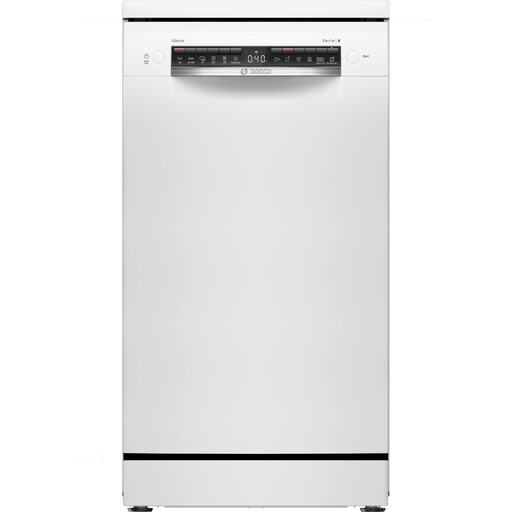
Bosch SPS4HKW49E Series 4, freestanding
For a freestanding space; the height-adjustable upper basket and cutlery drawer give you different loading options.
45 cm wide; 10 place settings; energy rating E; 44 dB(A); 76 kWh per 100 Eco cycles; 8.9 l per Eco cycle; appliance dimensions: 84.5 × 45 × 60 cm.
View at Joybuy
 No image available
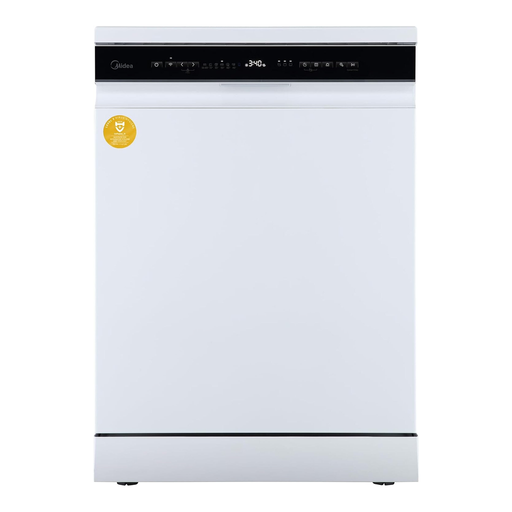
Midea MDWEF1034DW-WE, freestanding
For a freestanding space; the height-adjustable upper basket and cutlery basket are useful when loading for several people.
45 cm wide; 10 place settings; energy rating C; 44 dB.
View at Joybuy
Frequently asked questions
Is a width of 45 cm enough for our dinner plates?
Width alone won’t answer that. Measure your largest plates and check the basket layout of the specific model, as well as whether the spray arm can rotate freely. Place settings are useful for comparing capacity, but they don’t prove that your plates will fit.
What should we check before installing a dishwasher in our shared kitchen?
Measure the entire space and decide whether a freestanding appliance or a suitable under-counter or integrated installation is an option. Also check the connection and installation requirements for the specific model. A stated width of 45 cm confirms neither the other dimensions nor its suitability for your installation.
Can we use ordinary washing-up liquid, and when does the appliance need salt?
Bosch warns against using washing-up liquid in its dishwashers, as excessive foam can damage the appliance, and recommends using a suitable dishwasher detergent. Whether you need salt and which softening setting to use depend on the water hardness, detergent and appliance instructions. The figure of 14 °dH or above quoted by Bosch is not a general legal limit.
How can we compare running costs, and what happens if the appliance develops a fault?
Compare consumption figures on the same Eco basis, then estimate electricity costs using the number of cycles you expect to run and your tariff. If a newly purchased appliance is faulty, statutory rights against the seller are separate from a voluntary manufacturer’s guarantee. The Verbraucherzentrale explains that Germany has a two-year statutory warranty period.
Which energy label details matter for dishwashers?
For household dishwashers sold on the EU market, the energy label has used an A to G scale since 1 March 2021. The European Commission lists details such as electricity consumption per 100 Eco cycles, water consumption per Eco cycle, capacity and noise emissions. Older plus ratings are not a current basis for comparison.


