Hosts with a mix of crockery
After a bring-and-share, you’ll want plates, bowls and cutlery to fit neatly into the baskets. The Verbraucherzentrale recommends considering your own crockery needs as well as capacity when comparing models.


First, choose a design that suits your available space or kitchen recess. Then check that your plates, bowls and cutlery will fit in the basket layout of the specific model. If you’ll need your crockery again soon, compare the programme designed for that separately. For regular full loads, Eco consumption figures are more useful when compared on a like-for-like basis than figures for a quick programme.
After a bring-and-share, you’ll want plates, bowls and cutlery to fit neatly into the baskets. The Verbraucherzentrale recommends considering your own crockery needs as well as capacity when comparing models.
The key is whether the design and appliance dimensions suit your available space or kitchen recess. The Umweltbundesamt distinguishes between dishwashers with 45 cm and 60 cm widths, among other things.
If you’ll need your crockery again soon, it’s worth checking the relevant programme on the specific model. An Eco figure doesn’t automatically tell you how long a quick programme takes or how much it uses.
Start with the design and available space, then check the basket layout for your crockery. If needed, compare quick programmes alongside the Eco figures.
| Buying criterion | What to look for | Who it matters most to |
|---|---|---|
| Space for a mix of crockery | Check plate diameters, adjustable baskets, fold-down plate supports and the cutlery layout on the specific model. | If I want to fit plates, bowls and cutlery in together after a bring-and-share, the basket layout matters more to me than a number on the label. Around 36% of consumers would prioritise usable space for mixed crockery. |
| Fit and design | Compare the appliance dimensions with your available space or recess, and take the cabinet front, door movement and connections into account. | In a small kitchen, I want to know whether the appliance, cabinet front and connections will all fit in the space. Around 29% of consumers would put how well it fits in their kitchen first. |
| Time until you need it again | Check the programme duration and suitability for your usual level of soiling in the model documentation; treat any advertised speed-up as a manufacturer claim. | If I’ll need the plates again soon or plan to run several loads, the duration of the right programme matters to me. Around 21% of consumers would prioritise a short cycle time. |
| Consumption and running costs | Compare kWh per 100 Eco cycles, litres per Eco cycle and noise levels on a like-for-like basis; check delivery and installation services separately. | For regular everyday loads, I want to understand running costs and what’s included in the purchase. Around 14% of consumers would prioritise manageable running costs. |
The Verbraucherzentrale includes energy consumption per 100 Eco cycles and the number of place settings among the figures to compare. The Umweltbundesamt recommends using the Eco programme and running a full load to save energy. These figures don’t replace the need to check programme duration and how your crockery will fit.
The capacity shown on the EU energy label doesn’t guarantee that large everyday plates and serving bowls will fit comfortably at the same time.
Measure the plates you use most often and check the basket positions and cutlery layout on the model.
A 45 cm model won’t necessarily fit your recess or available space; the height, depth and design also need to be right.
Before ordering, compare all the appliance dimensions with the space, cabinet front and connections.
The figures on the energy label are based on the Eco programme. Any advertised speed-up feature is a separate manufacturer claim.
Compare Eco figures on a like-for-like basis only, and check the specific model’s documentation for quick programmes.
Delivery, connection, removal and taking away an old appliance may be separate services.
Before buying, check in writing which services are included in the specific offer.
The SPV2IKX10E is a fully integrated 45 cm model for a suitable built-in space.
The fully integrated SR65ZX22ME is a 45 cm option with adjustable baskets and additional features promoted by the manufacturer.
The semi-integrated DSS26020X is a 45 cm option with a visible control panel.
The BK6FB10BS7A0X is a freestanding 45 cm model for a suitable space.
The G 5790 SCVi SL is a fully integrated 45 cm option with a cutlery tray.
This selection features freestanding slimline dishwashers for kitchens with suitable space, rather than a built-in recess.
 No image available
For a suitable space if a flexible basket layout for mixed crockery is important to you.
10 place settings; height-adjustable upper basket; energy class C; stainless steel finish.
 No image available
For kitchens with suitable space if a freestanding slimline model is the design you’re looking for.
9 place settings; 6 programmes; silver.
 No image available
For a space rather than a built-in recess; the product listing mentions a flexible basket system for different loads.
Vario Flex basket system; energy class E.
 No image available
For a suitable space if you want to compare a stated capacity and a height-adjustable upper basket.
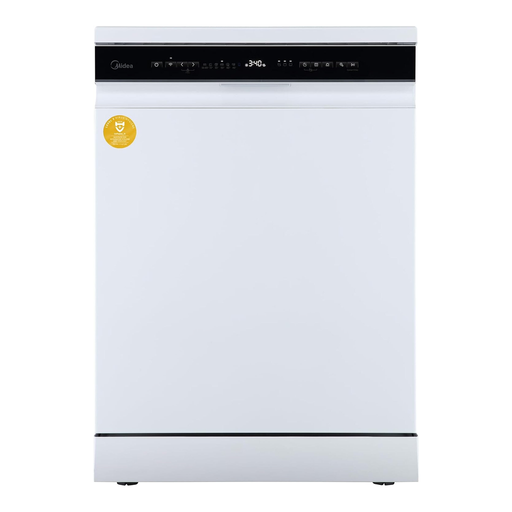
10 place settings; height-adjustable upper basket; cutlery basket; energy class C; white.
Not necessarily. Capacity is a useful figure for comparison, but check your plates, bowls and cutlery, as well as the basket adjustments. If everything won’t fit comfortably, plan to run more than one load.
No. The Umweltbundesamt recommends not pre-rinsing crockery, especially with warm water. It also recommends using the Eco programme with a full load to save energy.
Compare the appliance dimensions, design, cabinet front and connections with the installation plan and instruction manual for your chosen model. Miele advises in one of its appliance manuals that you read both before installation and first use; for another appliance, its own documentation is the one to follow.
According to the European Commission, the A to G scale has applied to household dishwashers since 1 March 2021. The label includes details such as energy consumption per 100 Eco cycles, water consumption per Eco cycle, capacity, Eco programme duration and noise level. These Eco figures shouldn’t be assumed to apply to a quick programme without checking.