Holiday home with a narrow kitchen
First, check that the appliance type and full dimensions suit the available space or installation niche. 45 cm models are available as both freestanding and integrated appliances.


There’s no one type of dishwasher that will suit every holiday-home kitchen. First, choose between a freestanding appliance and a suitable integrated model, based on the available space, cabinet front, connections and full dimensions. Then check the cutlery basket or drawer and how the rest of your crockery will fit. If the property is left unused for long periods, also check the model-specific care and connection instructions, and compare Eco figures on a like-for-like basis.
First, check that the appliance type and full dimensions suit the available space or installation niche. 45 cm models are available as both freestanding and integrated appliances.
If cutlery is loaded alongside varying amounts of crockery, a suitable basket or drawer layout is important.
Look for accessible care and connection instructions for an appliance that won’t be used continuously. The recommended steps can vary by model.
Start by comparing the appliance type, available space and connections. Then consider the cutlery layout and what’s needed for care during periods when the property is unused. Compare Eco figures on the same basis.
| What matters | What to check before buying | Who it matters to |
|---|---|---|
| Fit and appliance type | Check the full appliance and niche dimensions, door clearance, and water, drainage and electrical connections. | If I only have a narrow space or an existing niche, the appliance type, height and depth all need to fit. Around 29% of consumers say fit is their top concern. |
| Cutlery loading | Check whether the exact model comes with a cutlery basket or drawer, and whether the racks can be adjusted. | When I’m loading different combinations of plates and pans, I want enough room for cutlery without losing sight of the space needed for larger items. Around 23% of consumers prioritise cutlery loading. |
| Use and care | Check the model’s instructions, filter care guidance and advice on using the appliance again after a period of disuse. | After a long closure, I want to know how to care for the specific appliance and get it running again. Around 18% of consumers put care and use after periods of disuse first. |
| Water connections and protection | Read the water protection details, installation guidance and conditions for the specific model. | If the holiday home is sometimes empty, I want to understand the connections and water protection in advance. Around 18% of consumers put these points first. |
| Eco consumption and usage | Compare kWh per 100 Eco cycles, litres per Eco cycle, capacity and programme duration on the same label basis. | With irregular use, I want to assess consumption figures in light of how many washes I expect to run. Around 12% of consumers focus mainly on Eco consumption. |
Freestanding and under-counter models also differ in height and depth. Matching the stated width alone doesn’t mean the appliance will fit your kitchen.
Check the full dimensions of the model against the available space or installation niche, connections and door clearance.
An unsuitable niche may require extra work to adapt it.
The symbol indicates that an item is suitable for contact with food, not that it can be washed in a dishwasher.
Check the care instructions for your cutlery, and only put it in the dishwasher if the instructions say it’s suitable.
Midea’s website lists a cutlery drawer for the Midea MDWEF1034DW-WE, while the Joybuy product page lists a cutlery basket.
Before buying, confirm exactly what’s included with the specific model using clear product information or confirmation of the items supplied.
The stated Eco figure shows consumption per cycle or for 100 cycles, not how often the dishwasher will be used in your holiday home.
Compare like-for-like label figures and consider how often you expect to run the appliance.
The slimline freestanding SPS4EMW02D range is a useful reference for dimensions and cutlery layout.
The SR43ES24ME is an example of a slimline under-counter dishwasher for an existing installation niche.
The freestanding 45 cm BDFS26040XQ is a useful model to compare for capacity and cutlery layout.
The freestanding MDWEF1034DW-WE is a useful model to compare for dimensions and loading.
The fully integrated G 5790 SCVi SL is a slimline alternative for a suitable fitted kitchen.
This selection features freestanding slimline dishwashers for a suitable space without a cabinet front. Before you decide, check the full appliance dimensions and connections, as well as the cutlery layout for the exact version.
 No image available
For a suitable space where there’s no cabinet front for an integrated appliance.
Dimensions: 845 × 448 × 600 mm; 9 place settings; five programmes including Eco; AquaStop.
 No image available
A freestanding option if its capacity and cutlery layout suit the changing amount of crockery.
Beko lists 10 place settings, energy efficiency class C, 8.9 l per Eco cycle and 44 dB(A). Product details about the cutlery layout vary, so check whether the specific version comes with a basket or drawer.
 No image available
For a suitable freestanding space and a load that works with the cutlery tray.
Dimensions: 81.5 × 44.8 × 55 cm; 9 place settings; six programmes; cutlery tray and height-adjustable rack.
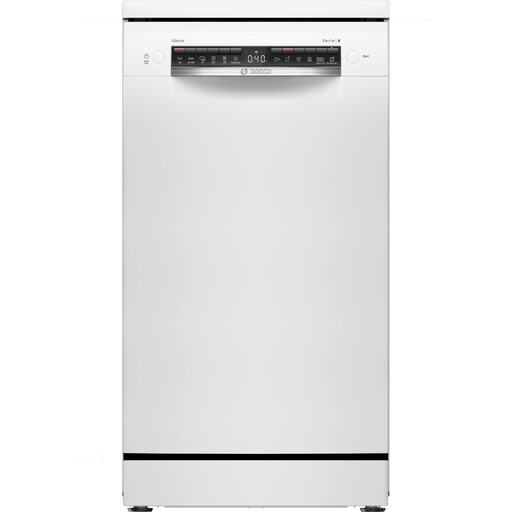 No image available
Suitable for a space designed for a freestanding 45 cm model.
Dimensions: 84.5 × 45 × 60 cm; 10 place settings; six main programmes; energy class E; cutlery drawer and height-adjustable upper basket.
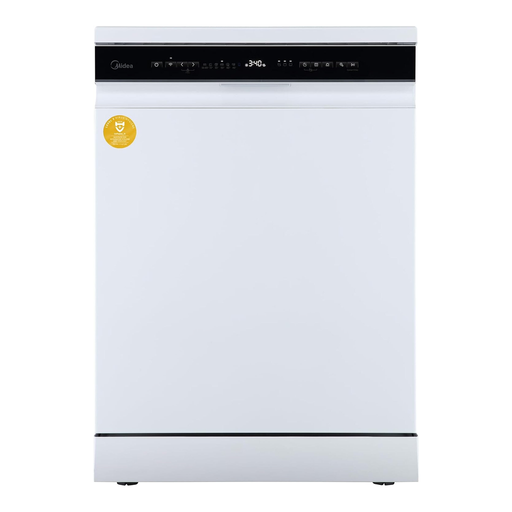 No image available
A freestanding option for a suitable space and a changing amount of crockery.
10 place settings and a height-adjustable upper basket. Midea lists a cutlery drawer, while the Joybuy product page lists a cutlery basket. Before buying, check the layout and appliance dimensions for the specific version.
Check the care instructions for your cutlery. The glass-and-fork symbol indicates that an item is suitable for contact with food, not that it’s dishwasher-safe.
The EU energy label shows electricity consumption for 100 Eco cycles and water consumption per Eco cycle. Compare like-for-like figures and consider how many washes you expect to run at the holiday home.
Check that the available space and connections match the instructions for the specific model. Follow its guidance for cleaning the filter and getting the appliance running again after a long period of disuse, as the steps can vary between models.
Electrical appliances must not be put in household waste. They can be taken to local collection points, among other options. Germany’s Federal Ministry for the Environment explains that retailers covered by the rules must accept a similar old appliance free of charge when you buy a new one, subject to the conditions of the Electrical and Electronic Equipment Act (ElektroG). Before finalising your purchase, check with the retailer how returns are handled when the new appliance is delivered.
New household dishwashers sold in the EU must meet ecodesign requirements, including having an Eco programme. The European Commission also describes the EU energy label, with classes from A to G and details such as consumption, capacity and noise levels.