Cutlery for lunch every working day
You regularly wash forks, spoons and knives that are suitable for dishwashers. What matters to you is whether a basket or a drawer makes loading and unloading easier.


A slimline dishwasher is a good fit for cutlery you use for lunch every working day if its freestanding or integrated design suits your kitchen and its cutlery storage suits the way you load it. Germany’s Federal Environment Agency recommends a width of 45 cm for small kitchens with limited space; Bosch Home Appliances notes that sorting cutlery into a drawer can take longer than putting it in a basket. Compare Eco consumption figures separately from programme duration and the programme you actually need, as the label figures are based on Eco.
You regularly wash forks, spoons and knives that are suitable for dishwashers. What matters to you is whether a basket or a drawer makes loading and unloading easier.
The space available limits the width of the appliance. Before buying, you’ll also need to decide whether a freestanding model or a suitable integrated option is right for you.
You need your cutlery again by the next working day, so you compare the duration of the available programmes with Eco mode.
First, measure the space or installation niche and check the connections. Then compare the cutlery storage and programmes with your washing routine.
| Priority | What to check | Who it matters to |
|---|---|---|
| Cutlery storage | Check what storage comes with the appliance and whether it suits the cutlery you regularly wash. | If I regularly load cutlery used for lunch, I want to know whether a basket is quick to fill or whether I’d rather sort the items separately into a drawer. Around 33% of consumers put cutlery storage first. |
| Kitchen fit | Compare the exact appliance’s height, width and depth with the available space or niche; check its design and connections too. | If space is limited, the appliance’s dimensions and design need to suit the kitchen. Around 27% of consumers prioritise how well it fits their kitchen. |
| Electricity and water | Compare kWh per 100 Eco cycles and litres per Eco cycle with how often you expect to use the appliance. | When running repeated wash cycles, I want to compare Eco consumption with my own usage rather than focus on just one figure. Around 20% of consumers put running costs first. |
| Programme duration | Check the Eco duration and the programmes available on the specific appliance separately. | If I need the cutlery again by the next working day, I compare the Eco duration with the shorter programmes available without assuming they use the same amount of energy or water. Around 20% of consumers prioritise having their cutlery ready in time. |
The width doesn’t tell you whether the height, depth or design will suit the available space. Appliances with the same stated width can also have different overall dimensions.
Check the full dimensions of the specific model against the installation niche or available space, and make sure the necessary connections are in place.
They differ in how you load your cutlery and how much room is left in the lower basket. Some model specifications may also list different types of storage.
Before buying, confirm what comes with the exact version you’re considering rather than relying on the model name alone.
Comparable energy label figures are based on Eco. They don’t tell you how much electricity or water another programme uses.
Consider the Eco duration and the programmes you need separately, and don’t assume Eco figures apply to a quick wash without checking.
The fully integrated 45 cm SPV6YMX08E is an option for kitchens with a suitable installation space.
The semi-integrated 45 cm DSS28021X has a cutlery tray and visible controls.
The fully integrated 45 cm SR65ZX22ME requires a suitable installation space.
The fully integrated 45 cm G 5790 SCVi SL is another integrated option with a cutlery tray.
The freestanding 45 cm MDWEF1034DW-WE may suit you if you don’t have a suitable installation niche.
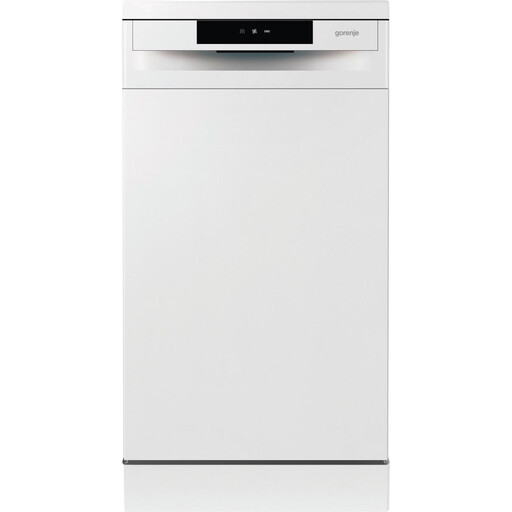
The following Joybuy products are freestanding slimline dishwashers for kitchens with suitable space. Check the dimensions and connections for each model.
 No image available
The freestanding 45 cm version may suit you if the space and connections are right.
 No image available
The freestanding 45 cm version may suit you if the space and connections are right.
 No image available
The freestanding slimline version may suit you if the space and connections are right.
 No image available
The freestanding 45 cm version may suit you if the space and connections are right.
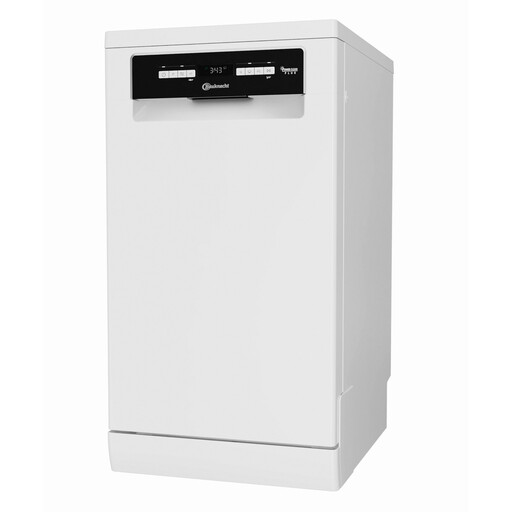 No image available
The freestanding 45 cm version may suit you if the space and connections are right.
No. First check the care instructions for the cutlery. The Verbraucherzentrale points out that the glass-and-fork symbol indicates suitability for contact with food; it doesn’t automatically mean an item is dishwasher-safe. Choose a programme according to the instructions for both the cutlery and the appliance.
No. Germany’s Federal Environment Agency advises against pre-rinsing, especially in warm water. Load the appliance properly and follow the loading instructions for your specific model.
Compare electricity use per 100 Eco cycles, water use per Eco cycle and the Eco duration. The Verbraucherzentrale explains these label figures; compare them with how often you use the appliance rather than applying them to every other programme.
Compare the exact appliance’s height, width and depth with the available space or niche, and check the water, drainage and electricity connections against the installation instructions. The 45 cm figure doesn’t describe all the appliance’s external dimensions.
Household dishwashers use the EU scale from A to G, which the European Commission says has been in use since 1 March 2021. Your Europe explains that online listings must show the label or the prescribed class arrow, with access to the label and product information sheet.