Teaching kitchens with lots of lunchboxes
If you need to wash several lunchboxes and their lids, the usable rack layout is crucial. The place-setting capacity is only a limited guide.


A slimline dishwasher can work well in a teaching kitchen, provided its design and connections suit the kitchen and your lunchboxes and lids fit in the racks without obstructing the spray arms. When there’s little time between sessions, programme duration and drying performance matter. If you often run full loads, compare the Eco consumption figures too. Place settings alone won’t tell you how many of your lunchboxes will fit.
If you need to wash several lunchboxes and their lids, the usable rack layout is crucial. The place-setting capacity is only a limited guide.
If clean lunchboxes need to be ready between sessions, compare programme duration and drying performance. Eco consumption figures don’t necessarily apply when you select a time-saving option.
If the space is already fixed, first choose between a freestanding model, an under-counter model and a fully integrated model – according to the available space, niche and cabinet door.
A good fit if: you have a suitable space with the necessary connections, but no suitable built-in niche and cabinet door.
Consider: the external dimensions and the space needed to open the door must suit the chosen spot.
A good fit if: you have a suitable built-in niche and cabinet door, and want the appliance to sit within the kitchen run.
Consider: check the niche dimensions and installation requirements before comparing features.
A good fit if: you want the appliance to sit beneath an existing worktop without needing a fully integrated cabinet door.
Consider: check the installation height, depth and clearance needed to open the door.
| Buying priority | What to look for when buying | Who is this especially important for? |
|---|---|---|
| Loading lunchboxes and lids | Check the largest items against the rack layout; keep the spray arms clear. | If I want to wash several lunchboxes and their lids in one load, I need a suitable rack layout. Around 33% of consumers would make loading their top buying priority. |
| Design and available space | Check the external or niche dimensions, connections and door clearance. | In a small teaching kitchen, the appliance needs to fit the designated space and the preferred installation type. Around 27% of consumers would put fit first. |
| Time and drying | Compare Eco duration, available time-saving options and drying method. | If lunchboxes need to be ready between teaching sessions, cycle time and drying matter. For around 20% of consumers, being able to reuse them in time would be the main priority. |
| Running costs | Compare kWh per 100 Eco cycles, litres per Eco cycle and Eco duration on a like-for-like basis. | If I run frequent loads, I want to compare consumption figures for the same programme rather than treating quick-programme figures as equivalent to Eco figures. Around 20% of consumers would make consumption their main priority. |
The capacity figure refers to place settings, not the number of your lunchboxes. Their shape and any loose lids affect how much of the usable rack space you can make use of.
Before deciding, check how your largest lunchboxes, lids and, if relevant, cooking utensils fit in the rack layout of the specific model.
Eco consumption and duration figures apply to that programme. A time-saving option is a different operating condition.
If you’re short on time, check the duration and consumption figures for the setting you actually intend to use separately.
Freestanding, fully integrated and under-counter models have different requirements for the available space, niche and cabinet door.
Before ordering, check the relevant external or niche dimensions, connections and the space needed to open the door.
The freestanding 45 cm SPS4HKW49E is an example of a slimline design with a flexible rack system and optional Extra Dry function.
The fully integrated 45 cm SR63EX25KE is an example suited to a compatible built-in niche and a tightly scheduled teaching kitchen.
The freestanding DFS28021W is an example of a 45 cm design with an adjustable upper rack.
The under-counter BSUO 3O33 PF X is an example for a kitchen with a suitable worktop.
The fully integrated 45 cm FSE32407Z is an example with an adjustable upper rack.
The Joybuy models below are freestanding 45 cm dishwashers. Before choosing, check the available space and make sure the rack layout suits your lunchboxes and lids.
 No image available
As a freestanding appliance, it’s an option for a suitable space without a built-in niche.
10 place settings; energy class C; stainless steel effect.
 No image available
This freestanding design is intended for a suitable space without a built-in niche.
9 place settings; 6 programmes; silver; delay start; intensive and Eco modes.
 No image available
This freestanding model is an option if you don’t have a suitable built-in niche.
Vario-Flex rack system; Extra Dry; energy class E; white.
 No image available
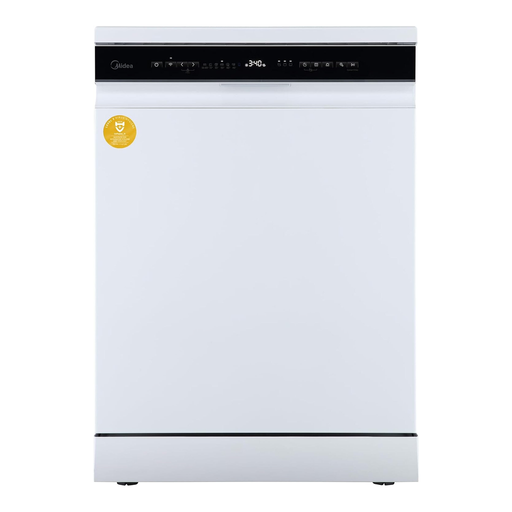
This freestanding design is suited to a suitable space outside a built-in niche.
10 place settings; height-adjustable upper rack; cutlery basket; delay start; white; energy class C.
 No image available
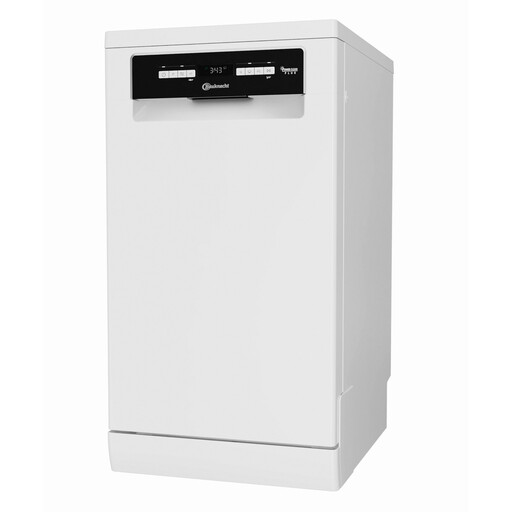
As a freestanding appliance, it’s an option for a kitchen without a suitable built-in niche.
10 place settings; PowerClean; ActivDry; energy class D.
No. The symbol indicates that the item is suitable for contact with food, not that it’s dishwasher-safe. Check the care instructions for the lunchbox, lid and removable parts separately; the Verbraucherzentrale explains what the symbol means.
Compare the appliance’s full dimensions, or the niche dimensions, and its design with the space you have available. Also check the connections and whether a cabinet door is needed. Bosch lists the freestanding SPS4HKW49E as 845 × 450 × 600 mm, while Siemens lists the fully integrated SR63EX25KE as 815 × 448 × 550 mm.
On the EU energy label, compare electricity use per 100 Eco cycles, along with water use and duration per Eco cycle. The Umweltbundesamt recommends running full loads where possible and using the Eco programme to save resources. These figures don’t necessarily apply to other programmes.