Households that wash lunchboxes every day
If containers, loose lids and other crockery regularly go in the dishwasher, you’ll want a rack layout that holds everything securely and gets the boxes ready to use again in good time.


First, choose a design that suits your available space or kitchen recess. Then check that your lunchboxes and lids fit safely in the racks without getting in the way of the spray arms. If you need the boxes again soon, compare the drying method and the duration of the programme you actually use; a drying function alone doesn’t guarantee that plastic containers will come out dry. If you run the dishwasher frequently, it’s also worth comparing Eco consumption figures on a like-for-like basis.
If containers, loose lids and other crockery regularly go in the dishwasher, you’ll want a rack layout that holds everything securely and gets the boxes ready to use again in good time.
The key is finding out whether a freestanding, under-counter or integrated model suits your available space, connections and planned cabinet door.
If you wash up often, compare electricity and water consumption on the same Eco basis, while also considering rack space and programme duration for your day-to-day needs.
First, check that the design suits your kitchen. Then compare the rack layout, drying performance and Eco figures with your washing-up routine.
| What matters to you | What to look for when buying | Who is it most important for? |
|---|---|---|
| Loading lunchboxes and lids | Measure your largest containers; check the rack height and make sure the spray arms can rotate freely. | If I wash lunchboxes and loose lids every day, the load needs to fit alongside my crockery. Around 36% of consumers would say that a practical rack layout is their top buying priority. |
| Finding the right design | Check the width, height and depth against the available space or recess; check the door front and connections. | If your kitchen has a fixed recess, the appliance and its installation type need to fit precisely. Around 29% would put fitting the dishwasher into their kitchen first. |
| Using the containers again in good time | Compare the drying method and the duration of the programme you actually use. | If you need the lunchboxes ready for the next working day, programme duration and residual moisture matter. Around 21% of consumers would make having their containers ready to use again in good time their top buying priority. |
| Consumption if you wash up frequently | Compare kWh per 100 Eco cycles, litres per Eco cycle and programme duration on the same label basis. | If you wash up often and keep an eye on running costs, compare the Eco figures with how you use your dishwasher. Around 14% would say consumption is their top buying priority. |
The stated capacity refers to standard crockery, not how well your containers and lids will fit. Large or tall lunchboxes may take up more rack space.
Measure your largest items and check the rack layout and height adjustment. When loading the dishwasher, make sure the spray arms can rotate freely.
Manufacturers’ information about drying technologies doesn’t prove that water will be removed from every recess in a particular container.
Compare the drying method and the duration of your usual programme. Check your lunchboxes and lids before filling them again, and dry them by hand if needed.
Slimline appliances also vary in height, depth and design, and in the requirements for a cabinet door.
Measure the entire space and check the dimensions and connections against the installation instructions for the specific model before ordering.
The stated electricity and water consumption figures are for the Eco programme and don’t automatically tell you how a quick programme performs.
Compare label figures on the same basis. To estimate costs for a different programme, you’ll need its consumption data and your own tariffs.
The range includes documented freestanding and fully integrated 45-cm models.
The BDFS26040XQ is a freestanding 45-cm dishwasher with 10 place settings and a height-adjustable upper rack.
The freestanding MDWEF1034DW-WE is listed as 45 cm wide, with 10 place settings and nine programmes.
The G 5790 SCVi SL is a fully integrated 45-cm model for a suitably sized kitchen recess.
The BK6UB10BS7A0X is an under-counter model and another option in the 45-cm range.
This selection features freestanding slimline dishwashers with a range of rack layouts, programmes and drying features.
 No image available
The freestanding design is made for a suitable space; it measures 45 cm wide.
9 place settings; 70 kWh per 100 Eco cycles; AquaStop; height-adjustable rack.
Check that the appliance dimensions of 84,5 × 44,8 × 60 cm and the connections suit your available space.
 No image available
This freestanding 45-cm dishwasher has a height-adjustable upper rack, which can be useful when arranging your load.
10 place settings; 8,9 litres of water per Eco cycle; energy efficiency class C.
The stated dimensions are 850 × 448 × 600 mm. Automatic door opening doesn’t guarantee dry plastic containers.
 No image available
This freestanding model is listed as 44,8 cm wide.
9 place settings; 6 programmes; 9 litres of water per Eco cycle; height-adjustable rack and cutlery tray.
A short programme and extra drying are listed features, but they don’t guarantee dry plastic containers. The appliance measures 81,5 × 44,8 × 55 cm.
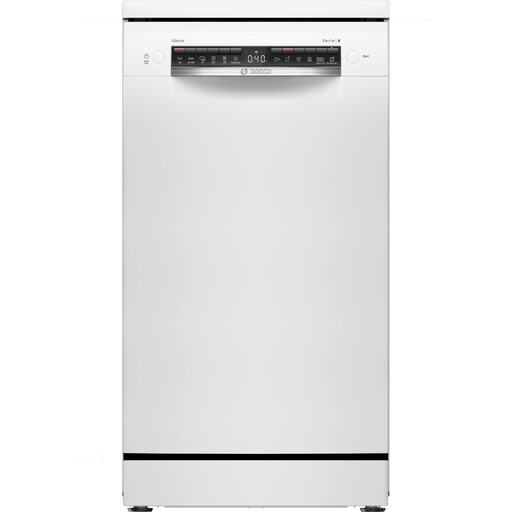 No image available
This freestanding model is 45 cm wide and has a height-adjustable upper rack.
10 place settings; 8,9 litres of water per Eco cycle; 1-hour programme and extra drying.
Check that the dimensions of 84,5 × 45 × 60 cm suit your available space. Extra drying doesn’t guarantee that plastic containers will come out dry.
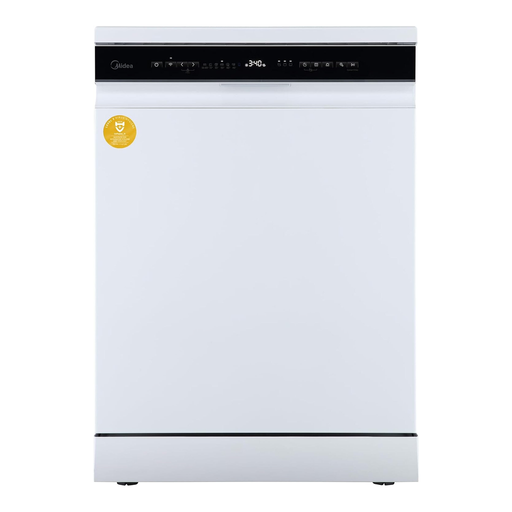 No image available
This freestanding model is 45 cm wide and has a height-adjustable upper rack.
10 place settings; AquaStop; delay start.
Check the rack configuration of the specific version before buying: the cutlery space is described as either a basket or a drawer.
No. According to the German consumer advice centre, the symbol indicates that an item is suitable for contact with food. Also check the care instructions to see whether the container and lid are dishwasher-safe.
Check that the dimensions and design of the specific model suit your available space or recess. Then use the installation instructions to check that the water inlet, drain and power supply are suitable for the intended location.
Not directly: the stated kWh per 100 cycles and litres per cycle refer to the Eco programme. To estimate the cost, you’ll need consumption data for the programme you actually use, as well as your own electricity and water tariffs.
Electrical waste must be collected separately and not put in household rubbish. The German Environment Agency lists municipal collection points, which generally accept old appliances free of charge. Check separately whether a retailer offers collection or take-back when delivering a new appliance.
The European Commission says that mains-powered household dishwashers, including built-in models, use the A to G scale introduced on 1 March 2021. The label shows Eco consumption, programme duration, capacity and noise levels; it doesn’t tell you whether a dishwasher is suitable for a particular lunchbox.