What should you look for when buying?
First, check the space available and the appliance design. Then compare the capacity for your usual dishes, followed by the consumption, noise and programme details for the specific models.
| What matters |
What to check before buying |
Especially important for |
| Fit and connections |
Compare the height, width and depth, as well as door clearance and connection positions, with the details for the specific model. |
If your kitchen has room for only a narrow space, it’s the overall fit—not just the width—that determines whether the appliance can go there. Around 36% of consumers prioritise fit, design and connections. |
| Capacity for dishes and cookware |
Compare the basket layout and adjustment options with your plates, glasses, cutlery and most-used saucepan. |
If you have dishes to wash every day, plus the occasional saucepan or frying pan, usable space matters more than the number of place settings alone. Around 29% of consumers focus on their typical mixed daily load. |
| Consumption and total costs |
Compare Eco electricity consumption per 100 cycles and water consumption per cycle; check delivery and installation separately. |
If you want to weigh up the purchase price, any installation costs and ongoing consumption together, compare the Eco figures for suitable models on the same basis. Around 21% of consumers prioritise these overall costs. |
| Noise and programme duration |
Check the noise level and Eco programme duration on the EU label; look at the details for other programmes separately. |
If the dishwasher runs in an open-plan living area or you need your dishes back quickly, noise and programme duration matter in everyday use. Around 14% of consumers prioritise quiet or predictable operation. |
Suitable dishwashers on Joybuy
The Joybuy models below are slimline freestanding dishwashers for kitchens with a suitable space and connections.
 No image available
Beko BDFS26040XQ, 45 cm, 10 place settings, energy class C, stainless steel look
The adjustable upper basket and stated capacity may be useful for a mixed load of everyday dishes and cookware. Check the basket layout against the items you usually wash.
Freestanding; this model is listed with 59 kWh per 100 cycles, 8,9 l per cycle, 44 dB(A) and six programmes.
Joybuy
 No image available
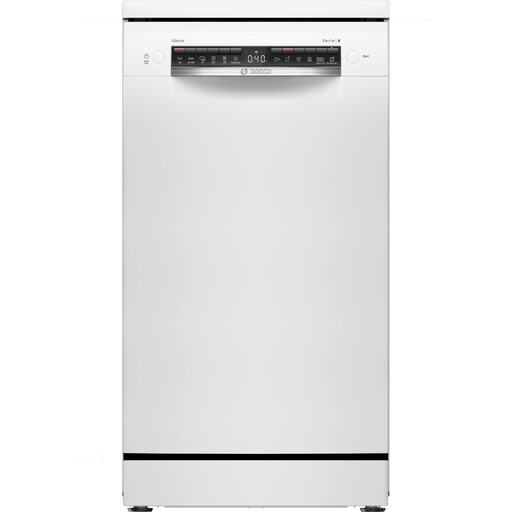
Bosch SPS4HKW49E Serie 4, freestanding, 45 cm, white, energy class E
This freestanding 45 cm model is an option if the space, door clearance and connections suit your kitchen. Check that the basket layout works for your usual dishes.
This model is listed with 10 place settings, a Vario-Flex basket system, 76 kWh per 100 Eco cycles, 8,9 l per cycle and 44 dB(A).
Joybuy
 No image available
Gorenje GS520E15W, 45 cm, 9 place settings, white
This freestanding model has a slim width. Check its stated dimensions against the available space, door clearance and connections.
This model is listed with dimensions of 84,5 × 44,8 × 60 cm, 70 kWh per 100 cycles, 9 l per cycle, 47 dB and five programmes.
Joybuy
Frequently asked questions
Is “45 cm” enough to know whether the appliance will fit in my kitchen?
No, width alone isn’t enough. Compare the height, width and depth, appliance design, door clearance and connections with the installation details for the specific model. Freestanding and under-counter appliances can also differ in height and depth.
How can I run a dishwasher as efficiently as possible if I don’t have many dishes each day?
The German Environment Agency recommends running the dishwasher with a full load on the Eco programme. If you don’t have many dishes, consider whether it’s practical to collect a full load in your everyday routine when choosing a size.
Do I need salt or rinse aid as well as all-in-one tablets?
This depends on factors including water hardness, detergent and appliance settings. Bosch home appliances recommends special salt for its appliances when water hardness is 14 °dH or above. For your model, follow its manual and check your local water hardness.
What information does the EU energy label show for dishwashers?
The EU energy label shows details including the efficiency class from A to G, electricity consumption for 100 Eco cycles, water consumption, capacity, Eco programme duration and noise levels. The European Commission explains the information on the label. The Eco test conditions aren’t the same as those for any quick programme.
Who should I contact if there’s a fault, and what happens to my old appliance?
Your statutory consumer rights for faulty goods apply against the seller. A manufacturer’s guarantee is separate, as the Consumer Advice Centre explains. The German Environment Agency outlines disposal through local collection points, and the return of a large, similar old appliance when you buy a new one. Before ordering, check whether collection is offered as part of the delivery.


