Families with lots of breakfast bowls
If you want bowls, cups and plates to fit in the machine together, the usable basket layout matters more than the number of place settings alone.


If kitchen space is limited, first choose the right style, then check whether the basket layout can accommodate bowls, cups and plates together without blocking the spray arms. If you have a large daily load and enough room, a 60 cm model may also be an option. Then compare Eco consumption, programme duration and the drying or speed features you actually need.
If you want bowls, cups and plates to fit in the machine together, the usable basket layout matters more than the number of place settings alone.
The key is whether a freestanding, semi-integrated or fully integrated model will fit the available space and your kitchen cabinetry.
If you need your crockery again soon, consider programme duration and drying performance as well as Eco figures.
First, check the style and whether there’s room for your usual breakfast load. Then compare programme duration, drying performance and consumption on a like-for-like basis.
| What matters when buying | What to check | Who is this important to? |
|---|---|---|
| Room for bowls | Check the place settings, basket layout and cutlery tray; make sure the spray arms can rotate freely with your usual load. | If I want deep bowls to fit in with cups and plates in one load, I need to check that everything fits without blocking the spray arms. Around 36% of consumers put usable space for breakfast crockery first. |
| Style and dimensions | Measure the available space or recess, then check the appliance’s height, depth and connections, as well as whether a furniture door is needed. | If space is limited in my kitchen, I need to know whether a freestanding, semi-integrated or fully integrated model will actually fit. Around 29% of consumers focus mainly on the style and installation dimensions when buying. |
| Having crockery ready when you need it | Check the programme duration and drying method for the specific model; don’t assume Eco figures apply to quick programmes. | If I’ll need the bowls or cups again soon, I want to know how long the programme takes and which drying method is suitable. Around 21% of consumers prioritise having their crockery ready again in time. |
| Electricity and water | Compare the EU energy label figures for electricity per 100 Eco cycles, water per Eco cycle, programme duration and noise. The German Environment Agency recommends running the Eco programme with a full load. | If the machine runs frequently, I want to compare electricity and water consumption on a like-for-like basis. Around 14% of consumers focus mainly on running costs. |
This figure indicates a standardised capacity. Deep bowls can take up basket space differently from standard crockery.
Think through your usual breakfast load using the basket layout, and make sure the spray arms can rotate freely. If everything doesn’t fit, you may need to run extra wash cycles.
Freestanding, semi-integrated and fully integrated models differ in how they’re installed and in their external dimensions. The height, depth and furniture door also need to fit.
Measure the available space or recess, then check the dimensions and required furniture door against the details for the specific model. Poor planning could mean extra work or an unsuitable furniture door.
Consumption and duration figures refer to the Eco programme; they don’t automatically tell you how a quick programme performs.
If you often use short programmes, check the figures for those programmes on the specific model. Only compare Eco figures with other figures measured on the same basis.
The freestanding SPS6EMI21E is one example of a slimline model with flexible baskets.
The fully integrated SR61IX05KE may suit a suitable recess with a furniture door.
The freestanding MDWEF1034DW-WE is a useful model to compare when looking at slimline appliances and their programmes.
The BSUO 3O33 PF X is a semi-integrated option if you’re not planning to fit a fully integrated furniture door.
The fully integrated G 5790 SCVi SL may suit a suitably sized installation recess.
This selection features slimline freestanding dishwashers for kitchens with a suitable space for installation.
 No image available
This freestanding 45-cm model is designed for a narrow space; check how your bowls fit in the basket.
9 place settings, 5 programmes including Eco and Quick, stainless steel interior, AquaStop and self-cleaning filter.
 No image available
This 45 cm freestanding slimline model is designed for a narrow space; check how your bowls fit in the basket.
10 place settings; energy class C.
 No image available
This freestanding 45 cm model is designed for a narrow space; check the basket layout against your usual breakfast load.
9 place settings, 6 programmes including Eco and Intensive, silver finish and delay start.
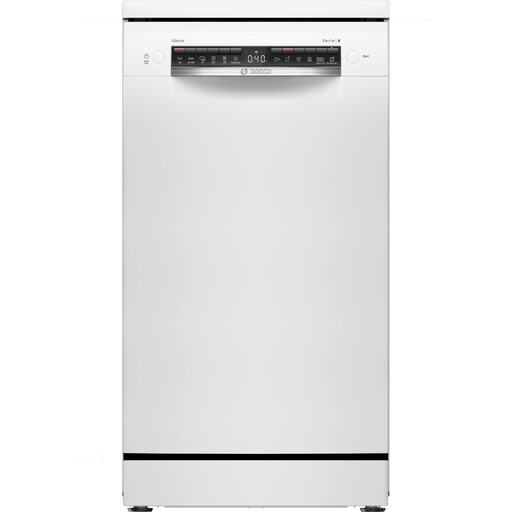 No image available
This freestanding 45 cm model is designed for a narrow space; whether your bowls fit depends on how you load it.
Vario Flex basket system, AquaStop, Extra Dry and energy class E.
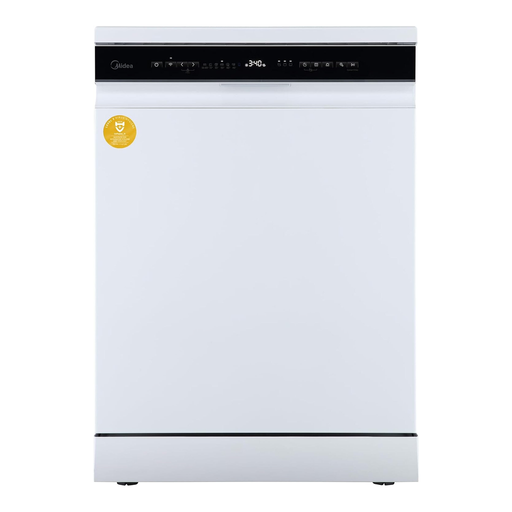 No image available
This freestanding 45 cm model is designed for a narrow space; check whether your usual breakfast load will fit in the basket.
10 place settings, height-adjustable upper basket, delay start and energy class C.
No. Place settings are a standardised measure of capacity. Also check the basket shape and cutlery tray, and make sure the spray arms can rotate freely with your usual load.
Check that the appliance style and dimensions suit the available space or recess, and follow the installation instructions for the specific model when connecting it. A semi-integrated model with a visible front and a fully integrated model with a furniture door are different solutions.
The EU energy label shows, among other things, electricity consumption per 100 Eco cycles and water consumption per Eco cycle. Compare figures on the same basis; actual costs also depend on how you use the machine and your tariffs.
The European Commission states that, since 1 March 2021, the EU energy label for household dishwashers has used classes A to G. The label also includes information about the Eco programme and noise levels.