Households with staggered mealtimes
If braised cabbage is served at different times after cooking, what happens when the cooking time ends and the food’s actual temperature are important factors to consider.


For braised cabbage served at staggered mealtimes, a slow cooker with an adjustable cooking time and an automatic switch to keep warm is useful if cooking finishes before the first portion is served. Choose a pot size that suits the batch. The German Federal Institute for Risk Assessment (BfR) recommends keeping hot food at a minimum of 60 °C throughout; a keep-warm function alone does not prove that the cabbage is at this temperature.
If braised cabbage is served at different times after cooking, what happens when the cooking time ends and the food’s actual temperature are important factors to consider.
For several portions or a batch to store, the pot capacity should suit the amount of cabbage you plan to cook. Separate leftovers you intend to keep for longer from portions you’ll be serving soon.
A compact insert may suit smaller quantities. At the same time, consider whether you’ll need room for second helpings or guests.
For braised cabbage served at staggered mealtimes, the key considerations are the temperature when it’s served later, the cooking cycle, the right batch size and how easy it is to handle after the meal.
| Buying criterion | What to look for | Who will find this especially important? |
|---|---|---|
| Temperature while keeping food warm | The BfR recommends keeping food at a minimum of 60 °C throughout. Check the temperature of the cabbage under the conditions in which you’ll actually use it; a keep-warm mode is not proof that it reaches this temperature. | If I’m serving later, I want to know whether the cabbage stays hot enough throughout. Around 36% of consumers put the safe temperature of the later portion first. |
| Cooking time and switch to keep warm | Check whether the model only lets you set a cooking time or automatically switches to keep warm when that time ends. Delayed start and automatic switching are different functions. | If the food won’t be served as soon as cooking ends, I don’t want to miss the switch. Around 29% of consumers prioritise a predictable finish time and as little manual adjustment as possible. |
| Pot capacity | Compare the recipe quantity with the insert and the fill guidelines in the specific instruction manual. You can’t convert a capacity in litres into a number of portions without checking. | If I’m cooking for my household, guests or to stock up, I want the planned amount of cabbage to fit in the pot. Around 21% of consumers prioritise choosing the right batch size. |
| Cleaning and handling | Check whether the insert can be removed and whether the pot and lid are dishwasher-safe according to the instructions. Only move hot, full inserts as directed by the manufacturer. | After serving, I want to be able to clean the pot without unnecessary effort. Around 14% of consumers put easy cleaning and handling first. |
A programme name doesn’t tell you what temperature the cabbage reaches throughout. The BfR recommends keeping hot food at a minimum of 60 °C throughout.
If you’re serving portions at different times, check the temperature of the cabbage you’ve actually cooked. For leftovers you plan to keep for longer, the BfR recommends cooling them quickly to below 7 °C.
An adjustable timer doesn’t automatically mean the appliance will switch to keep warm by itself when cooking ends. The process varies between models.
Check the instructions for the specific model to see what happens when the cooking time ends and whether it has a delayed-start function.
A small insert may limit the batch size you can make, while a larger pot isn’t automatically the right choice for small quantities. The stated capacity doesn’t replace the fill guidelines for the specific appliance.
Compare the quantity in your recipe with the instructions and insert for the specific model.
Crock-Pot lists a capacity of 4.7 l and an automatic switch to keep warm for the digital SCCPRC507B; the manual SCV400RD has a capacity of 3.5 l. These specifications apply to the respective models.
Russell Hobbs lists a capacity of 6 l and an adjustable cooking time for the digital MaxiCook 22750-56. The manual Cook@Home 22740-56 has a capacity of 3.5 l and three settings.
The manufacturer lists a removable 3.5 l ceramic insert, two heat settings and a keep-warm setting for the Tristar VS-3915.
The supplier lists a capacity of 1.42 l, a removable ceramic insert and a keep-warm setting for the NX3199 slow cooker.
This selection includes slow cookers for braised cabbage, from manual models for smaller quantities to a larger appliance with adjustable time and temperature settings.
 No image available
Manual controls may suit you if you want to choose the heat setting yourself and keep an eye on when cooking ends.
2.6 l capacity; two manual heat settings; non-stick insert.
 No image available
This model may suit you if you’re looking for a slow cooker with additional steaming and soup-making functions.
4.1 l capacity; described as an electric slow cooker, steamer and soup maker.
 No image available
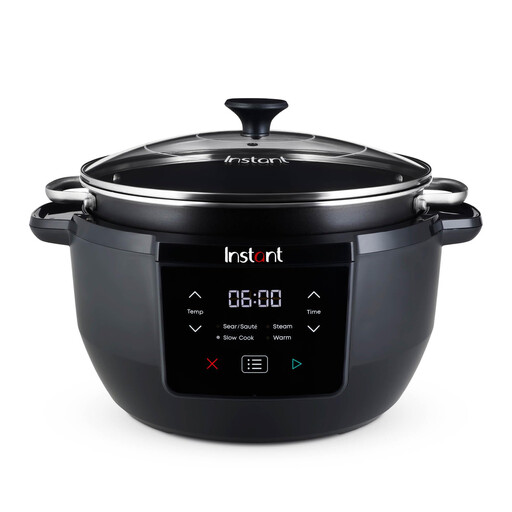
This larger model may suit a bigger batch of cabbage, as long as its capacity matches the recipe quantity and you follow the fill guidelines.
7 l capacity; adjustable time and temperature settings; keep-warm function. The manufacturer lists dishwasher-safe parts and says it can serve up to 10 portions.
A keep-warm function doesn’t prove that the cabbage reaches a minimum of 60 °C throughout. The BfR recommends this temperature throughout the food.
No. The function’s name doesn’t tell you whether the cabbage is at a safe temperature. The BfR recommends keeping hot food at a minimum of 60 °C throughout; check the cabbage under the conditions in which you’ll actually use it. If you plan to store hot food for longer, the BfR recommends cooling it quickly to below 7 °C.
Follow the instructions for the specific model. The Instant Superior Slow Cooker instructions require a stable, level, non-combustible surface and warn that the insert and lid get hot; these specific instructions don’t automatically apply to other appliances. Check the relevant instructions to see whether the pot and lid are dishwasher-safe.
In Germany, the seller’s statutory liability for defects is separate from a voluntary guarantee. If a product is faulty, you may initially be entitled to have it put right, for example through repair or replacement. According to the consumer advice centre, online purchases usually come with a 14-day right to cancel from the date you receive the goods; check the specific contract and any exceptions.
Electrical appliances covered by the relevant harmonised EU rules must carry the CE marking. This is the manufacturer’s declaration of conformity, not an independent quality mark. The German Federal Network Agency also recommends checking that the manufacturer can be identified and that the appliance comes with German-language instructions containing the necessary warnings.