Smaller holiday groups
If you’re planning a modest batch of soup, consider the pot capacity and the space available together. For example, Crock-Pot and Tristar offer models with capacities of 3.5 l and 4.5 l respectively.


First, choose a model with a pot that holds your full recipe quantity and whose filling guidance you can follow. A timer and keep-warm function can make planning your day easier, but they don’t replace heating the chicken thoroughly or checking the temperature if you’re keeping the soup hot for a longer period.
If you’re planning a modest batch of soup, consider the pot capacity and the space available together. For example, Crock-Pot and Tristar offer models with capacities of 3.5 l and 4.5 l respectively.
If several people will be eating or you want to have portions left over, you’ll need to consider suitable containers and enough room to chill them, as well as the pot capacity. The German Federal Institute for Risk Assessment recommends cooling hot food quickly to below 7 °C for longer-term storage.
A timer can help you fit the cooking time around your plans for the day. When making chicken soup, thorough heating and checking the temperature while keeping it hot remain important steps you’ll need to take yourself.
When making chicken and pearl barley soup in a holiday kitchen, consider the batch size, cooking process, cleaning and how you’ll handle leftovers.
| What matters when buying | What to check | Who this matters most to |
|---|---|---|
| Recipe quantity and available space | Compare the total quantity you plan to cook with the capacity and filling guidance in the instruction manual. Also check the appliance dimensions against the space where you intend to put it. | If I’m planning chicken, pearl barley, vegetables and stock for the group, it all needs to fit in the pot without taking over the worktop. Around 33% of consumers prioritise recipe quantity and available space. |
| Cooking schedule and serving temperature | Check whether the timer controls the cooking time or lets you set a delayed start. Check the temperature of the food rather than assuming it from a programme setting. | If I’m out and about during a day of my holiday, I want to plan the cooking time and serve the finished meal safely. Around 27% of consumers prioritise cooking schedules and serving temperature. |
| Cleaning and cookware | Check the cleaning instructions for the pot and lid. Only use the insert on a hob if the instructions for that exact model allow it. | If the holiday kitchen has limited equipment, I want to keep washing-up to a minimum. Around 20% of consumers put cleaning and available cookware first. |
| Taking it with you and storing leftovers | Check the dimensions and how easy it is to transport, as well as the fridge space available for leftover soup. | If I want to bring the appliance with me and cook a larger batch, I also need to be able to store the leftovers in the holiday cottage. Around 20% of consumers prioritise portability and making use of leftovers. |
The litre capacity describes the pot, but it doesn’t automatically tell you how much you can fill it. The chicken, pearl barley, vegetables and stock all need to fit in the insert together.
Before buying, compare your recipe quantity with the filling guidance in the instructions for the specific model.
Choosing a pot that’s too small could mean cooking a second batch or serving fewer portions.
A keep-warm function doesn’t prove that the chicken has been heated thoroughly or that the soup is at the required temperature throughout. The German Federal Institute for Risk Assessment recommends heating food to at least 70 °C for 2 minutes throughout, and keeping food at a minimum of 60 °C throughout while holding it hot.
Check that the food has been heated thoroughly and, if keeping it hot for a longer period, check its temperature.
Whether an insert is suitable for use on a hob depends on the model. The Tristar VS-3920 instructions say not to use its removable bowl on a hob.
Check the instructions for the model you’re actually buying to find out whether you can brown food in the insert and how to clean it.
A larger batch is only practical if you can cool and chill the leftovers promptly afterwards. The German Federal Institute for Risk Assessment recommends cooling hot food quickly to below 7 °C for longer-term storage.
Before you start cooking, check how much fridge space and how many suitable containers are available in the holiday cottage.
For smaller batches of soup, the CSC030X is a documented model with a capacity of 3.5 l.
The slow cookers documented here include the 3.5 l Cook@Home 22740-56 and the 6 l MaxiCook 22750-56.
The VS-3920 is a slow cooker with a capacity of 4.5 l and an adjustable cooking time.
A multi-cooker alternative if you want to use other cooking methods as well as making soup; the German Duo manual describes slow cooking.
This selection includes slow cookers and multi-cookers with an explicitly described slow-cooking function, for batches of soup of different sizes.
 No image available
The stated 2.6 l capacity can help you plan a smaller batch of soup.
Capacity: 2.6 l. Described features include two manual heat settings and a removable non-stick inner pot.
For indoor use only; place the appliance on a stable, level, heat-resistant surface with good ventilation.
 No image available
An option if you want to use one appliance for other cooking methods as well as slow cooking soup or stew.
Capacity: 5.7 l. Slow cooking and other cooking methods are listed; the lid and stainless steel pot are dishwasher-safe.
 No image available
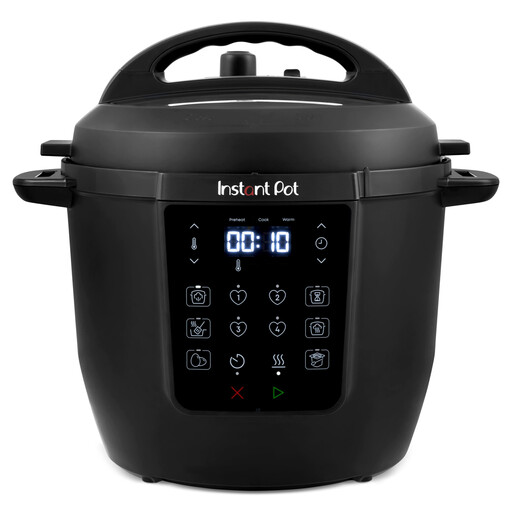
The stated 8 l capacity gives you an indication of the size if you’re planning a larger batch of soup.
Listed features include an 8 l capacity, 1200W, 12 pre-set programmes, a 24-hour delay timer and automatic keep-warm for up to 12 hours.
When using pressure mode, the stated fill limit for foods that expand, such as grains, is no higher than the 1/2 mark.
The German Federal Institute for Risk Assessment recommends heating food to at least 70 °C for 2 minutes throughout. A suitable food thermometer can help you check; a selected cooking setting or elapsed time doesn’t prove that the required temperature has been reached. Keep raw poultry separate from ready-to-eat ingredients when preparing the food.
Only if the instructions for that exact model allow it. Russell Hobbs says you can brown food in the Cook@Home 22740-56 insert; the Tristar VS-3920 instructions, on the other hand, say not to use its removable bowl on a hob.
The German Federal Institute for Risk Assessment recommends cooling hot food quickly to below 7 °C for longer-term storage, and keeping perishable food in the fridge at between 2 °C and no more than 7 °C. Make sure there’s enough fridge space in the holiday cottage; keeping food warm isn’t a substitute for chilling it.
Electrical appliances covered by relevant harmonised EU legislation must carry the required CE marking before being placed on the market; this isn’t an individual safety check of the soup. Your statutory rights when goods are faulty are separate from any voluntary guarantee. Online purchases usually come with a 14-day right to cancel; the terms of the specific purchase apply.