Those who batch-cook lunches
If you’re cooking chicken and pearl barley soup for several working days, plan the recipe quantity and cooker capacity together – and allow space for portioning and chilling, too.


Choose the capacity to suit the full recipe, including chicken, pearl barley, vegetables and stock, as well as the number of lunch portions you need. For smaller batches, a compact cooker may be a better choice than a large model for batch cooking. A timer makes planning easier, but it doesn’t confirm that raw chicken has cooked through: the German Federal Institute for Risk Assessment (BfR) recommends heating food to at least 70 °C throughout for two minutes. For lunches to enjoy later, the soup also needs to be cooled quickly to below 7 °C and kept chilled during transport; keeping it warm is no substitute for these steps.
If you’re cooking chicken and pearl barley soup for several working days, plan the recipe quantity and cooker capacity together – and allow space for portioning and chilling, too.
If you want the soup to be ready at a particular time, check whether the cooker has a timer for the cooking duration or lets you set a finish time. Crock-Pot and Tristar describe different timing functions for their respective models.
For just a few portions, a smaller stated capacity, a suitable footprint and ease of cleaning may matter more than a large pot for batch cooking. Russell Hobbs describes the Compact Home 25570-56 as a 2 l model for up to two portions.
First work out the full quantity of soup, then check the timer function you need. Plan how you’ll cool and transport it safely separately from your choice of cooker.
| What matters | What to check before buying | Who is it important to? |
|---|---|---|
| Quantity of soup and pot size | Compare the total recipe quantity and portions you want with the stated capacity and the filling guidance in the instructions; don’t convert litres directly into finished portions. | If I’m batch-cooking for several working days, the whole soup, including the stock, needs to fit in the pot. That’s why around 31% of consumers put choosing the right pot size first. |
| Cooking duration and finish time | Check the instructions to see whether you can set the cooking duration or a specific finish time, and what happens when the programme ends. | With a set weekday routine, I need to know when the soup will be ready and how I can plan the cooking. Around 25% of consumers prioritise timing for this reason. |
| Portioning and chilling | Check in advance whether you can quickly divide the finished quantity into portions and chill it; don’t rely on the keep-warm setting for storage. | If I’m taking the soup with me later, I need a plan for cooling, storing and keeping it chilled while I’m out. Around 25% of consumers focus on these steps first. |
| Cleaning and footprint | Compare the external dimensions, placement guidance and any explicit dishwasher-safety information for the insert and lid of the specific model. | For just a few portions, I want to find a good place for the cooker and take cleaning into account. Space and care come first for around 19% of consumers. |
The actual quantity your recipe makes also depends on the chicken, pearl barley, vegetables and stock, as well as the filling guidance for the model.
First plan the full recipe quantity, then check the stated capacity and instructions for the specific cooker.
A pot that’s too small may mean cooking in multiple batches; a very large batch needs space for portioning and chilling.
According to Tristar, the VS-3920 lets you set the cooking duration; Crock-Pot says the CSC066X lets you enter the time you want your meal ready. These functions aren’t the same.
Before buying, compare the exact timer function and what happens at the end of the programme in the instructions.
A keep-warm function doesn’t, by itself, confirm the actual temperature throughout the soup or cool it for meals to enjoy later.
Divide the finished soup into suitable portions promptly, chill it and keep it chilled while you’re out. For later storage, the BfR recommends cooling it to below 7 °C.
Remember to allow for suitable portion containers and enough space to keep them chilled.
The models mentioned offer different pot sizes and timing functions for making soup.
The Compact Home 25570-56 and Cook@Home 22740-56 offer useful points of comparison for smaller and medium-sized batches of soup.
The VS-3920 is an option for buyers looking for a timer that lets them set the cooking duration.
The Instant Pot Superior Slow Cooker instructions describe several cooking functions in addition to slow cooking.
This selection includes slow cookers for smaller batches of soup, extra cooking options and preparing several portions.
 No image available
For smaller batches of soup where a manual heat setting is all you need.
2.6 l; two manual heat settings; removable non-stick inner pot.
 No image available
For a medium-sized batch of soup if you’d also like a steaming function.
4.1 l; described as a slow cooker, soup maker and steamer. Steam may escape when you open it; wait a few minutes after cooking and follow the instructions.
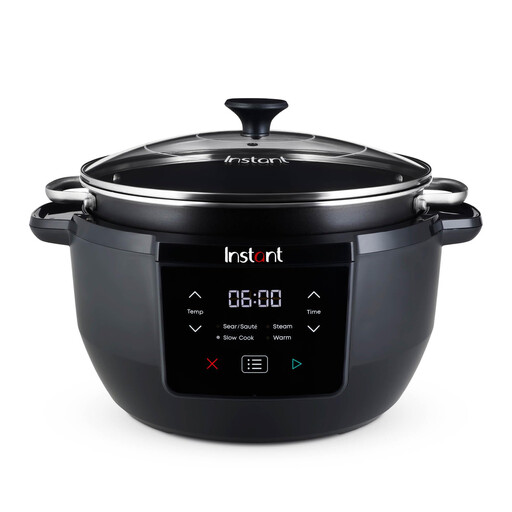 No image available
For preparing several portions if a larger pot and extra cooking functions suit your routine.
7 L; described as having slow-cook, steam, sauté and keep-warm functions. According to the product description, the inner pot isn’t suitable for use on a hob, induction hob or in an oven.
No. The BfR recommends heating food to at least 70 °C throughout for two minutes. When cooking raw chicken, check its actual temperature rather than relying on the heat setting or timer alone.
Keeping food warm and storing it are two different steps. For food kept hot, the BfR specifies at least 60 °C throughout; for lunches to enjoy later, it recommends cooling the soup quickly to below 7 °C and keeping it chilled while you’re out.
Follow the instructions for the specific version on the surface it should stand on, hot parts and cleaning. Check dishwasher suitability explicitly: it isn’t specified for the accessories of the Russell Hobbs Compact Home 25570-56, while Crock-Pot lists the CSC063X insert and lid as dishwasher-safe.
In Germany, your statutory rights for a faulty purchase are against the seller; any additional guarantee is a voluntary service with its own terms. The Verbraucherzentrale (German consumer advice centre) makes the same distinction between these rights. Before buying, check who the seller is and what guarantee terms, if any, are offered.
The German Federal Network Agency describes CE marking as the manufacturer’s declaration of conformity, not an independent quality mark. Check the marking and required accompanying documents for the specific product listing, such as German-language instructions and safety information; this doesn’t establish the conformity of that individual listing.