Who is a slow cooker useful for?

Families who regularly cook stews

If you regularly cook bean stew with other ingredients for several people, compare the full recipe quantity with the usable capacity of the cooking pot. Tristar lists the VS-3915 as having a 3.5 l capacity and serving up to four portions.

Busy cooks using tinned beans

Tinned beans are already cooked and can be eaten straight from the tin, according to the Federal Centre for Nutrition. So if you only want to heat them up quickly, first check whether a saucepan you already own will do the job.

Households that batch-cook

If you prepare extra portions or serve meals at different times, capacity, ease of cleaning and the temperature actually reached all matter. The Federal Institute for Risk Assessment recommends keeping hot food at a minimum of 60 °C throughout.

What should you look for when buying?

A saucepan you already own

A good fit if: you want to heat ready-cooked beans with a few ingredients and serve them soon.

Bear in mind: you’ll need to keep an eye on the pan yourself, but there’s no need for another appliance.

A slow cooker of around 3.5 l

A good fit if: you regularly make a slow-cooked stew for a family meal and the recipe quantity suits the cooker.

Bear in mind: Tristar lists the VS-3915 as serving up to four portions; you’ll still need to check your recipe and the appliance instructions.

A larger slow cooker or multicooker

A good fit if: you batch-cook more portions or want to use other cooking methods in the same appliance.

Bear in mind: a larger appliance takes up more worktop space and needs to suit the quantity you actually cook.

Buying priority What to check when buying Who is this especially relevant to?
Getting the quantity right Compare the full recipe quantity with the usable fill range in the instructions; treat portion estimates as a guide only. If I’m planning a stew with vegetables, sauce and possible leftovers for the family, the whole batch needs to fit in the appliance. Around 33 % of consumers give this priority the highest importance.
Cooking time Consider whether you regularly want to slow-cook a complete stew or simply heat beans up quickly. If I want tinned beans on the table soon, I don’t want to buy an appliance for slow cooking that I don’t need. Around 27 % of consumers put quick preparation first.
Heating and keeping food warm Measure the temperature if needed. The BfR recommends heating food to at least 70 °C for two minutes and keeping it hot at a minimum of 60 °C, in both cases throughout. If family members eat at different times, I don’t want to rely on the keep-warm button alone. Around 20 % of consumers focus above all on being able to control heating and keeping food warm.
Cleaning and space Check which parts are dishwasher-safe for the specific model and how to clean the appliance base. If I cook stew often and have little space, I want to know how much cleaning and storage the appliance involves. Around 20 % of consumers prioritise ease of use and space requirements.

Common buying and usage mistakes

  • Buying a slow cooker just for tinned beans

    Pulses from a tin are already cooked, according to the Federal Centre for Nutrition. A slow cooker is more useful for slowly cooking a whole stew with other ingredients.

    If you only want to heat beans up quickly, first check whether a saucepan you already own is suitable.

  • Confusing stated capacity with usable capacity

    Remember to include liquids and other ingredients in the total quantity. FoodSafety.gov recommends filling a slow cooker between half and two-thirds full; you should also follow the instructions for your specific model.

    Estimate the full recipe quantity before you buy and compare it with the fill guidance for the appliance you’re considering.

  • Assuming the keep-warm setting means the food has reached the right temperature

    A keep-warm function doesn’t prove that the food has reached the recommended temperature throughout. The Federal Institute for Risk Assessment recommends keeping hot food at a minimum of 60 °C throughout.

    Measure the food’s temperature if needed rather than relying on the function’s name alone.

Key brands at a glance

Tristar

The manufacturer describes the VS-3915 as a 3.5 l slow cooker that serves up to four portions.

  • For the VS-3915, Tristar lists two heat settings, a keep-warm function and a removable ceramic pot.
  • The specifications do not include a delayed start. A keep-warm function is no substitute for checking the food’s temperature.

Russell Hobbs

The manufacturer’s German product information includes the 3.5 l Cook@Home 22740-56 and the 6 l MaxiCook 22750-56.

  • According to the manufacturer, the cooking pot of the Cook@Home 22740-56 is removable and dishwasher-safe. The MaxiCook 22750-56 pot can be used on a hob, according to the manufacturer.
  • These details apply to the models named. Before buying, check that the pot size, cleaning requirements and space needed suit your household.

Instant Pot

The Superior Slow Cooker instructions describe slow cooking, steaming, sautéing and keeping food warm.

  • The instructions therefore describe several functions in one appliance, going beyond slow cooking.
  • According to the instructions, the pot can become very hot and heavy when full. Information about the UK 7.1-l version cannot automatically be applied to an EU version.

Slow cookers at Joybuy

The appliances below are slow cookers for slow-cooked stews and family meals. Check the size of each one against the full quantity of your recipe.
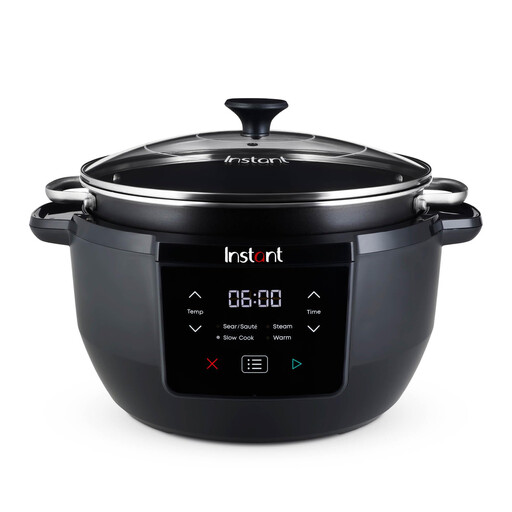
Instant Pot Superior Slow Cooker, 7 L, Grey, model 140-6128-01-EU

Instant Pot Superior Slow Cooker, 7 L, Grey, 140-6128-01-EU

This model could be suitable for a larger slow-cooked stew, as long as 7 L is right for the full recipe quantity.

The product name lists a 7 L capacity. According to the product information, the inner pot is not suitable for use on a hob, induction hob or in an oven.

View at Joybuy

Bear DDZ-J25G2 Electric Slow Cooker, 4.1L

Bear DDZ-J25G2 Electric Slow Cooker, 4.1L

If you want to slow-cook a stew and use the steaming function too, check whether this version is suitable for your recipe.

The product name lists a 4.1L capacity. The safety information warns that hot steam may escape during use; don’t open the lid immediately after cooking.

View at Joybuy

IAGREEA Slow Cooker, 2.6L

IAGREEA Slow Cooker, 2.6L

Only consider the 2.6L version for a family meal if the full recipe quantity fits its capacity.

The product name lists two manual heat settings, a steaming rack and a non-stick coating. According to the product information, the appliance is designed for gentle cooking; high-temperature frying is not recommended.

View at Joybuy

Frequently asked questions

Do tinned white beans need to cook through in a slow cooker?

No. The Federal Centre for Nutrition explains that pulses from a tin or jar are already cooked and can be eaten straight away. The usual advice on heating still applies when you’re making a hot meal; raw or dried beans are a different case.

Can I delay cooking if I put the ingredients in the cooker in the morning?

If you’re using perishable ingredients, don’t plan to delay cooking as a general rule. FoodSafety.gov advises starting the slow cooker as soon as it has been filled and not setting a delayed start time; this advice is not a statement that delayed starting is prohibited in Germany.

How should I store leftovers and the contents of an opened tin of beans?

For longer storage, cool hot food quickly to below 7 °C, as recommended by the Federal Institute for Risk Assessment. The Verbraucherzentrale advises using opened tins straight away or transferring their contents to a suitable container with a lid.

What should I look for in an electric slow cooker for use in Germany?

Check that the specific appliance has the required CE marking. According to EU consumer information, the manufacturer uses it to declare that the appliance meets the relevant EU requirements; it is not an independent quality mark.

What happens if a product bought online develops a fault?

Your statutory rights for faulty goods apply against the seller and are separate from any voluntary manufacturer’s guarantee. The first step when something is faulty is usually to have it repaired or replaced. Most online purchases also come with a 14-day right to cancel, although exceptions may apply.