Limited space, smaller portions
If you usually cook venison stew for one or two people, consider the capacity you need alongside the cooker’s footprint and the space required to use it.


For one or two portions, a small slow cooker is a good place to start, as long as its capacity, filling guidance and external dimensions suit your recipe and available space. For larger quantities, or if you want to brown ingredients without using a separate pan, consider a model with an insert explicitly approved for use on a hob. A timer is no substitute for checking the temperature: the Federal Institute for Risk Assessment recommends heating game meat to at least 70 °C at its centre for two minutes.
If you usually cook venison stew for one or two people, consider the capacity you need alongside the cooker’s footprint and the space required to use it.
If you want to prepare several portions at once, you’ll need enough room for the meat, vegetables and liquid. Be sure to check the filling guidance for the specific appliance, too.
If you want to brown the ingredients before slow cooking, check whether the removable insert is explicitly approved for use with your type of hob.
Start by deciding how much you want to cook and how much space you really have. Then weigh up whether browning in the insert and setting a cooking time make the extra space and operating steps worthwhile for you.
| What matters | What to check | Who is it important to? |
|---|---|---|
| Footprint and portion size | External dimensions and clearance for lifting the lid; insert capacity and filling guidance in the manual. | If I usually cook for one or two people, I want an appliance that suits the recipe and the space available. Around 36% of consumers put footprint and portion size first. |
| Safe cooking of game | Defrost game in the fridge and check the core temperature: the Federal Institute for Risk Assessment recommends at least 70 °C at the centre for two minutes. | If I want to cook venison stew safely and reliably, I need to be able to check the temperature of the meat. Around 29% of consumers prioritise safe cooking of game meat. |
| Browning and cleaning | Check that the specific insert is approved for use with your type of hob, and read the cleaning instructions for the insert and lid. | If I want to brown ingredients before slow cooking and use as few extra pans as possible, I look for an insert explicitly approved for hob use. Around 21% of consumers prioritise browning and cleaning. |
| Cooking time and running costs | Check whether you can set a cooking time and what happens when it ends; work out the cost using the energy used per cooking cycle and your own tariff. | If I want to fit the cooking time around my daily routine and keep track of running costs, the timer and actual energy use matter. Around 14% of consumers prioritise timing and cost. |
The capacity refers to the insert, not the cooker’s external dimensions or the clearance you need to lift the lid.
Measure the available surface and height, then compare them with the appliance dimensions and the space you’ll need to use it.
Hob suitability applies only to inserts explicitly approved for that use, and only with the hob types specified.
Use the insert only with the hob types listed by the manufacturer for that exact model, and follow the instructions.
A set cooking time or keep-warm function does not prove that the game meat has reached the required temperature.
Defrost frozen game in the fridge and check the core temperature. The Federal Institute for Risk Assessment recommends heating game meat to at least 70 °C at its centre for two minutes.
The rated power alone doesn’t tell you how much electricity a complete, temperature-controlled cooking cycle will use.
Compare costs using the energy used in kWh per cooking cycle and your electricity tariff.
The Compact Home Mini Slow Cooker 25570-56 has a 2.0 l capacity and is designed for smaller meals; according to the manufacturer, it serves up to two portions.
The models mentioned range from the CSC046X, with a 2.4 l capacity for smaller meals, to the CSC111X, with a 3.5 l capacity and a hob-safe insert.
According to the manufacturer, the VS-3915 has a 3.5 l capacity and serves up to four portions.
The 6.5 l PH 6520 is a larger option if capacity matters more to you than having a small insert.
This selection includes a smaller slow cooker for modest amounts of stew and a model with several pots for larger batches or cooking different dishes separately.
 No image available
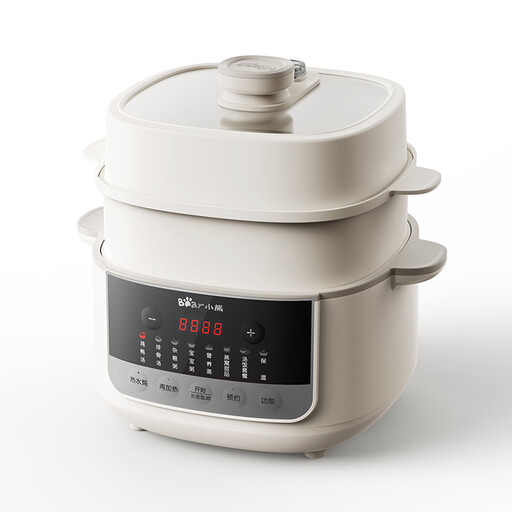
A smaller option for batches of stew, if two manual heat settings are enough for you.
2.6L capacity; listed as having a steaming function and a non-stick surface in the product name.
 No image available
An option for larger batches or cooking different dishes separately; check the listed dimensions against your available space before buying.
The description lists a 2,5-l main pot and four inner pots of 0,4 l each, as well as external dimensions of 32,8 × 27,1 × 31,0 cm.
According to the description, the ceramic pot must not be used directly over an open flame. Wait until cooking has finished before opening, as steam may escape.
Choose a capacity that suits the amount of meat, vegetables and liquid you’ll be using. Manufacturers list 2.0 and 2.4 l models for smaller meals, and 3.5 l models for larger batches. Also check the filling guidance and external dimensions of the appliance you choose.
Don’t make this your standard approach: the Federal Institute for Risk Assessment recommends defrosting frozen game meat in the fridge before cooking. Keep raw meat separate from other foods and cook it thoroughly; for game meat, the Institute recommends at least 70 °C at the centre for two minutes.
Only if the manufacturer approves that specific insert for use with your type of hob. For the Crock-Pot CSC111X, the manufacturer lists gas, electric and induction hobs; this approval doesn’t apply to other inserts.
No. Keeping food warm isn’t the same as cooking it through. The Federal Institute for Risk Assessment recommends keeping food that has already been heated to at least 60 °C throughout until it’s eaten; this recommendation doesn’t prove that a particular appliance setting reaches that temperature.